

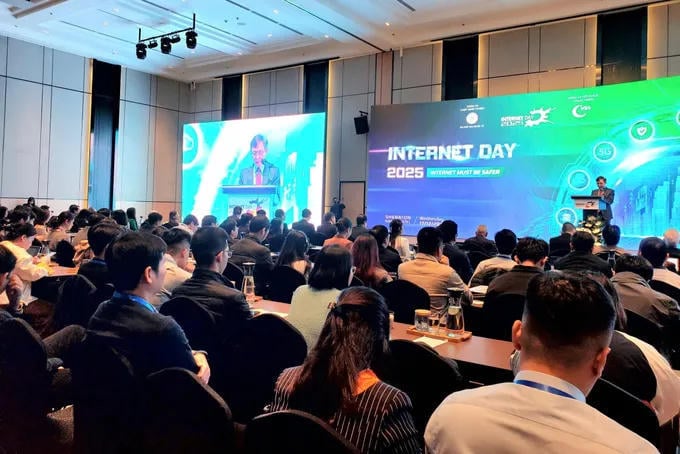
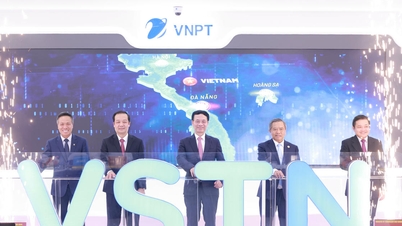
At the event, Mr. Vu Hoang Lien, Chairman of the Vietnam Internet Association, emphasized the nearly 30-year journey of the Internet's presence in Vietnam, since its global connection on November 19, 1997. From a nascent technical infrastructure, the Internet has now become a "second living space" for nearly 80 million users, with an average usage time of about 7 hours per day, closely integrated into their daily lives, work, and activities.
According to Mr. Lien, while previously the main challenges revolved around transmission speed and infrastructure coverage, the biggest challenge now is creating a safe, healthy, and trustworthy digital space. He pointed out the downside of technological development, where new tools like artificial intelligence and deepfakes are being exploited for increasingly sophisticated manipulation and fraud, making the line between "real" and "fake" increasingly blurred.
"The internet must be safer – this is not the responsibility of any single individual or specific agency, but a shared commitment of the entire Vietnamese internet community," Mr. Lien emphasized, adding that the digital environment needs to be not only smarter but also kinder, more humane, and more trustworthy.
This orientation was also clarified by Deputy Minister of Science and Technology Pham Duc Long, who emphasized that after nearly 30 years of development, the Internet has become an inseparable part of Vietnam's socio -economic life. Internet infrastructure is becoming increasingly modern, the level of social participation in the digital environment is deepening, and the quality of the Internet has improved significantly, approaching the level of many developed countries.
However, Deputy Minister Pham Duc Long affirmed that, entering a new phase of development, the issue is no longer about expanding the Internet in terms of scale or speed, but rather about proactively orienting its development towards sustainability, inclusiveness, and effective service for national development. In the spirit of Resolution No. 57-NQ/TW of the Politburo , the Internet is not just a technical infrastructure but a development space where science, technology, innovation, and digital transformation are connected, operated, and transformed into practical value.
According to the Deputy Minister, "a sustainable Internet must first and foremost be an Internet of trust," in which trust is built through institutions, norms, and the synchronized participation of the State, businesses, and society.
Four pillars of digital belief
A key highlight of Internet Day 2025 was the discussions surrounding the concept of Digital Trust, with its four core pillars: Trust in People: Building trust between people, civilized behavior, respect, and sharing accurate information; Trust in Platforms: Building trust from a transparent, fair platform with reliable data; Trust in Technology: Building trust from technology with ethical artificial intelligence, sustainable cloud and data, and stable digital infrastructure; Trust in Community: Building trust from the community.
From a journalistic and media perspective, in a presentation titled "Journalism and Public Trust," Mr. Le Quoc Minh, a member of the Central Committee of the Communist Party of Vietnam, Editor-in-Chief of Nhan Dan Newspaper, and President of the Vietnam Journalists Association , noted that AI-generated content is emerging as a new "front" in the crisis of trust. AI tools can generate text, images, audio, and video with a very high degree of realism, almost indistinguishable from human-generated products. In this context, the risk of fake information infiltrating the mainstream is increasing, while many journalists and newsrooms lack the necessary skills, tools, and procedures to detect and verify AI-generated content.
From the perspective of Internet infrastructure and resource management, Mr. Nguyen Truong Giang, Acting Director of the Vietnam Internet Center (VNNIC), stated that Vietnam currently has an IPv6 conversion rate of 67.68%, leading the region. This is considered an important foundation for expanding a safe and reliable Internet space for citizens and businesses.
2025 also marks a step forward for VNNIC in applying AI, expanding the DNS Abuse Mitigation program to address domain name abuse, prevent impersonation and violations in cyberspace, especially cross-border violations.
The in-depth discussions at Internet Day 2025 covered a wide range of topics, from digital self-defense skills and protecting children online to Cloud-Edge architecture, cybersecurity for small and medium-sized enterprises, and international perspectives on multi-link, multi-technology internet infrastructure. Notably, the event also launched the Safe Gate Plus project, aimed at strengthening the protection of children and adolescents – a vulnerable group against digital risks.
Source: https://daidoanket.vn/internet-viet-nam-kien-tao-khong-gian-so-an-toan-tin-cay.html
![[Photo] Enchanting ancient rose garden on the mountainside in Nghe An](/_next/image?url=https%3A%2F%2Fvphoto.vietnam.vn%2Fthumb%2F1200x675%2Fvietnam%2Fresource%2FIMAGE%2F2025%2F12%2F19%2F1766109900916_vuon-hong-chin-do-thu-hut-du-khach-toi-check-in-o-ha-noi-3-20162778-1671624890024-1671624890104198100259.jpeg&w=3840&q=75)


![[Photo] General Secretary To Lam visits the exhibition space showcasing books, photo exhibitions, and achievements of digital transformation in journalism.](/_next/image?url=https%3A%2F%2Fvphoto.vietnam.vn%2Fthumb%2F1200x675%2Fvietnam%2Fresource%2FIMAGE%2F2025%2F12%2F19%2F1766110879215_1766110240024-jpg.webp&w=3840&q=75)


























































































Comment (0)