

Symphony music playing in the chicken coop.
One morning at the end of May, the countryside of Duy Xuyen commune still lingered with the scent of fresh straw. Amidst this peaceful atmosphere, Pham Thi Nhan (34 years old) busily walked among the rows of enclosed chicken coops spanning thousands of square meters.
The gentle sound of water from the cooling system blends with the melodious symphonies emanating from speakers hung throughout the farm. Thousands of free-range chickens here "listen to music" every day. Locals initially found it strange, even laughing at the idea. But for Ms. Nhân, music isn't just for show. It's part of a modern farming process that helps reduce stress, stabilize growth, and improve egg quality.
Few people know that before becoming the owner of a large-scale farm, she had a stable job at a bank in Ho Chi Minh City. Life in the city was comfortable, but she was always troubled by the question: "Why do young people in my hometown have to leave to find opportunities?" To find the answer for herself, she and her husband decided to return to their hometown to start a business.
The early days were almost entirely a series of self-taught experiences under pressure. She taught herself everything from animal care techniques, disease prevention, and feed mixing to brand building and finding markets for her products. Lack of capital, management experience, and operating costs weighed heavily on the young couple.
But instead of relying on luck for a good harvest, Ms. Nhan chose to operate her farm like a real business. She invested in a cooling system, biological bedding, established a clean farming process, and calculated the market from the outset. Her perseverance paid off. Every day, the farm supplies more than 2,500 free-range chicken eggs to the markets in Da Nang and Quang Ngai. The OCOP 3-star product under the Hao Nhan brand is gradually becoming known to consumers. Even the chicken manure has become a source of income when sold to coffee farmers in the Central Highlands.
The dream of growing grapes and peonies in the "flood-prone" region.
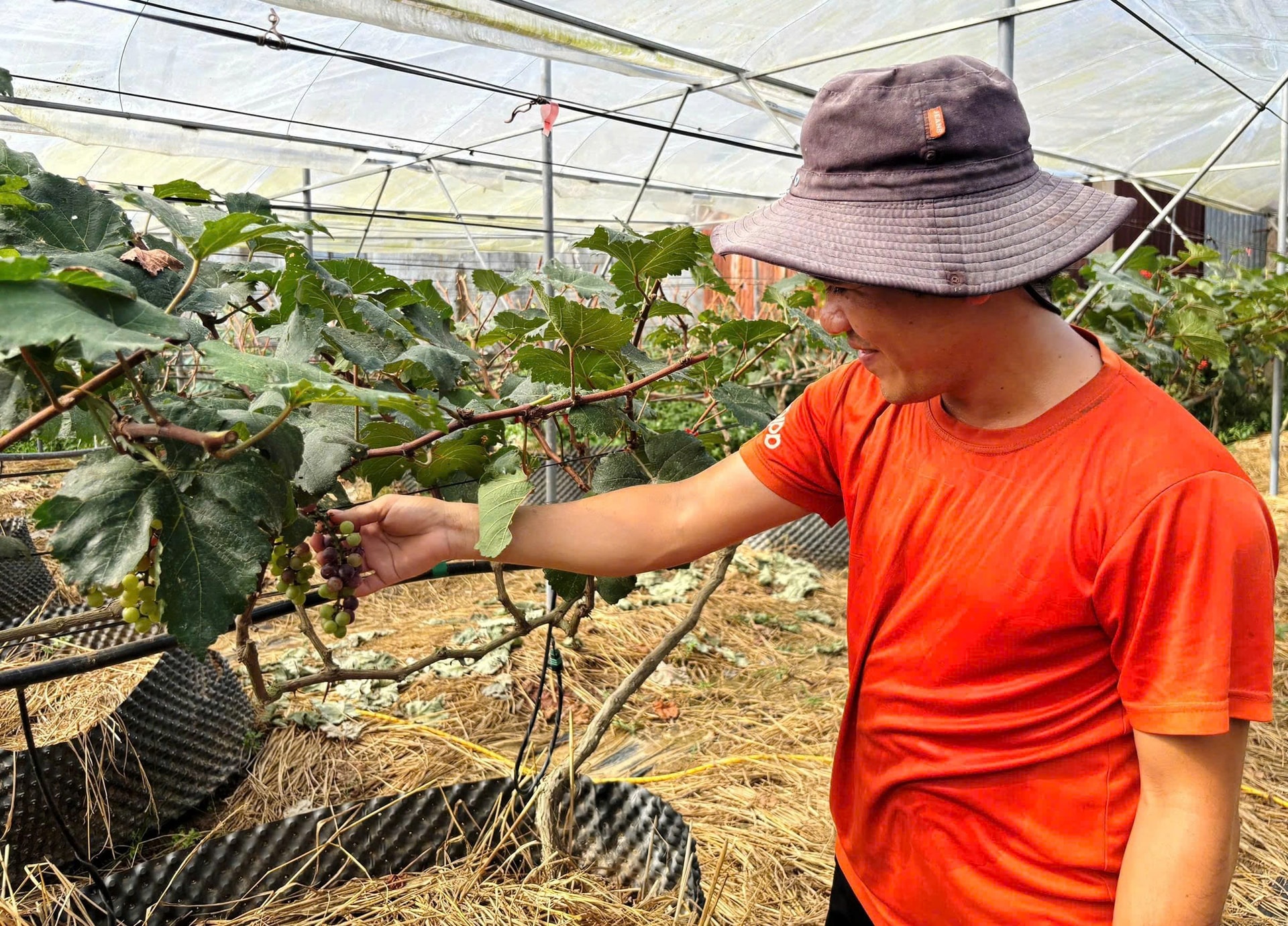
While Ms. Nhan chose the path of livestock farming, Mr. Hoang Ngoc Minh (40 years old, from Dai Loc) was determined to bring lush green grapevines – a plant considered a "specialty" of Ninh Thuan or temperate countries – to take root in the sunny and windy central region of Vietnam.
In 2009, Hoang Ngoc Minh graduated with a degree in Electrical Engineering from the University of Technology (Da Nang University). Afterward, he was hired to work at a hydroelectric power plant in the Central Highlands with a stable income. However, after 12 years of work, he decided to quit and return to his hometown.
During a visit to an acquaintance in the North, Minh was captivated by the grape cultivation model. The idea of bringing this plant, considered "fussy," to the sunny and windy Central region began to take shape from there. But theory and practice are two vast differences. When he started working on an area of over 800m², Minh faced countless challenges and skepticism from many people.
"Some people thought I must be crazy to quit a high-paying job to become a farmer. What puzzled many people even more was how the harsh climate, with scorching summer sun and prolonged winter rains, could possibly be suitable for growing grapes," Minh recalled.
Ignoring the gossip and rumors, he began to research on his own, importing plant varieties from abroad to experiment with. Lacking experience, he learned as he went, from selecting varieties and preparing the soil to building trellises and pruning techniques to ensure the plants flowered and bore fruit. He learned as he went along, from choosing the right variety and soil to pruning and caring for the plants.
His first grape harvest failed due to pests, diseases, and bad weather. Watching the entire vineyard wither, his money wasted, he lost sleep for many nights. The economic pressure intensified when, for the first two years, the vineyard generated almost no revenue, while the costs of seedlings, trellises, fertilizers, and care continued to accrue.
With the mindset of an engineer, he began to re-analyze each parameter: soil pH, irrigation water volume, humidity, and fruit bagging techniques to protect against pests and diseases. He realized that modern agriculture could not rely solely on anecdotal experience, but must be based on data, science, and adaptability.
Between mid-May and June, Minh's vineyard enters its most beautiful season. Under the early summer sun, the plump clusters of grapes stand out against the lush green leaves, creating a rare and peaceful scene. Last year, the vineyard yielded over 400 kg of grapes, bringing in approximately 70 million VND.
But what's even more noteworthy is that many tourists have come to visit, take photos, and experience picking fruit in the orchard. More importantly, he understands that today's consumers don't just buy clean fruit. They also buy the experience and the story behind the product. From there, he reoriented the model towards eco-tourism.
Source: https://baodanang.vn/khi-nguoi-tre-chon-ve-que-3338772.html

![[Photo] The General Secretary, President and his wife begin their state visit to the Philippines.](https://vphoto.vietnam.vn/thumb/1200x675/vietnam/resource/IMAGE/2026/05/31/1780230559452_anh-man-hinh-2026-05-31-luc-19-28-11.png)
![[Photo] Admire the coral "masterpiece" amidst the million-year-old heritage of Dak Lak province.](https://vphoto.vietnam.vn/thumb/1200x675/vietnam/resource/IMAGE/2026/05/31/1780221235105_anh-man-hinh-2026-05-31-luc-16-53-27.png)

![[Photo] Solemn bathing ceremony and Buddha procession in Hue](https://vphoto.vietnam.vn/thumb/1200x675/vietnam/resource/IMAGE/2026/05/31/1780228263543_1-jpg.webp)
![[Image] Hanoi Police officially crowned champions of V-League 2025/2026](https://vphoto.vietnam.vn/thumb/1200x675/vietnam/resource/IMAGE/2026/05/31/1780244769054_ndo_br_039d561b692be875b13a-jpg.webp)


![When forestry is a 'weakness' of Nghe An?: [Part 1] Living a precarious life amidst the golden forests](https://vphoto.vietnam.vn/thumb/402x226/vietnam/resource/IMAGE/2026/05/30/1780156547904_1-2-001514_717-225327.jpeg)






![[Video] Sunset at Lap An Lagoon – Where the sun sets over the fishing nets](https://vphoto.vietnam.vn/thumb/340x192/vietnam/resource/IMAGE/2026/05/31/1780192137701_beach-landscape-sea-water-nature-grass-745871-pxhere-com.jpeg)


































![[Photo] Admire the coral "masterpiece" amidst the million-year-old heritage of Dak Lak province.](https://vphoto.vietnam.vn/thumb/402x226/vietnam/resource/IMAGE/2026/05/31/1780221235105_anh-man-hinh-2026-05-31-luc-16-53-27.png)































Comment (0)