Every time I see the price list for a new apartment project, the first feeling isn't about whether I can afford it, but rather that the price has just increased beyond my reach. Many working people in urban areas now share this feeling: salaries keep rising but still can't keep up with apartment prices.
This story was included in the World Bank's Vietnam Economic Update – May 2026. The institution added a series of data showing that money in the economy is currently flowing strongly into real estate.
According to this report, real estate credit is projected to increase by 42% in 2025, nearly double the overall credit growth rate of 19%. This sector currently accounts for approximately 25.5% of total outstanding credit.
This also means that for every four dollars of credit in the economy, more than one dollar flows into real estate.
More notably, about half of this real estate credit was granted to real estate development companies. Meanwhile, credit for industry and agriculture increased by only 12.1% and 9.1%, respectively.
Looking at the credit flow, it's clear that the real estate sector is attracting much more capital than the manufacturing sector.
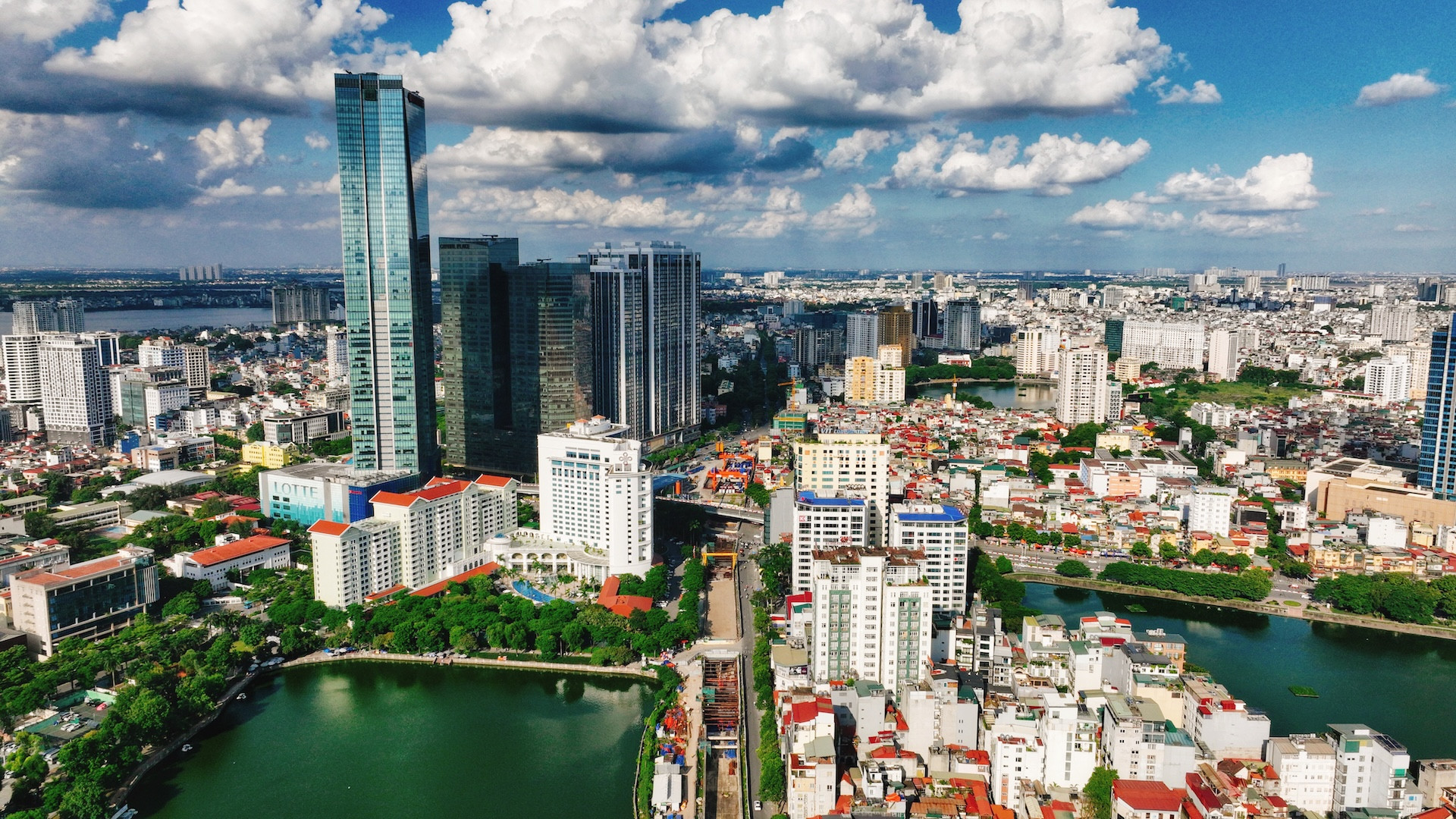

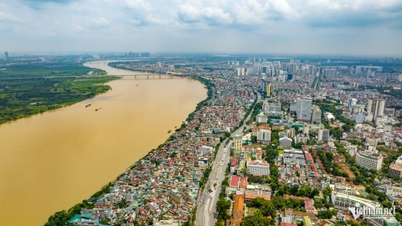
A paradox is becoming quite apparent: Credit is increasing sharply, liquidity in the economy is very high, but the feeling of owning a home is becoming increasingly distant for many people. Photo: Hoang Ha
The World Bank also noted that current credit allocation is “structurally inefficient,” as banks are prioritizing asset-backed but low-productivity segments over sectors capable of generating sustainable growth and employment. This is the crucial point, because the important thing is not how much credit increases, but where the money is flowing.
When more money flows into land than factories, property prices will almost certainly rise faster than workers' incomes, a trend that is quite clearly reflected in the current housing market.
The World Bank says that the ratio of house and land prices in some areas has now exceeded 30 times an average household's annual income, while the international standard for housing affordability is typically around 3–8 times income.
This makes it increasingly difficult for first-time homebuyers to enter the market. Rent costs and mortgage repayment burdens have also eaten up a significant portion of the remaining spending money for many low- and middle-income households.
A paradox is emerging quite clearly: Credit is increasing rapidly, liquidity in the economy is very high, but the feeling of owning a home is becoming increasingly distant for many people. Property prices are rising faster than the income-generating capacity of the majority of workers in the economy.
However, the flow of money into real estate is only part of a larger story.
According to the World Bank, Vietnam's credit-to-GDP ratio is currently around 145%. That figure is very high in itself, but what's more concerning is that there's still a lot of money in the economy that isn't flowing strongly into production and consumption.
While credit is increasing rapidly, the economy's money turnover is expected to slow to around 0.6 by 2025, the lowest level in a decade.
According to the World Bank, liquidity is currently circulating primarily within the financial sector rather than providing new impetus to the real economy.
In other words, there's actually a lot of money in the economy; it's just that the flow of money is increasingly shifting towards the asset market.
As house and gold prices continue to rise, money begins to flow out of banks and into other assets.
According to the World Bank, the proportion of household deposits in the banking system has decreased from 48% in 2024 to 44% in 2025, as people shift their money to real estate, gold, and USD in search of higher yields.
This shift forced banks to compete more fiercely to attract deposits, pushing interest rates on 6-12 month deposits up to 6-8% in March 2026.
More notably, this trend occurred even when the policy interest rate did not increase, suggesting that the actual market interest rate level was under much stronger upward pressure than the policy signals indicated.
Liquidity stress is also reflected in the fact that interbank interest rates have at times exceeded policy interest rates, indicating that monetary policy has in practice become tighter.
To alleviate liquidity pressure, the State Bank of Vietnam significantly expanded its open market operations and injected approximately $700 million through OMO operations in March and April 2026. These actions suggest that the central bank is becoming more cautious in the face of the strong inflow of capital into the real estate sector.
However, the World Bank notes that the capital adequacy ratio of the entire banking system is currently only around 12.1%, lower than many ASEAN countries.
The banking system is not currently facing major risks, but the safety buffer is no longer as thick as it was a few years ago, especially given the increasing proportion of real estate loans in total outstanding loans.
Rising asset prices attract more money into real estate. This new money, in turn, pushes asset prices even higher, creating the feeling that the slower you are, the harder it is to keep up with the market.
In this vortex, the banking system also faces another risk: using short-term mobilized capital to finance long-term real estate loans. A sharp reversal in cash flow or a change in depositor sentiment could lead to liquidity pressure.
Source: https://vietnamnet.vn/khi-tien-dang-chay-vao-dat-nhieu-hon-vao-nha-may-2516612.html


![[Photo] General Secretary and President To Lam presides over a meeting on the implementation of Directive No. 34-CT/TW of the Party Central Committee.](https://vphoto.vietnam.vn/thumb/1200x675/vietnam/resource/IMAGE/2026/05/19/1779187768672_a1-bnd-2350-631-jpg.webp)

![[Photo] Capturing the moment the tide recedes at Yen Binh Son rapids - a million-year-old scenic spot in Quang Ngai.](https://vphoto.vietnam.vn/thumb/1200x675/vietnam/resource/IMAGE/2026/05/19/1779175463885_yen9-1199-jpg.webp)

![[Photo] National Assembly Chairman Tran Thanh Man attends the groundbreaking ceremony for the National Highway 1A spatial axis project.](https://vphoto.vietnam.vn/thumb/1200x675/vietnam/resource/IMAGE/2026/05/19/1779161360398_ndo_br_bnd-1412-jpg.webp)















































![[Photo] General Secretary and President To Lam receives Indian Defense Minister Rajnath Singh](https://vphoto.vietnam.vn/thumb/402x226/vietnam/resource/IMAGE/2026/05/19/1779184046302_anh-man-hinh-2026-05-19-luc-16-46-58.png)

























Comment (0)