

 |
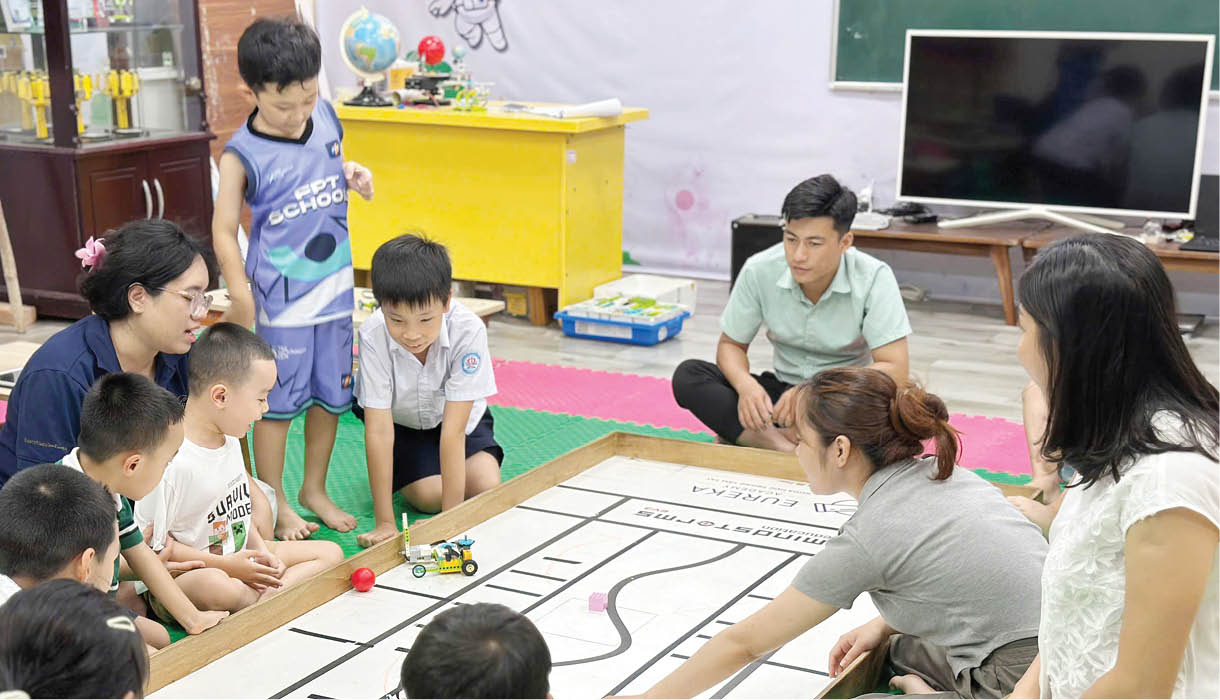
| Successfully controlling robots to catch balls in the "LEGO Science and Robotics" robotics class. |
Children can learn robotics at the Eureka Experiential Science Center, the Human Resource Training and Development Center, or the Hue City Information Technology Center (Hue CIT), with 30% of the learning time dedicated to theory and up to 70% to practical training.
At the Eureka Experiential Science Center, the atmosphere in robotics classes is usually quite lively. On the desks are LEGO sets, sensors, wheels, electric motors, and tablets for programming. For about an hour, students assemble robots based on themes guided by the teacher, then program them to perform tasks such as moving, avoiding obstacles, navigating mazes, or collecting objects.
The most exciting part usually happens at the end of the lesson, when groups of students bring their "creations" to participate in simulated challenges. Some groups control robots to overcome obstacles, while others try programming the robots to find the shortest path. The cheers and applause make the classroom feel like a miniature technology playground, where children learn and explore with natural curiosity.
Tuệ Tâm, a fourth-grade student at Trường An Primary School, said that what she enjoyed most was creating and controlling her own robots. “Sometimes the robots malfunction or don’t work, so we have to take them apart and fix them. At first, I found it difficult, but I got used to it and found it very enjoyable,” Tuệ Tâm shared.
According to teachers, robotics is an educational field that integrates many elements such as mechanics, electronics, programming, and logical thinking. However, the most important thing is not whether students can build a complete robot, but rather the process of learning to observe, experiment, accept mistakes, and find their own solutions to problems.
Unlike theory-based learning, robotics allows children to access knowledge through hands-on experience. When a robot doesn't work as expected, students must check each detail themselves, from assembly and motor connection to programming commands. This process helps children develop critical thinking, patience, and teamwork skills.
According to Ms. Ngo Thi Thuan, who teaches robotics at Eureka, the curriculum is usually designed according to the age and learning ability of the students. In the initial stage, children mainly get acquainted with simple assembly models and basic programming operations on smart devices. At higher levels, students begin learning programming using Scratch on computers, using sensors, and building robot models capable of handling more complex situations.
Besides technological knowledge, robotics also helps students develop many soft skills. In group lessons or competitions, students must exchange ideas, divide tasks, and coordinate to complete the product. This is also an opportunity for children to practice communication, presentation, and teamwork skills.
However, teaching robotics also places considerable demands on facilities and personnel. Due to its hands-on nature, teachers need to closely monitor each student to provide support during assembly and programming. Therefore, the number of students in each class is usually kept small to ensure effective learning.
Although robotics is still a relatively new field in many localities, the increasing interest from parents and students shows that the trend of education linked to technology experiences is gradually developing. Not only does it spark a love for science, robotics also contributes to the development of creative thinking, problem-solving skills, and proactiveness in children in the digital age.
Source: https://huengaynay.vn/giao-duc/khoi-mo-tu-duy-cong-nghe-tu-robotics-166140.html

![[Image] Nearly 125,000 Hanoi students completed the Literature exam for the 10th grade entrance exam.](https://vphoto.vietnam.vn/thumb/1200x675/vietnam/resource/IMAGE/2026/05/30/1780117233041_ndo_br_thiet-ke-chua-co-ten-2-png.webp)





























![[Photo] Admire the coral "masterpiece" amidst the million-year-old heritage of Dak Lak province.](https://vphoto.vietnam.vn/thumb/1200x675/vietnam/resource/IMAGE/2026/05/30/1780107638639_y25-jpg.webp)




























































Comment (0)