

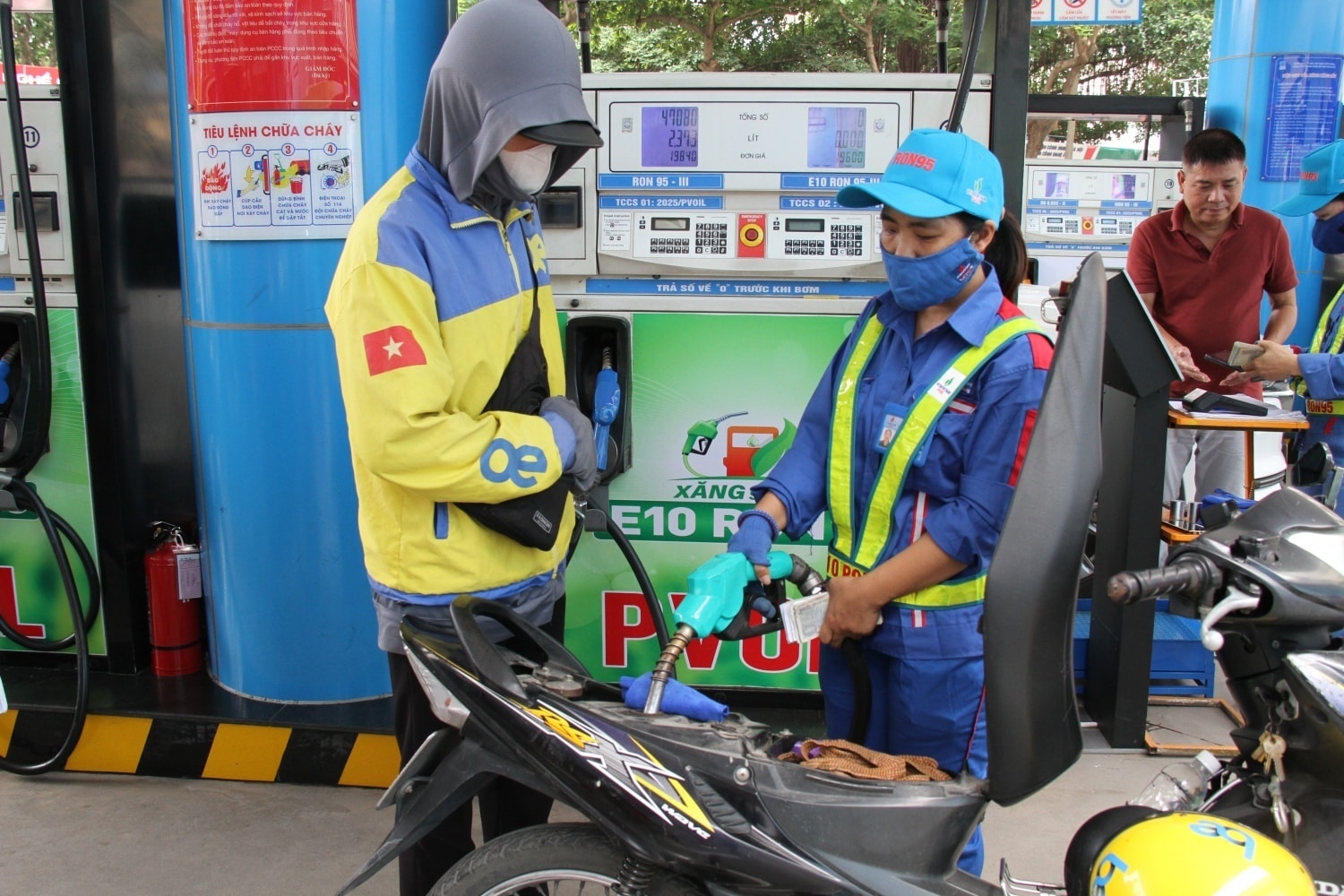
According to Mr. Do Van Tuan, Chairman of the Vietnam Biofuel Association, the widespread rumors surrounding E10 gasoline today, such as its potential to clog fuel pipelines, damage engines, affect vehicle performance, or require additional additives for stable engine operation, are inaccurate and lack scientific basis.
Furthermore, a common concern is that leaving a vehicle unused for extended periods will cause E10 gasoline to absorb moisture from the air, leading to water separation. According to Mr. Do Van Tuan, when stored in a sealed container, the gasoline vapor pressure inside is usually higher than the outside air pressure. Therefore, gasoline vapor tends to escape. It is highly unlikely that E10 gasoline will spontaneously absorb moisture from the air to cause separation. Cases of water contamination in fuel (if any) are usually related to the storage, transportation, or preservation of fuel at the main depot or gas station.
Furthermore, another common misconception on social media is that E10 gasoline can clog fuel lines or injectors. However, according to Mr. Do Van Tuan, this is not inherent to or caused by E10 gasoline. E10 gasoline actually has the properties of a mild solvent. For vehicles that have used conventional gasoline for a long time, dirt and deposits may have accumulated. When switching to E10 gasoline, this fuel can loosen and wash away these long-standing deposits, thus causing clogging during the first use.
Therefore, in this case, users simply need to have the fuel lines and injectors cleaned at a repair facility. After cleaning, this problem will almost certainly not occur again in subsequent uses.
Mr. Do Van Tuan stated that many automobile and motorcycle manufacturing associations, along with major petroleum companies, advise consumers against adding additives of unknown origin to fuel without authorization. The reason is that additives whose quality is not controlled can negatively impact engines.
When an accident occurs, it is difficult to determine whether the cause is due to additives or the fuel itself. Therefore, using standard E10 gasoline, without mixing in any unregulated additives, remains the safest solution for vehicles.
Meanwhile, Mr. Dao Cong Quyet, from the Vietnam Automobile Manufacturers Association (VAMA), stated that most new car models from VAMA members are designed to be compatible with E10 gasoline. Businesses have also implemented the dissemination of information about the use of E10 gasoline to their dealerships and customers.
For vehicles currently on the market, the materials used in the fuel system, from the fuel tank and fuel pump to the injectors and seals, have all been researched and selected to be ethanol-resistant.
Therefore, corrosion or aging of rubber gaskets will not occur if customers use E10 fuel in accordance with the National Standard QCVN 01:2022 of the Ministry of Science and Technology . Customers can therefore use it with complete peace of mind. For older vehicles, VAMA recommends that owners of older models proactively have their vehicles inspected at authorized dealerships for advice and replacement of parts such as gaskets and fuel lines if necessary, before switching to E10 gasoline.
Source: https://hanoimoi.vn/khong-can-lac-xe-hay-tu-pha-them-phu-gia-khi-dung-xang-e10-975864.html

![[Image] Pleasant weather helps students enter the 10th grade entrance exam with confidence.](https://vphoto.vietnam.vn/thumb/1200x675/vietnam/resource/IMAGE/2026/05/29/1780034401612_ngay-1-thi-lop-10-minh-duy-8-5009-jpg.webp)


![[Photo] Ba Lang An Lighthouse - the "eye of the sea" amidst the "rock museum" of Quang Ngai province.](https://vphoto.vietnam.vn/thumb/1200x675/vietnam/resource/IMAGE/2026/05/29/1780038698840_anh-man-hinh-2026-05-29-luc-14-10-42.png)






















































































Comment (0)