Local authorities are urgently restocking herds.
In Hanoi , African Swine Fever (ASF) forced the culling of more than 10,000 pigs. The Hanoi People's Committee issued a directive requiring the containment, disinfection, and control of transportation, stipulating that only facilities meeting biosafety requirements, having completed 21 days of quarantine, and certified by veterinary authorities are allowed to repopulate their herds.

Deputy Minister of Agriculture and Environment Phung Duc Tien and his delegation inspected the pig repopulation program in Phu Tho province.
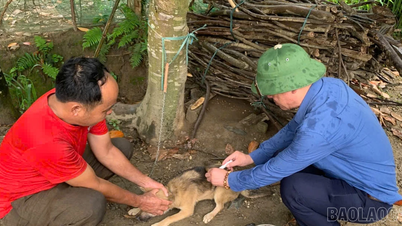
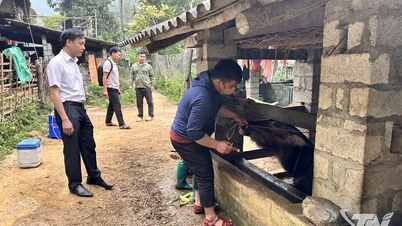
In the northern mountainous and midland regions, many localities such as Phu Tho, Cao Bang , and Lao Cai are urgently restocking their herds. However, veterinary authorities are urging disease control and prohibiting the import of new pigs unless they have tested negative. Some communes in Lao Cai province have passed the 21-day mark, and the authorities are preparing for controlled restocking.
In Central Vietnam, the leaders of Nghe An province directed that "restocking should only be done with veterinary confirmation." In August, the People's Committee of Quang Ngai province issued a detailed guidance document: farmers must leave their barns empty for at least 30 days, disinfect them completely, test negative, and obtain veterinary confirmation before importing breeding pigs. This regulation is applied uniformly, serving as a basis for ensuring the safety of the pig herd at the end of the year.
Meanwhile, in the Southeast region – the country's largest livestock farming hub – Dong Nai province has issued a plan to standardize restocking conditions according to a biosafety model, maintaining the stability of the total herd and ensuring supply for Ho Chi Minh City and surrounding areas for the remaining months of the year. In the Mekong Delta, An Giang province also requires both controlling the disease and maintaining the stability of the total herd to serve the peak season at the end of the year, preventing supply disruptions during holidays and Tet (Lunar New Year).
Ensuring food supply
Deputy Minister of Agriculture and Environment Phung Duc Tien stated that African Swine Fever (ASF) has had a significant impact. In 2020, the disease forced the culling of up to 9 million pigs. Currently, the fisheries sector is not a major concern, but the livestock sector needs to urgently begin recovery after the disease outbreak and floods. “With only four months left until the end of the year, food demand will increase significantly, especially during Christmas, New Year's Day, and Lunar New Year. The Ministry has directed the Department of Animal Husbandry and Veterinary Medicine to organize a conference with localities to urgently rebuild herds,” Deputy Minister Phung Duc Tien said.
Deputy Director of the Department of Animal Husbandry and Veterinary Medicine, Phan Quang Minh, provided further information, stating that African Swine Fever (ASF) initially appeared sporadically at the beginning of the year, but then broke out strongly in July. From August until now, the disease has subsided. Currently, two provinces have gone 21 days without a recurrence of the disease, and six provinces have fewer than 10 communes with outbreaks. The practice of discarding diseased pig carcasses into the environment has ceased in many localities, and the situation is no longer as critical as before thanks to strict control measures.
Although the outbreak has temporarily subsided, there is still a risk of re-emergence due to storms in the North and Central regions, along with the emergence of a hybrid (recombinant) virus strain (as reported by SGGP newspaper). However, Mr. Phan Quang Minh affirmed that the vaccines in circulation from 2019 to the present are still effective against this strain, but complacency is still necessary. Deputy Minister Phung Duc Tien warned that facilities that have contained the outbreak and controlled the disposal of pig carcasses into the environment need to continue disinfection and sterilization because the pathogen still exists.
Because the epidemic has not been completely eradicated, the Ministry of Agriculture and Environment has directed "conditional restocking," linked to the development of disease-free zones and facilities. By the end of August 2025, the whole country had 3,780 recognized disease-free zones and facilities.
The Deputy Minister of Agriculture and Environment also requested disease control at small-scale slaughterhouses that do not ensure food safety. Hanoi has planned to resolutely crack down on unlicensed slaughterhouses and control illegal and temporary markets from now until the end of 2025. Regarding the new challenge of hybrid virus strains, the Ministry of Agriculture and Environment has directed vaccine manufacturers to continue cooperating with international partners to research suitable preparations, preventing the recurrence of the disease and its impact on the pig herd at the end of the year, given that pork currently accounts for 61%-65% of the national food basket.
ANGEL
Source: https://www.sggp.org.vn/khong-de-thieu-thit-heo-dip-tet-post811836.html




![[Photo] Solemn bathing ceremony and Buddha procession in Hue](https://vphoto.vietnam.vn/thumb/1200x675/vietnam/resource/IMAGE/2026/05/31/1780228263543_1-jpg.webp)
![[Photo] The General Secretary, President and his wife begin their state visit to the Philippines.](https://vphoto.vietnam.vn/thumb/1200x675/vietnam/resource/IMAGE/2026/05/31/1780230559452_anh-man-hinh-2026-05-31-luc-19-28-11.png)
![[Image] Hanoi Police officially crowned champions of V-League 2025/2026](https://vphoto.vietnam.vn/thumb/1200x675/vietnam/resource/IMAGE/2026/05/31/1780244769054_ndo_br_039d561b692be875b13a-jpg.webp)
![[Photo] Admire the coral "masterpiece" amidst the million-year-old heritage of Dak Lak province.](https://vphoto.vietnam.vn/thumb/1200x675/vietnam/resource/IMAGE/2026/05/31/1780221235105_anh-man-hinh-2026-05-31-luc-16-53-27.png)























![[Video] Sunset at Lap An Lagoon – Where the sun sets over the fishing nets](https://vphoto.vietnam.vn/thumb/340x192/vietnam/resource/IMAGE/2026/05/31/1780192137701_beach-landscape-sea-water-nature-grass-745871-pxhere-com.jpeg)


































![[Photo] Admire the coral "masterpiece" amidst the million-year-old heritage of Dak Lak province.](https://vphoto.vietnam.vn/thumb/402x226/vietnam/resource/IMAGE/2026/05/31/1780221235105_anh-man-hinh-2026-05-31-luc-16-53-27.png)

































Comment (0)