


The race for "prime time"
Returning from a maritime rescue mission, Captain Dinh Xuan Truong of the SAR 413 vessel – belonging to the Maritime Search and Rescue Coordination Center Region III (based in Phuoc Thang Ward, Ho Chi Minh City) – is busy preparing for the next voyage. For those involved in rescue work, there is almost no rest between "returning" and "setting sail." Each trip is a confrontation with harsh nature and the limits of human capabilities.
Having been in the profession for over 10 years, Captain Dinh Xuan Truong said that the biggest pressure in search and rescue operations is not the rough seas and strong winds, but the haunting fear of making mistakes. “Accidents at sea come in many forms. Each incident is a different problem with many variables. When a ship sinks, people fall into the sea and disappear; the victims don't stand still, and time waits for no one,” Truong shared. Recalling memorable rescue missions, he still remembers the incident where the Dai Hai Phat 17 ship ran aground in the Tra Vinh sea area, about 43 nautical miles south-southwest of Vung Tau cape, at the end of 2019. At that time, the ship was carrying over 4,293 tons of coal from Dong Nai to Tra Vinh, with 11 people on board. The ship ran aground, and the owner hired a towing vessel, but it was unsuccessful due to bad weather. Large waves continuously flooded the engine room, causing the ship to tilt sharply and lose control. In this perilous situation, the captain sent out an emergency distress signal. Upon receiving the information, the rescue forces dispatched the SAR 413 vessel to the scene, rescuing all 11 people on board the ship that night before it was sunk by waves.
According to those in the profession, the biggest challenge in maritime rescue is not just reaching the scene, but accurately locating the victim. Throughout the journey, the SAR vessel continuously communicates with the Vietnam Maritime Search and Rescue Coordination Center to update data and adjust the search plan. At the command center, experts use SAROPS software to calculate the victim's drift trajectory based on wind direction, currents, and object characteristics. However, according to Captain Dinh Xuan Truong, technology is only supportive, because in reality, the initial reported coordinates can change completely in just a few hours.
When the duty officer's phone rang with the message, "People in distress offshore," the entire system was immediately activated. Outside the dock, the ship started its engines and urgently left the dock. In the control room, maps were opened, and rapid response plans were put into action.
"A battle of wits" with nature
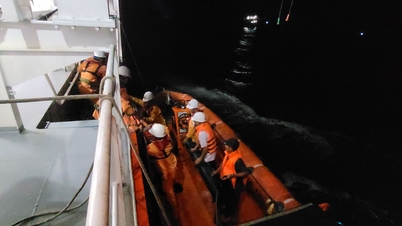
If the command center is a battle of wits with data, the field is a direct fight against the waves. Despite their specialized design, SAR vessels still shake violently when encountering waves of level 7 or 8. In such conditions, time becomes the greatest pressure. Those in the profession understand that the "golden hour" in rescue operations is the first 24 hours. After this period, the victim's chances of survival are very low due to dehydration, hypothermia, and exhaustion. At night, limited visibility makes search operations even more difficult. Large waves prevent crew members from standing on deck; all observation must be done from inside the cabin.
According to Captain Dinh Xuan Truong, if a victim drifts alone, the search is almost like "searching for a needle in a haystack." They are visible when the waves recede, but disappear when the waves rise. Meanwhile, if the victim manages to get onto a life raft or lifeboat, the chances of finding them are higher. But finding them is only the first step. Approaching and bringing the victim onto the ship in rough seas is the real danger. Many times, rescue teams cannot lower the lifeboat due to the high risk of capsizing. In such cases, methods such as shooting ropes or throwing lifebuoys are employed. In exceptional situations, when the victim is exhausted, rescue personnel attach safety ropes to themselves and jump directly into the sea to bring the victim back to the ship.
On the evening of April 8, 2026, the Vietnam Maritime Search and Rescue Coordination Center received information from the container ship ESL Dachan Bay (Portuguese nationality) about a Filipino crew member suffering from acute abdominal pain while the ship was en route from Taiwan to Singapore. Immediately afterwards, the SAR 272 vessel – belonging to the Maritime Search and Rescue Coordination Center Region III – was dispatched from shore to approach the ship offshore to carry out a medical evacuation. After more than 13 hours at sea, the patient was safely brought ashore for further treatment. Amidst the turbulent waves, approaching a "fortress" at sea to rescue someone has never been easy. For Captain Nguyen Van Do and the crew of the SAR 272, each rescue mission is a "battle of wits" with nature. In harsh weather conditions, directly approaching the side of a large ship is extremely dangerous due to the risk of a strong collision between the two vessels.
According to the leaders of the Vietnam Maritime Search and Rescue Coordination Center, the successful rescue further affirms Vietnam's coordination capabilities, situational handling skills, and its role as an international focal point in maritime rescue operations within its area of responsibility. There is no single scenario for rescue situations at sea. Each voyage is a chance to face the unknown. But amidst rough seas and countless uncertainties, maritime rescue forces persevere, racing against the "golden hour" to secure a chance of survival for those in distress at sea.
Source: https://www.sggp.org.vn/gianh-lai-co-hoi-song-giua-bien-khoi-post855338.html
![[Photo] Admire the coral "masterpiece" amidst the million-year-old heritage of Dak Lak province.](https://vphoto.vietnam.vn/thumb/1200x675/vietnam/resource/IMAGE/2026/05/31/1780221235105_anh-man-hinh-2026-05-31-luc-16-53-27.png)

![[Image] Hanoi Police officially crowned champions of V-League 2025/2026](https://vphoto.vietnam.vn/thumb/1200x675/vietnam/resource/IMAGE/2026/05/31/1780244769054_ndo_br_039d561b692be875b13a-jpg.webp)
![[Photo] The General Secretary, President and his wife begin their state visit to the Philippines.](https://vphoto.vietnam.vn/thumb/1200x675/vietnam/resource/IMAGE/2026/05/31/1780230559452_anh-man-hinh-2026-05-31-luc-19-28-11.png)
![[Photo] Solemn bathing ceremony and Buddha procession in Hue](https://vphoto.vietnam.vn/thumb/1200x675/vietnam/resource/IMAGE/2026/05/31/1780228263543_1-jpg.webp)
















![[Video] Sunset at Lap An Lagoon – Where the sun sets over the fishing nets](https://vphoto.vietnam.vn/thumb/340x192/vietnam/resource/IMAGE/2026/05/31/1780192137701_beach-landscape-sea-water-nature-grass-745871-pxhere-com.jpeg)












































































Comment (0)