

A new series of images taken by the James Webb Space Telescope has revealed remarkable detail about 19 spiral galaxies located relatively close to the Milky Way, providing new clues about star formation, as well as the structure and evolution of galaxies, Reuters reports.
The nearest of the 19 galaxies is called NGC5068, located approximately 15 million light-years from Earth. The furthest of them is NGC1365, approximately 60 million light-years from Earth. One light-year is the distance light travels in one year, equivalent to 9.5 trillion kilometers.
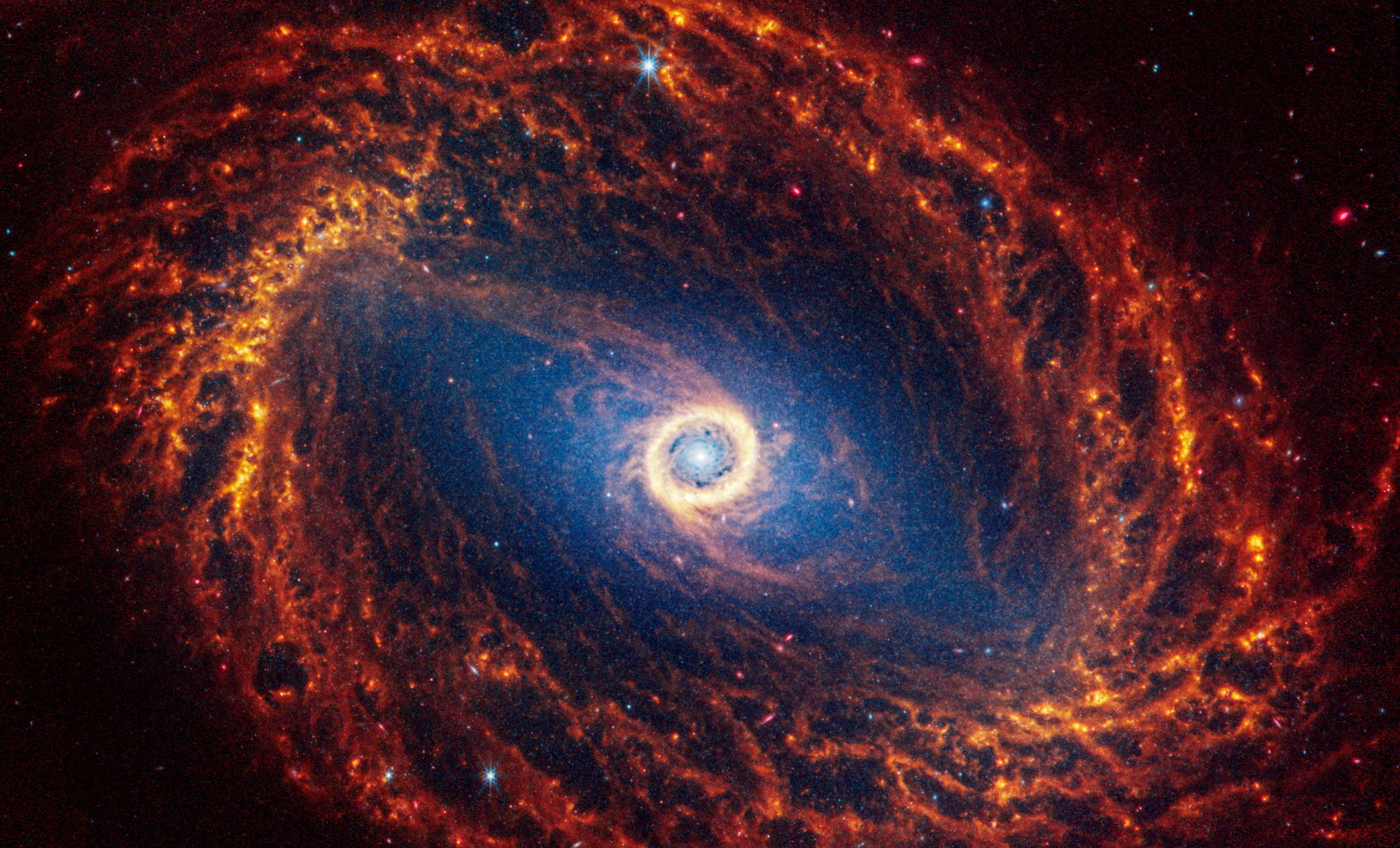
The spiral galaxy NGC 1512 is located 30 million light-years from Earth.
The James Webb Space Telescope (JWST) was launched in 2021 and began collecting data in 2022. The images obtained have helped reshape our understanding of the early universe, while also capturing wondrous pictures of the cosmos.
Among galaxies, the most common type is the spiral galaxy, which resembles giant windmills. Our Milky Way is one such galaxy, but what makes it special is that it contains a sun.
The new images were captured using the Near Infrared Camera (NIRCam) and the Medium Infrared Instrument (MIRI) of the James Webb telescope. The data reveals approximately 100,000 star clusters and millions, or perhaps billions, of individual stars within the Milky Way.
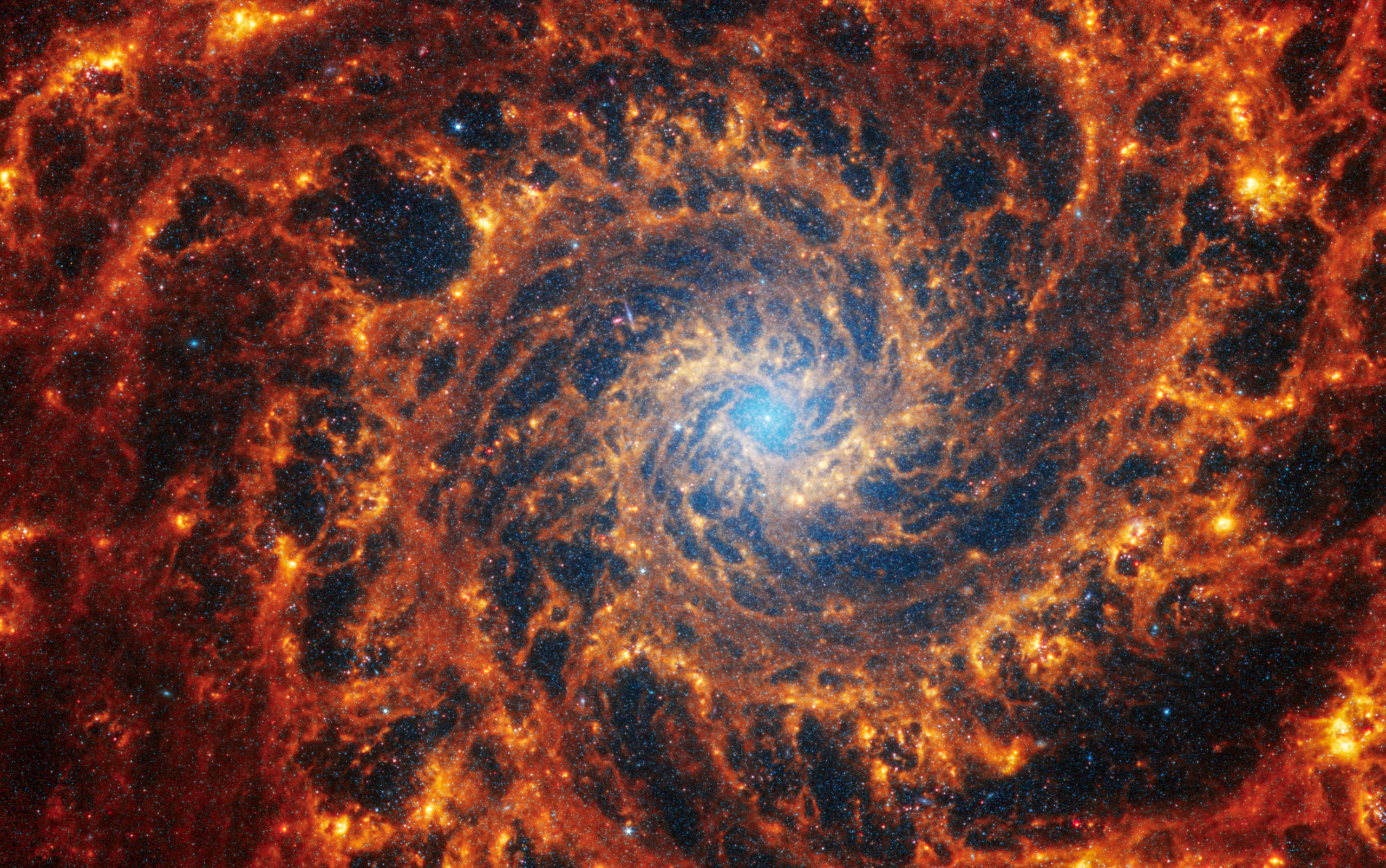
The spiral galaxy NGC 628 is located 32 million light-years from Earth.
"This data is crucial because it gives us new insights into the earliest stages of star formation," said Thomas Williams, an astronomer at Oxford University (UK) and head of the team processing the image data.
These images also allowed scientists to understand, for the first time, the structure of the dust and gas clouds from which stars and planets form in galaxies at a high level of detail.
Astronomer Janice Lee of the Space Telescope Science Institute (USA) said: "These images are not only aesthetically impressive but also tell a story about the star formation and feedback cycle, which is the energy and momentum released by young stars into interstellar space."
Source link






















![[Photo] Prime Minister Pham Minh Chinh holds a phone call with the CEO of Russia's Rosatom Corporation.](/_next/image?url=https%3A%2F%2Fvphoto.vietnam.vn%2Fthumb%2F1200x675%2Fvietnam%2Fresource%2FIMAGE%2F2025%2F12%2F11%2F1765464552365_dsc-5295-jpg.webp&w=3840&q=75)











































Comment (0)