

However, in reality, requesting and receiving input invoices is not only a legal requirement but also brings many practical benefits, helping business households protect their legitimate rights, avoid legal risks, and demonstrate professionalism and transparency in business.
First and foremost, invoices are crucial legal documents proving the purchase and sale of goods and services between the buyer and the seller. For household businesses, they serve as the basis for determining legitimate expenses when declaring taxes, and are evidence of transparency and honesty in their production and business activities. Having input invoices allows household businesses to easily account for expenses and demonstrate the legal use of goods and services. Conversely, the absence of invoices exposes household businesses to risks during tax audits, leading to direct financial losses. Ignoring invoices is tantamount to removing a "shield" protecting household businesses from potential risks.
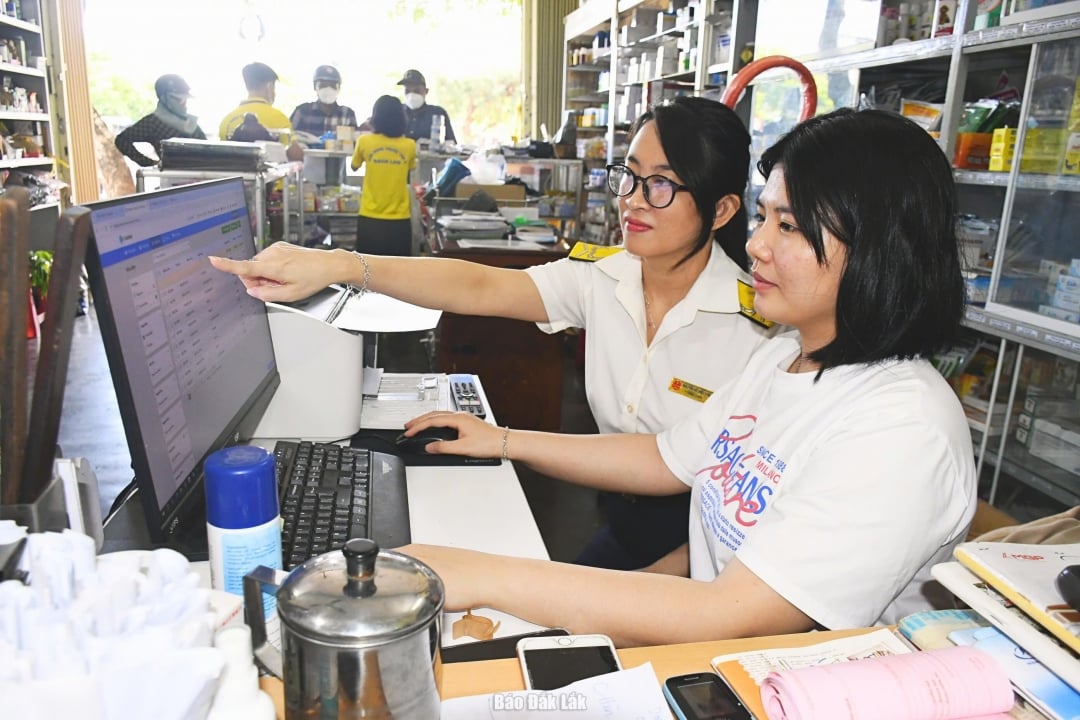 |
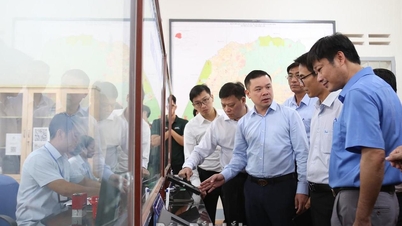
| Tax officials in seven provinces of Dak Lak are guiding business households on how to obtain input invoices when purchasing goods and issue electronic output invoices when selling goods and services. |
Another undeniable benefit of obtaining and retaining invoices is that it helps businesses project professionalism and credibility in the eyes of partners and customers. In the context of a rapidly transforming digital economy , with the increasing prevalence of electronic transactions and invoices, strict adherence to invoice regulations demonstrates that businesses are keeping pace with the trend towards transparency and modernization.
Moreover, invoices serve as a "warranty" for the buyer's rights. In cases where goods or services have quality issues, invoices provide businesses with a legal basis to file complaints, request exchanges, or seek refunds. Many small-scale commercial disputes, especially in the construction materials, food, or consumer goods sectors, have become complicated simply because buyers lack invoices to prove the transaction.
Currently, the tax authorities are actively promoting the nationwide implementation of electronic invoices. However, many businesses still lack a full understanding of the role and benefits of invoices, primarily due to old habits or concerns about the complexity of declaration and storage. Nevertheless, with the current software system, creating, searching, and storing electronic invoices has become incredibly convenient. With just a few taps on a phone, businesses can easily search for invoices, download them, or present them for verification. This demonstrates that obtaining invoices is no longer a "cumbersome procedure" as many people believe, but rather a small but significant step in business management.
It is also important to emphasize that not requesting invoices when purchasing goods and services can inadvertently enable businesses to abet tax evasion and commercial fraud. In many cases, sellers intentionally refuse to issue invoices to avoid tax obligations, creating unfair competition and negatively impacting the overall market. When each business proactively requests invoices, it is not only an act of protecting personal interests but also a responsibility to contribute to building a fair and transparent business environment.
It's time for businesses to change their mindset and view obtaining invoices as an essential habit, integral to their daily buying and selling activities. A seemingly small invoice serves as proof of transaction, a tool to protect rights, and a measure of business culture. When every transaction is accompanied by an invoice, trust between buyers, sellers, and regulatory agencies is strengthened, creating a solid foundation for economic development.
Source: https://baodaklak.vn/kinh-te/202511/la-chan-bao-ve-quyen-loi-ho-kinh-doanh-c461adf/
![[Photo] Solemn bathing ceremony and Buddha procession in Hue](https://vphoto.vietnam.vn/thumb/1200x675/vietnam/resource/IMAGE/2026/05/31/1780228263543_1-jpg.webp)

![[Image] Hanoi Police officially crowned champions of V-League 2025/2026](https://vphoto.vietnam.vn/thumb/1200x675/vietnam/resource/IMAGE/2026/05/31/1780244769054_ndo_br_039d561b692be875b13a-jpg.webp)
![[Photo] The General Secretary, President and his wife begin their state visit to the Philippines.](https://vphoto.vietnam.vn/thumb/1200x675/vietnam/resource/IMAGE/2026/05/31/1780230559452_anh-man-hinh-2026-05-31-luc-19-28-11.png)
![[Photo] Admire the coral "masterpiece" amidst the million-year-old heritage of Dak Lak province.](https://vphoto.vietnam.vn/thumb/1200x675/vietnam/resource/IMAGE/2026/05/31/1780221235105_anh-man-hinh-2026-05-31-luc-16-53-27.png)

![When forestry is a 'weakness' of Nghe An?: [Part 2] Potential dangers from reforestation efforts](https://vphoto.vietnam.vn/thumb/402x226/vietnam/resource/IMAGE/2026/05/31/1780218665205_b-2-011709_303-160943.jpeg)














![[Video] Sunset at Lap An Lagoon – Where the sun sets over the fishing nets](https://vphoto.vietnam.vn/thumb/340x192/vietnam/resource/IMAGE/2026/05/31/1780192137701_beach-landscape-sea-water-nature-grass-745871-pxhere-com.jpeg)
































































Comment (0)