


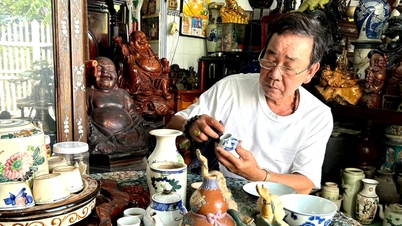
Mr. Tran Minh Doan is passionate about carpentry. Photo: Hanh Chau
Established and developed for over 200 years, the Cho Thu wood carving village boasts many artisans with exquisite carving techniques. Its carved wooden products are renowned for their quality and sophisticated designs, offering a wide variety of items, from household goods to fine art carvings for tourism . The village is famous for many wooden products such as altars, wardrobes, tables and chairs, and fine art wood carvings.
Along National Highway 80B and surrounding roads, the sounds of hammers, saws, chisels, planers, and paint machines create a vibrant atmosphere in the craft village preparing for Tet (Lunar New Year). At the workshop of Cam Tu Woodworking, Long Thuan 2 hamlet, more than a dozen workers are sawing, planing, and chiseling wood to assemble a variety of products. Mr. Luu Van Minh, a resident of Long Dien commune, said: “I have been in the woodworking profession for over 20 years, earning 250,000 - 300,000 VND per day. Completing a product requires many steps, and the price is calculated per finished item. On average, I finish one bed in two days.”
In the workshop, Mr. Nguyen Van Thanh diligently planed and assembled wooden planks for bed frames. While working, Mr. Thanh shared that he has been carpentry for nearly a decade after learning the trade at the workshop. According to him, carpentry provides a stable income, and the longer he stays in the profession, the more his skills improve.
To complete a product, carpenters in Cho Thu must go through many stages such as: sawing and cutting wood to specifications, planing, measuring, framing, marking, drawing, carving, assembling, painting, and attaching accessories. From the initial rough pieces of wood, under the skillful hands of the craftsmen, each chisel and carving seems to breathe life into the product, creating exquisite furniture and interior decorations with images of dragons, phoenixes, lotus flowers, plum blossoms, or Buddha statues, all imbued with aesthetic and traditional cultural values.
According to Ms. Nguyen Thi Anh Tuyet, owner of Minh Tu Woodworking Workshop, from an initial showroom, the business has expanded to three large stores, displaying hundreds of products such as cabinets, tables, chairs, and interior decorations. The workshop imports wood for production at its own factory and collaborates with over 20 woodworking workshops for custom orders. Each stage is carried out by skilled craftsmen, ensuring high-quality products. This year's Tet holiday saw a booming market with strong demand, resulting in insufficient wood supply compared to previous years. In addition to retail sales, the workshop also distributes wholesale to over 100 stores in the Mekong Delta provinces, delivering hundreds of sets of beds and cabinets daily.
Mr. Tran Minh Doan, representative of the Cho Thu carpentry village, said: “In 2006, this place was recognized by the province as a traditional craft village with more than 1,000 establishments and about 2,000 craftsmen. Since then, the carpentry craft has developed in 4 neighboring communes with more than 1,700 households and nearly 3,000 workers. The distinctive feature of Cho Thu carpentry village products is their exquisite craftsmanship, blending rustic and traditional elements, without the overuse of machine carving like in other places.”
The traditional carpentry craft of My Luong is equally famous, specializing in the production and sale of fine art wood products and furniture such as cabinets, tables, and chairs with exquisite patterns and high-quality wood. The products are diverse, mainly cabinets, tables, chairs, and artistic carvings and fine art wood products. Skilled carpenters meticulously carve patterns, infusing their souls into the products, enhancing the value of the wood. The village's reputation stems from the quality of the wood and the meticulousness in its craftsmanship.
According to the People's Committee of Long Dien commune, the Cho Thu carpentry village still has over 500 households practicing the craft, with nearly 50 carpentry workshops. The My Luong carpentry village has 825 households practicing the craft. The average income of workers in these villages ranges from 5 to 7 million VND per person per month. These craft villages contribute to job creation, industrial development, economic growth, and the preservation of traditional village crafts.
The craft village combines technology, preserving traditional features while applying CNC engraving machines to increase productivity, yet still retaining the "soul" of handcrafted products. The village's market is wide, with products sold not only locally but also in neighboring provinces, Ho Chi Minh City, and throughout Central and Northern Vietnam.
Previously, the locality had many policies supporting capital, training, trade promotion, encouraging linkages and production associated with environmental protection. Businesses proactively innovated, applied QR codes for traceability, and enhanced their reputation. Following the development of society and the high demand for wooden interior decoration, the craft village formed skilled craftsmen specializing in making traditional wooden furniture and houses for temples, villas, businesses, and private homes, creating exquisite artistic wooden products.
Today, the most machine-assisted techniques in woodworking are CNC engraving (3D to 4D machine engraving). However, the distinctive feature of products from Cho Thu village is the exquisite craftsmanship blended with rustic and traditional elements, without over-reliance on machine engraving. According to the craftsmen, certain stages require the skillful hands and expertise of the artisans to create soulful and unique works that contribute to the village's development. Therefore, the woodworking villages of Cho Thu and My Luong are constantly striving to preserve and develop their craft despite fierce competition from industrial products and challenges in the consumer market.
Source: https://baoangiang.com.vn/lang-nghe-moc-tram-nam-don-tet-a473781.html




![[Photo] Standing Committee member of the Party Central Committee Tran Cam Tu working with the Central Inspection Committee](https://vphoto.vietnam.vn/thumb/1200x675/vietnam/resource/IMAGE/2026/05/28/1779969579668_ndo_br_bnd-2495-jpg.webp)












































































Comment (0)