

The offensive began in early May, starting with thousands of Russian troops marching across the northern border and forcing Ukraine to deploy troops from other regions to defend the positions.
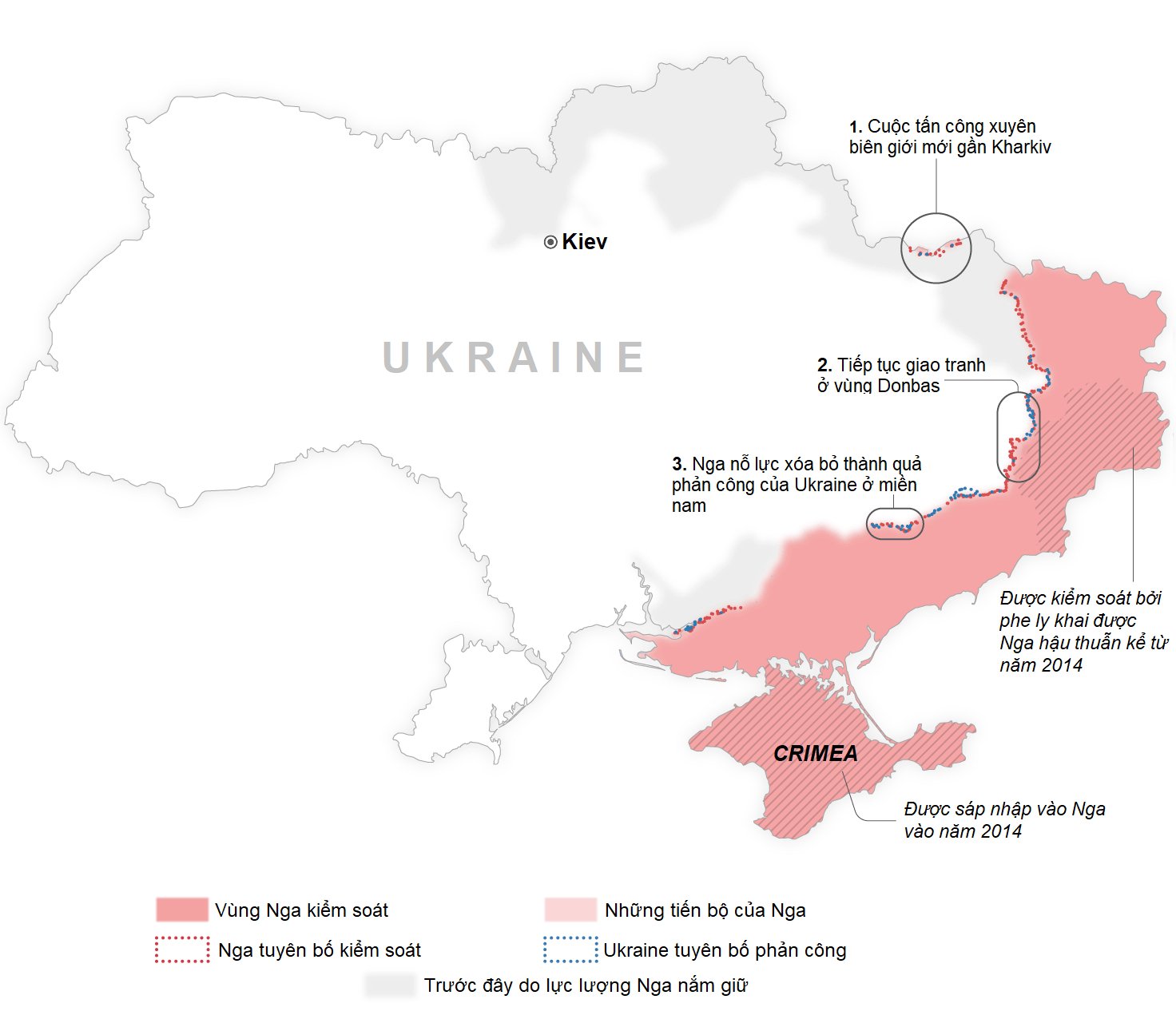
Three key strategic areas along the Russia-Ukraine front line. Data as of May 29. Graphic: CNN
This is an example of how Russia is exploiting Ukraine's key weaknesses: insufficient manpower, a lack of artillery, sparse air defenses, and inadequate defensive fortifications.
Ukraine's frontline brigades are holding out as they desperately await ammunition from allies, as well as the arrival of new recruits to provide much-needed manpower support.
In the north, Moscow's forces are aiming to bring troops within artillery range of the city of Kharkiv. Along the southern front, Russia is trying to regain control of villages recaptured by Ukraine in last year's counteroffensive, while also attempting to advance deeper into Ukrainian territory.
Kharkiv Front
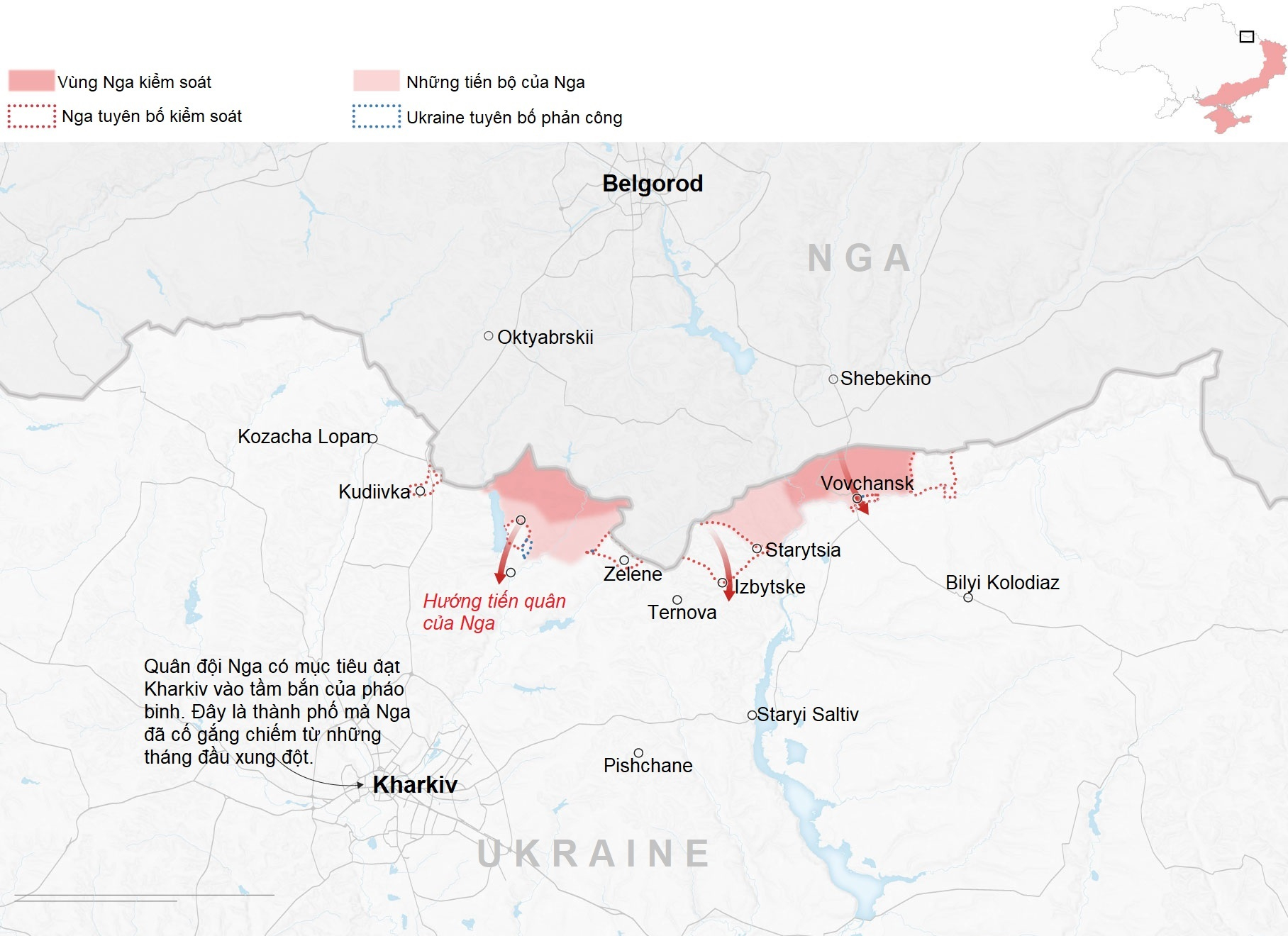
Kharkiv Front. Graphic: CNN
The cross-border offensive saw Russian forces quickly seize control of several villages. Since then, Russia has intensified its attacks in the region as it attempts to gain control of key settlements in Vovchansk and Lypsti.
Lyptsi, located about 30 km north of Kharkiv (the capital of Kharkiv province), is under heavy Russian shelling. Capturing this large village would allow Russian forces to deploy artillery with a range capable of striking Kharkiv, Ukraine's second-largest city, which is vulnerable to missile attacks.
The Russian offensive also forced Ukraine's already limited resources to divert away from other front lines and created a buffer zone against Ukrainian attacks on the Russian border region. For example, the nearby Russian region of Belgorod has been increasingly targeted by Ukrainian offensives in recent months.
Eastern Front - Avdiivka and Bakhmut
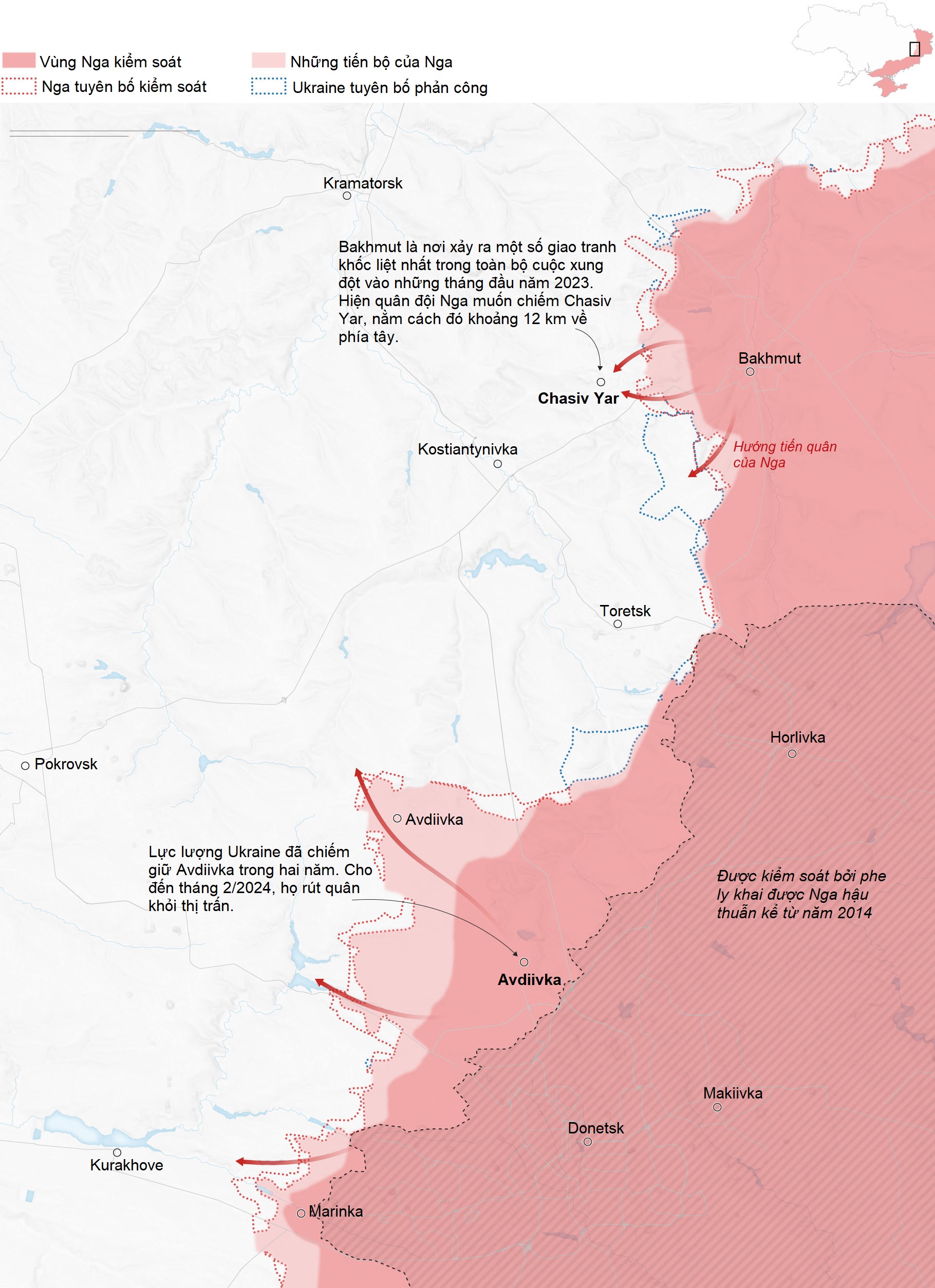
The eastern front of Ukraine. Graphic: CNN
Aside from the offensive in Kharkiv, Russia has primarily focused its offensive capabilities in the east, where it has steadily advanced since October 2023 when Ukraine's much-anticipated counteroffensive failed last summer. Capturing the industrial heartland of eastern Ukraine – known as Donbas – remains the Kremlin's primary objective.
In February, Moscow's army achieved a major success on this front by capturing the town of Avdiivka. Ukrainian President Volodymyr Zelenskyy stated that the decision to withdraw troops was to preserve their strength as they faced intense and continuous Russian shelling, as well as a disadvantage in artillery fire (10 to 1).
Since then, Russian troops have steadily advanced westward toward Pokrovsk, which serves as a crucial military center in Ukraine.
A few dozen kilometers to the north, the eastern city of Bakhmut was recaptured by Russia last spring after a nine-month battle. Russian forces are now advancing westward toward Chasiv Yar. Gaining control of the high ground where the town is located would bring Russian troops closer to the strategically important city of Kramatorsk.
The Battle for Robotyne Village
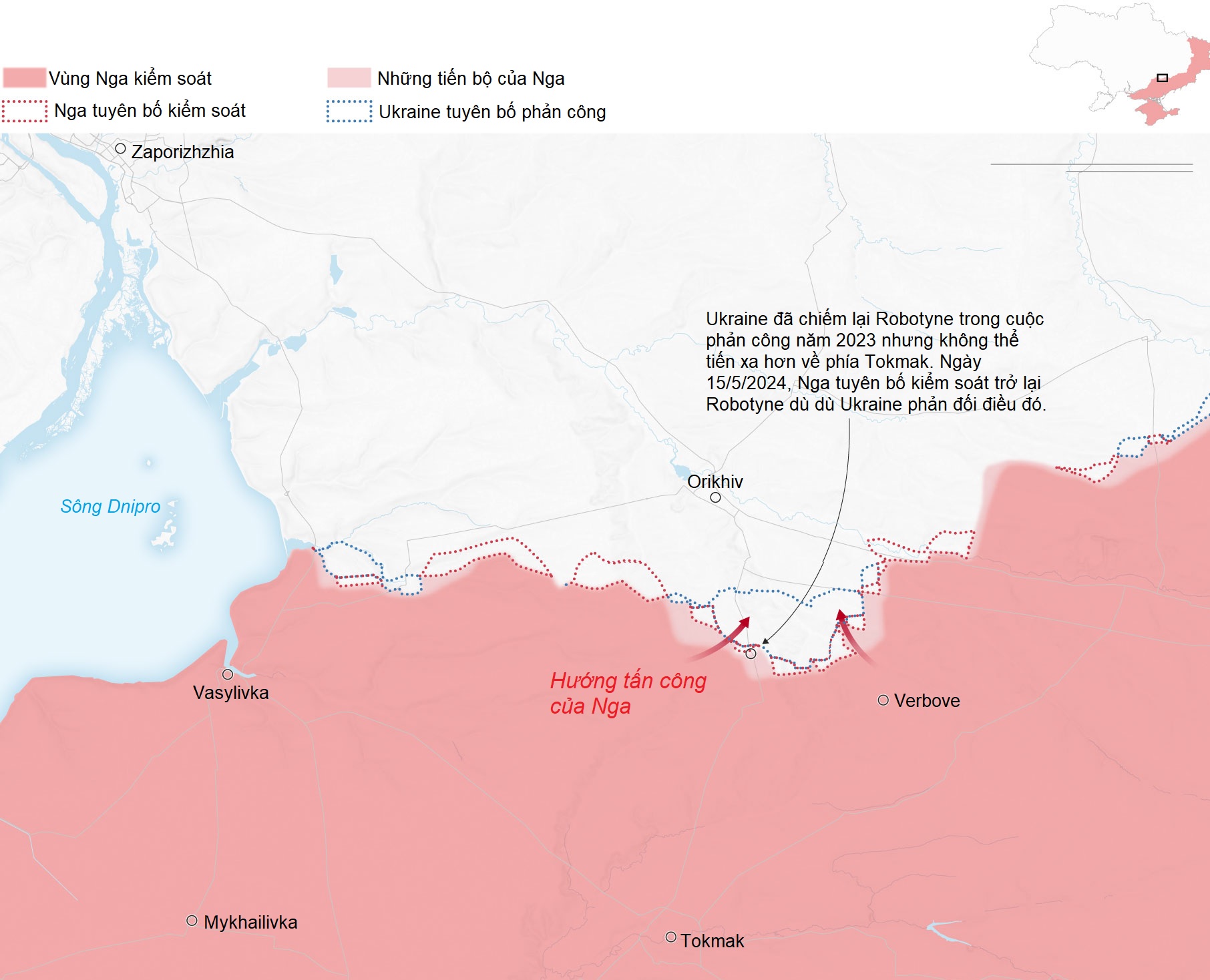
The battle for the village of Robotyne. Graphic: CNN
Further south, Ukrainian forces are under pressure southeast of Zaporizhzhia, one of the few areas where they achieved success, albeit on a modest scale, in last summer's counteroffensive.
Russian military bloggers and Ukraine's DeepStateMap conflict map have both reported on small Russian advances into recaptured Ukrainian territory.
Robotyne, a small village now completely destroyed, changed hands several times during the conflict. The village was first captured by Russian forces in early March 2022, and Moscow again claimed control of it earlier this month, a claim that Ukraine denies.
The Battle for Robotyne village highlights the flexibility of the battlefield and is a vivid illustration of the nature of war. The war is decided by brutal clashes in often abandoned villages.
Hoai Phuong (according to CNN)
Source: https://www.congluan.vn/lap-ban-do-3-tran-danh-then-chot-moi-trong-cuoc-chien-nga--ukraine-post297715.html


![[Photo] Prime Minister Pham Minh Chinh attends the Conference on the Implementation of Tasks for 2026 of the Industry and Trade Sector](/_next/image?url=https%3A%2F%2Fvphoto.vietnam.vn%2Fthumb%2F1200x675%2Fvietnam%2Fresource%2FIMAGE%2F2025%2F12%2F19%2F1766159500458_ndo_br_shared31-jpg.webp&w=3840&q=75)











































































Comment (0)