


Amidst all the clamor, football still managed to speak another language: a round ball, rolling across the pitches of France, and the third World Cup unfolded as a brief festival, before the world went dark for twelve years.
France opened its doors, but not everyone could enter. The 1938 World Cup was held in France, from June 4th to 19th, 1938.
The tournament featured 15 teams, and like the previous one, it was essentially a mini-European championship. Only two South American nations participated alongside 11 European teams. The remaining team was Indonesia, then known as the Dutch East Indies, the only Southeast Asian representative to participate in the World Cup to this day.
The odd number 15 has a story in itself: it was supposed to be 16, but Austria withdrew due to its annexation by Germany. And some Austrian players also "merged" into the German national team.
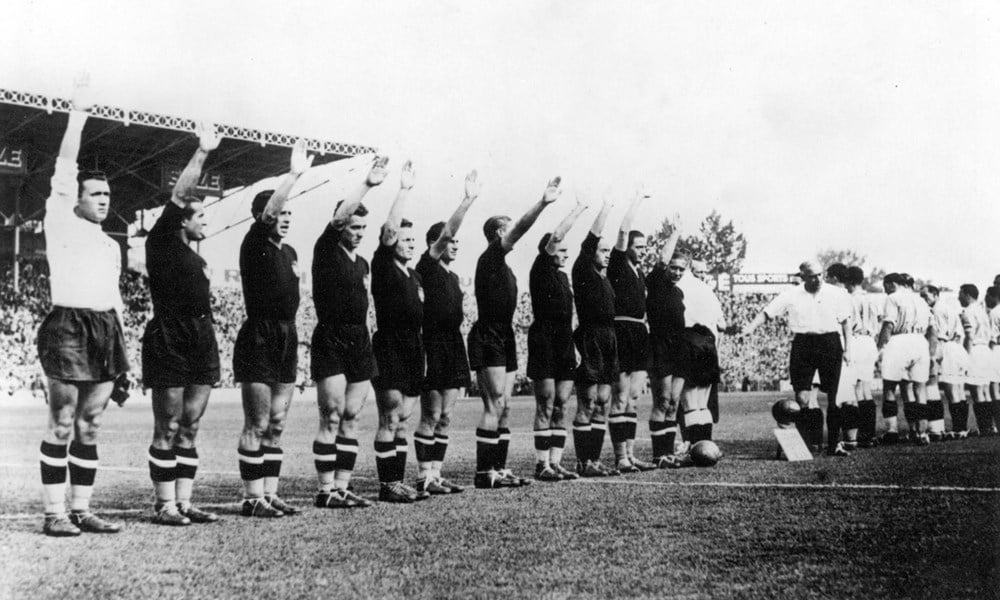
With the swastika symbol pinned to their chests and every emblem of Nazi power at their fingertips, the German team entered the tournament full of confidence, declaring themselves invincible, only to stumble against a more modest Switzerland.
Germany's defeat came just days before the "Aryan supremacy" received another blow in New York: Black boxer Joe Louis crushed German champion Max Schmeling.
Sport cannot stop the wheels of history, but knowing how to leave your own mark on history is important, and Austria is not the only one missing out.
FIFA's decision to continue allowing Europe to host the tournament (after Italy in 1934) provoked a reaction from many South American teams, with Uruguay and Argentina withdrawing.
The tournament retains the spirit of its early days: a knockout system right from the start, with no group stage. If the score is tied, extra time is played; if it's still tied, a replay is required.
Italy replicated their previous World Cup feat. In the semi-finals, the Azzurri beat Brazil. There was a questionable penalty, but Brazil's protests were futile. Just like in 1934, all the referees were European.
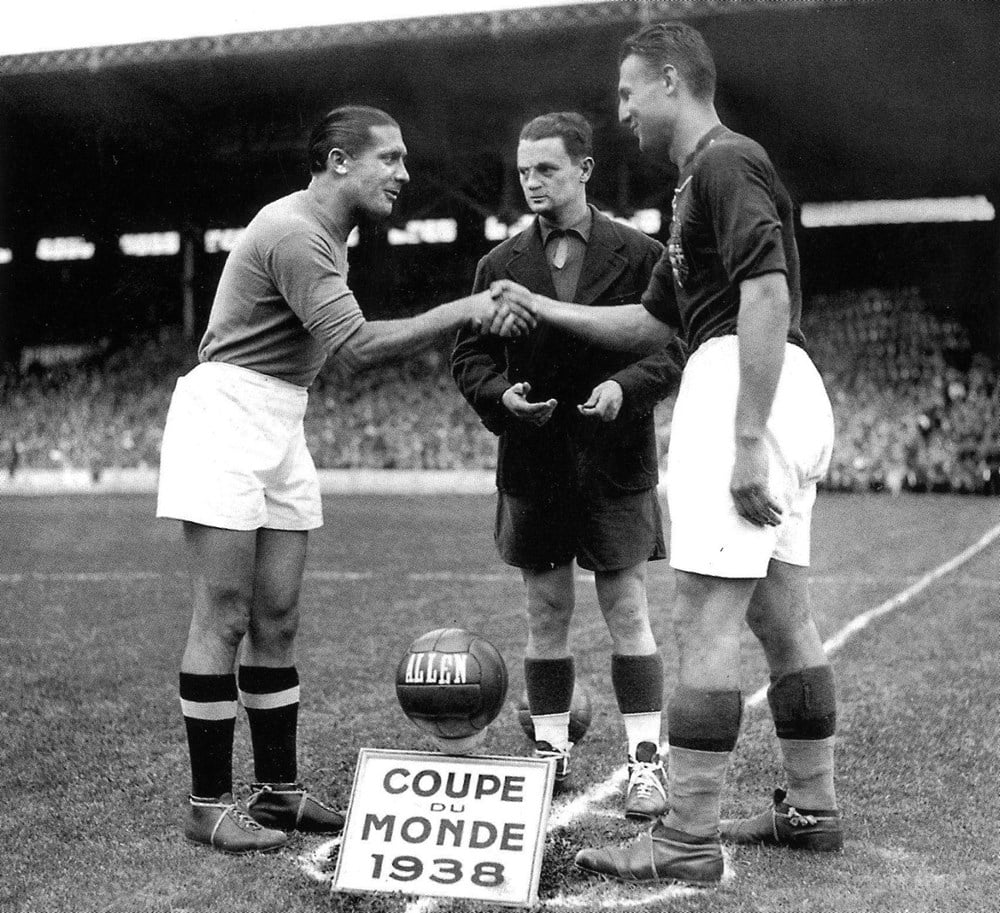
Then came the final, Italy faced Hungary – for Mussolini, victory was a national affair. The night before the match, the Italian players received a three-word telegram from Rome, signed by the Nazi leader: "Win or die."
The Azzurri did not die, as Italy won 4–2. The following day, the victors wore their uniforms to the closing ceremony presided over by Mussolini.
Instead of reporting on the tiny, matchbox-sized baby like in 1930, La Gazzetta dello Sport celebrated "the pinnacle of Fascist sport symbolized by the victory of this race."
However, international media chose the best players of the tournament to be Brazil's prolific striker Leonidas. With seven goals, Leonidas led the scoring charts, followed by Hungary's Zsengellér with six goals.
His most spectacular goal came in the match against Poland. It was raining heavily, Leonidas lost his shoe in the mud of the penalty area, and he scored barefoot.
Stunning images from the 1938 World Cup:




Source: https://baovanhoa.vn/the-thao/lich-su-world-cup-1938-ky-hoi-cuoi-cung-truoc-con-bao-227620.html
![[Image] Pleasant weather helps students enter the 10th grade entrance exam with confidence.](https://vphoto.vietnam.vn/thumb/1200x675/vietnam/resource/IMAGE/2026/05/29/1780034401612_ngay-1-thi-lop-10-minh-duy-8-5009-jpg.webp)

![[Photo] Ba Lang An Lighthouse - the "eye of the sea" amidst the "rock museum" of Quang Ngai province.](https://vphoto.vietnam.vn/thumb/1200x675/vietnam/resource/IMAGE/2026/05/29/1780038698840_anh-man-hinh-2026-05-29-luc-14-10-42.png)








































































Comment (0)