

TPO - In its comments on the draft Law on Geology and Minerals, the Vietnam Federation of Trade and Industry proposed auctioning the right to exploit minerals. The organization expressed concern that the regulation designating areas where mineral exploitation rights will not be auctioned would create ample room for favoritism and corruption.
The Vietnam Federation of Commerce and Industry (VCCI) has recently sent a document to the National Assembly's Committee on Science , Technology and Environment providing feedback on the draft Law on Geology and Minerals.
In its written comments, the Vietnam Chamber of Commerce and Industry (VCCI) expressed concern that the regulation designating areas without auctioning mining rights would create ample room for a system of favoritism and corruption. The VCCI cited the Ministry of Natural Resources and Environment 's report summarizing 10 years of implementing the 2010 Mineral Law, which showed that only 6 licenses were granted through auction out of a total of 421 mining licenses issued by the ministry, representing only 1.4%.
Regarding licenses issued by provincial People's Committees, 394 out of a total of 4279 licenses were granted through auction, accounting for 9.2%. This very low percentage indicates that the majority of mineral mines are still licensed through a "request-and-grant" system.
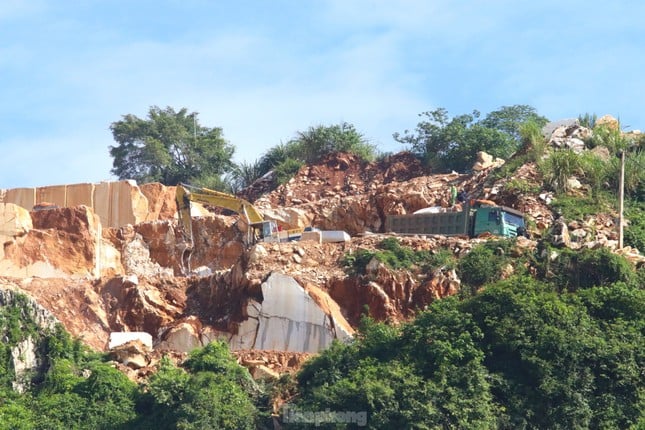 |
According to VCCI, the majority of mineral mines are licensed through a "request-and- grant" process. |
The draft also stipulates areas where mineral exploitation rights will not be auctioned (if the minerals have already been planned as raw materials for projects processing them into industrial products).
According to VCCI, this regulation has a very broad scope, encompassing many important minerals, especially metallic minerals such as bauxite, titanium, and iron ore. These are all minerals with significant exploitation potential and high commercial value. Therefore, these mines could be converted to a non-auction mechanism, continuing the "request-and-grant" system.
Meanwhile, the effectiveness of the auction process has been demonstrated in practice. The winning bids for 6 licenses issued by the Ministry of Natural Resources and Environment were 76% higher than the starting price. Therefore, if the scope of auctions is expanded, VCCI believes that the benefits to the budget will be enormous, while also creating a transparent and healthy business environment for enterprises.
Therefore, VCCI proposes that the drafting committee research and consider stipulating that all mineral exploitation rights must be granted through auction (or bidding).
Regarding financial issues, according to VCCI, Vietnam's mineral sector has not attracted large-scale, well-planned investment projects in recent years. The law lacks adequate protection mechanisms for businesses investing in large-scale projects with long payback periods.
According to feedback from businesses, one of the biggest reasons limiting large-scale investment in the mineral sector is policy risk. Frequent and continuous policy changes, often unfavorable to already operational mineral projects, have had a very negative impact on Vietnam's investment and business environment.
"Some businesses have reported that their financial obligations to the budget have increased nearly threefold compared to the regulations at the time of granting mining licenses, such as increased resource taxes, mining rights fees, environmental protection fees for mineral exploitation, and mineral export taxes," VCCI reported.
In light of this situation, VCCI proposes studying the addition of an investment guarantee mechanism for large-scale mineral projects. The State should ensure a stable investment environment regarding the financial obligations of enterprises to the budget. In the event of changes in the law, investors should not be subjected to unfavorable changes for the entire or at least 50% of the initial period of the project.
Source: https://tienphong.vn/lo-ngai-viec-cap-phep-mo-khoang-san-rong-cua-xin-cho-post1649211.tpo


![[Photo] Prime Minister Pham Minh Chinh presides over a meeting on private sector economic development.](/_next/image?url=https%3A%2F%2Fvphoto.vietnam.vn%2Fthumb%2F1200x675%2Fvietnam%2Fresource%2FIMAGE%2F2025%2F12%2F20%2F1766237501876_thiet-ke-chua-co-ten-40-png.webp&w=3840&q=75)

































































Comment (0)