

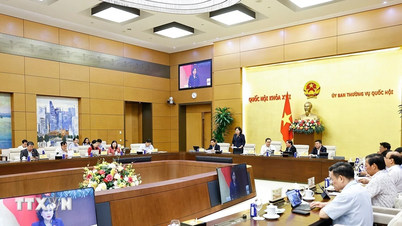
On the afternoon of June 13, continuing its 34th session, the Standing Committee of the National Assembly gave its opinion on the draft law amending and supplementing a number of articles of the Law on Land, the Law on Housing, the Law on Real Estate Business, and the Law on Credit Institutions.
According to the submission, the Government proposes allowing the Land Law, the Housing Law, and the Real Estate Business Law to take effect from August 1, 2024. However, some transitional provisions in Articles 253 to 260 of the Land Law will be allowed to take effect from January 1, 2025.
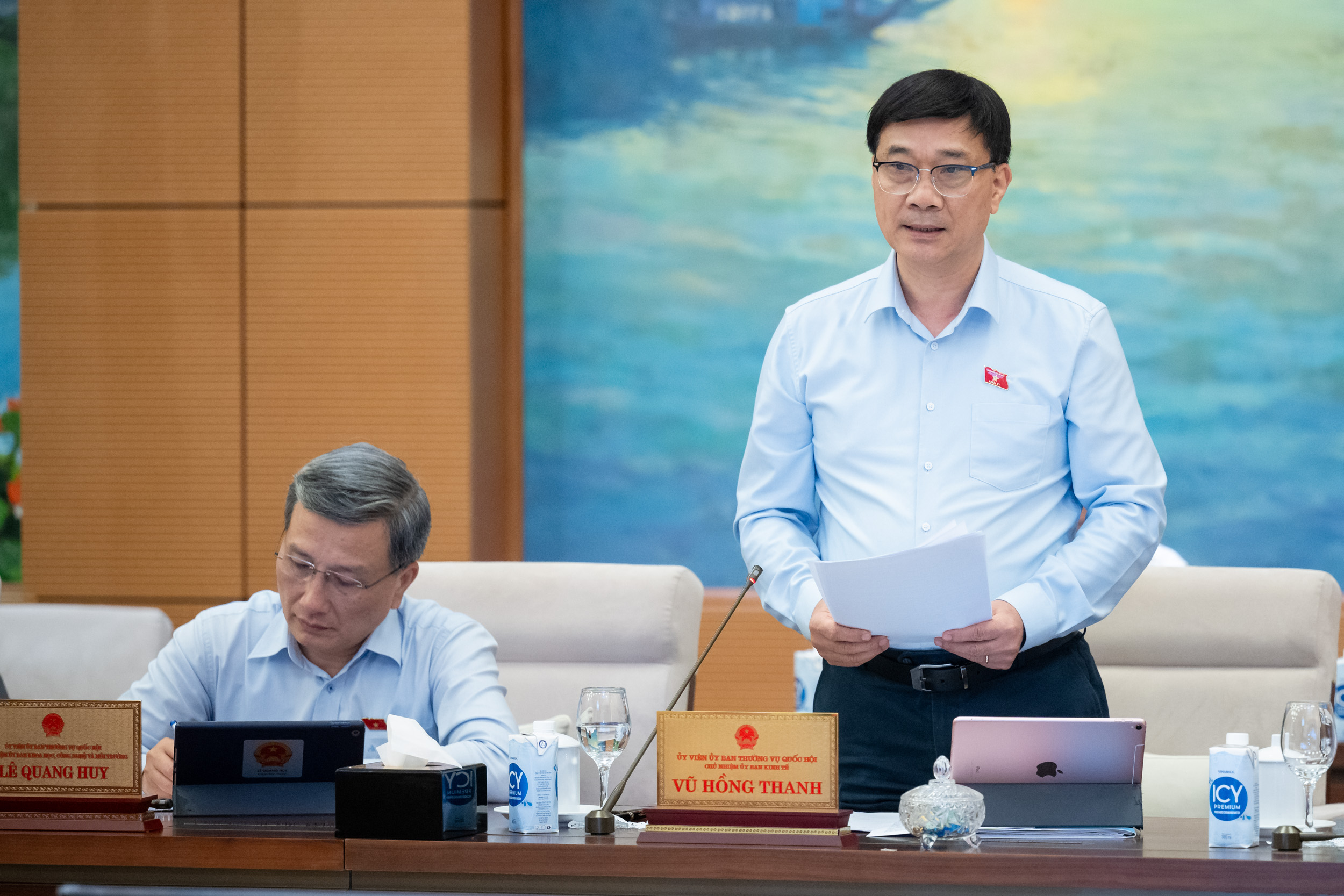
Chairman of the National Assembly's Economic Committee, Vu Hong Thanh, reports on the preliminary review of the Government's submission.
"Allowing the Land Law to take effect earlier will unlock resources, unleash potential, maximize the value of land resources, and meet the aspirations and wishes of localities, businesses, and people," the government's submission emphasized.
Similarly, many policies in the Housing Law and the Real Estate Business Law can be implemented immediately without the need for detailed guidance.
Furthermore, the Law on Credit Institutions, specifically Clause 3, Article 200 and Clause 15, Article 210, takes effect from January 1, 2025 (the entire law takes effect from July 1), ensuring its validity coincides with the effective date of the Law on Real Estate Business. Therefore, when the effective date of the Law on Real Estate Business changes, it is necessary to amend the validity of Clause 2, Article 209 of the Law on Credit Institutions, which stipulates the validity of Clause 3, Article 200 and Clause 15, Article 210 of this law, to ensure consistent application of legal provisions and strict control when accepting collateral from credit institutions.
Consider with utmost caution.
In its review report at the session, the National Assembly's Economic Committee stated that the early implementation of these laws is not only a desire but also a requirement set by the National Assembly when voting to pass them.
However, Mr. Thanh clarified that the Economic Committee assessed that amending the effective date of newly passed laws, which have not yet come into effect and contain many new, important, complex, and impactful provisions, to take effect five months earlier requires extremely careful consideration.
Instead, the remaining time should be used for thorough preparation, ensuring the quality of detailed guidance documents, organizing widespread dissemination of legal information, creating uniformity in understanding and implementing the laws, and ensuring effectiveness in their deployment.
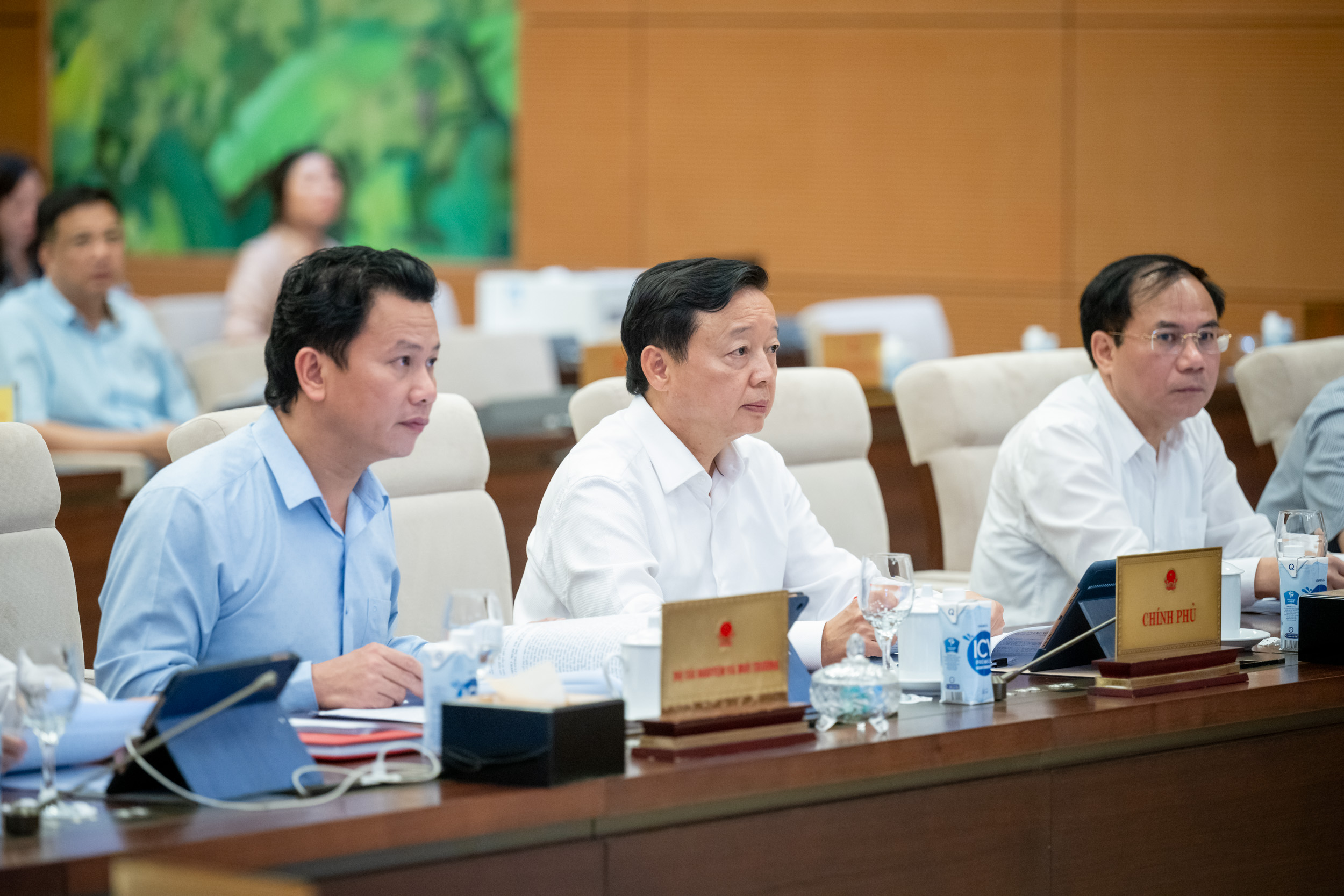
Government representatives at the discussion session.
Chairman Vu Hong Thanh stated that the majority of opinions within the Economic Committee believe that, based on the content of the draft law submitted to the National Assembly Standing Committee for review, the draft law is not yet ready for approval at the 7th session. However, Mr. Thanh suggested that it could be considered if the draft law is further refined.
Specifically, this includes solutions to ensure the conditions for implementation; perfecting the content of the transitional provisions to ensure that there is no legal vacuum due to the different effects of the law and the transitional provisions; avoiding conflicts with related laws; and having solutions to mitigate any adverse impacts (if any)...
Without causing obstruction, bottlenecks, or difficulties.
Concluding this discussion, Deputy Speaker of the National Assembly Nguyen Duc Hai affirmed that, after deliberation, the Standing Committee of the National Assembly unanimously agreed to submit to the National Assembly for consideration and decision the Law amending and supplementing a number of articles of the Land Law, the Housing Law, the Real Estate Business Law, and the Law on Credit Institutions at the ongoing 7th session.
The Standing Committee of the National Assembly also requested the Government to urgently and promptly issue directives to ministries, sectors, and localities to issue guiding documents, ensuring quality and progress, and to fully prepare the conditions for the implementation of the law from August 1st. At the same time, a thorough review of transitional provisions is needed to ensure consistency, uniformity, feasibility, and to avoid overlaps and conflicts within the laws, between laws, and within the legal system.
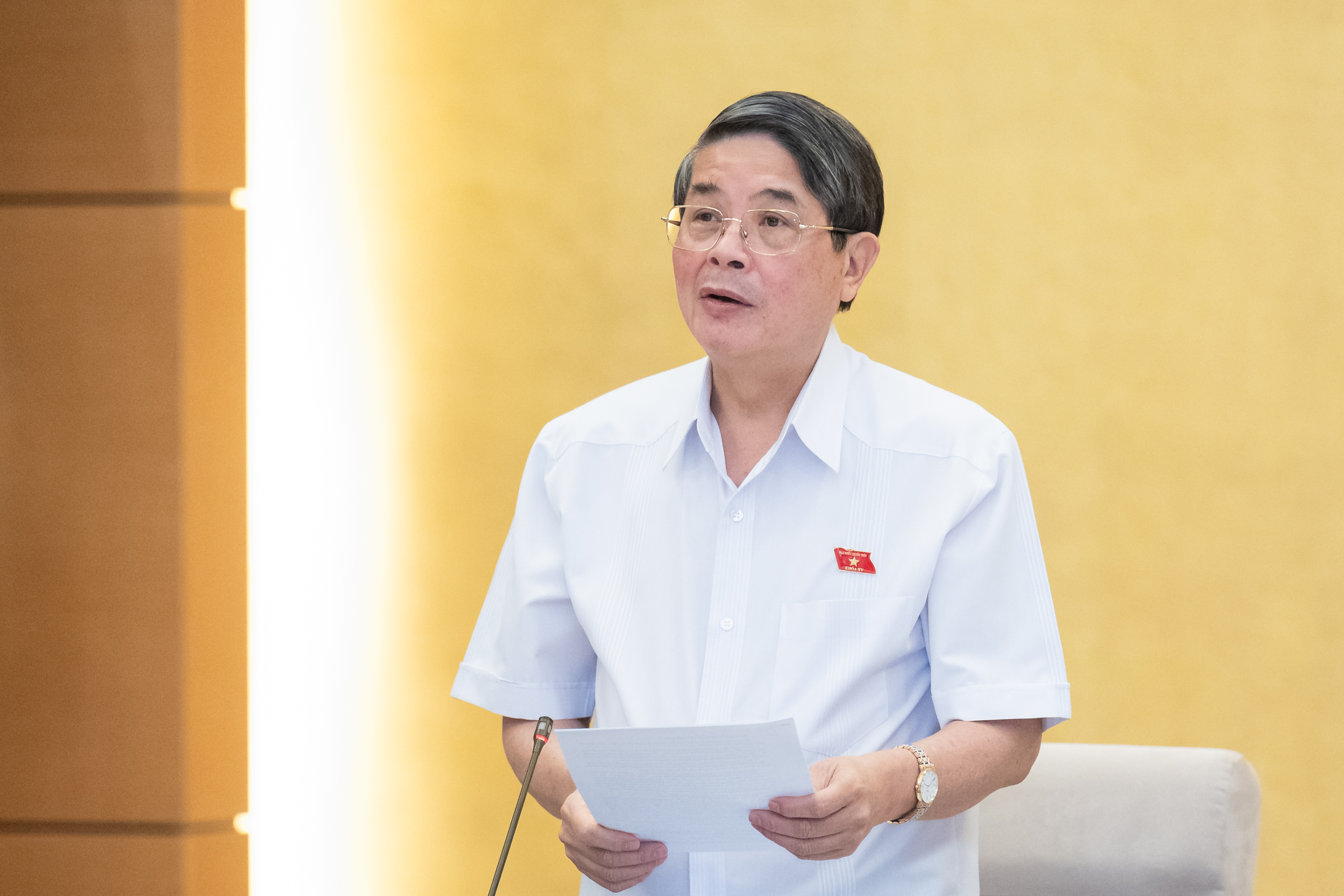
Deputy Speaker of the National Assembly Nguyen Duc Hai concluded the working session.
The Standing Committee of the National Assembly also requested the Government to fully identify the risks, challenges, and negative consequences of adjusting the effective dates and transitional provisions of laws in order to develop solutions for control and mitigation.
"The government needs to commit and take full responsibility before the National Assembly and the people for the effectiveness of adjusting the effective date and transitional provisions of laws; not creating legal or regulatory vacuums, or allowing negative practices, policy abuse, or the legitimization of violations and group interests to occur," Mr. Hai stated clearly.
The Standing Committee of the National Assembly also requested the Government to commit to not creating obstacles, bottlenecks, or difficulties for localities, people, and businesses, hindering development, and not creating negative legal effects that affect the rights of affected parties, the investment and business environment, or the legitimate rights and interests of people, businesses, and credit institutions, leading to social reactions, complaints, and lawsuits that affect security, order, and social safety.
Mr. Hai suggested that the Government should fully consider and incorporate the opinions of the members of the National Assembly Standing Committee and the opinions of the reviewing agencies, and finalize the draft law before submitting it to the National Assembly. The Economic Committee, in coordination with the Legal Committee and the reviewing agencies, will officially submit the draft law to the National Assembly for consideration and decision at the 7th session, following the one-session procedure.
Source: https://thanhnien.vn/luat-dat-dai-co-hieu-luc-som-hon-se-khoi-thong-nguon-luc-18524061317505434.htm
![[Photo] Capturing the moment the tide recedes at Yen Binh Son rapids - a million-year-old scenic spot in Quang Ngai.](https://vphoto.vietnam.vn/thumb/1200x675/vietnam/resource/IMAGE/2026/05/19/1779175463885_yen9-1199-jpg.webp)

![[Photo] General Secretary and President To Lam presides over a meeting on the implementation of Directive No. 34-CT/TW of the Party Central Committee.](https://vphoto.vietnam.vn/thumb/1200x675/vietnam/resource/IMAGE/2026/05/19/1779187768672_a1-bnd-2350-631-jpg.webp)
![[Photo] National Assembly Chairman Tran Thanh Man attends the groundbreaking ceremony for the National Highway 1A spatial axis project.](https://vphoto.vietnam.vn/thumb/1200x675/vietnam/resource/IMAGE/2026/05/19/1779161360398_ndo_br_bnd-1412-jpg.webp)






















































![[Photo] General Secretary and President To Lam receives Indian Defense Minister Rajnath Singh](https://vphoto.vietnam.vn/thumb/402x226/vietnam/resource/IMAGE/2026/05/19/1779184046302_anh-man-hinh-2026-05-19-luc-16-46-58.png)



























Comment (0)