

I don't know where to look it up.
Recently, authorities have implemented the issuance of unique identification codes for real estate properties as a significant step in the digitization of land and housing data. Each house and plot of land is assigned a unique code, similar to a "citizen's identity card" for real estate, to facilitate management, transactions, and data connectivity. However, many residents in Ho Chi Minh City and surrounding areas have reported not having been notified about the unique identification codes of their properties.
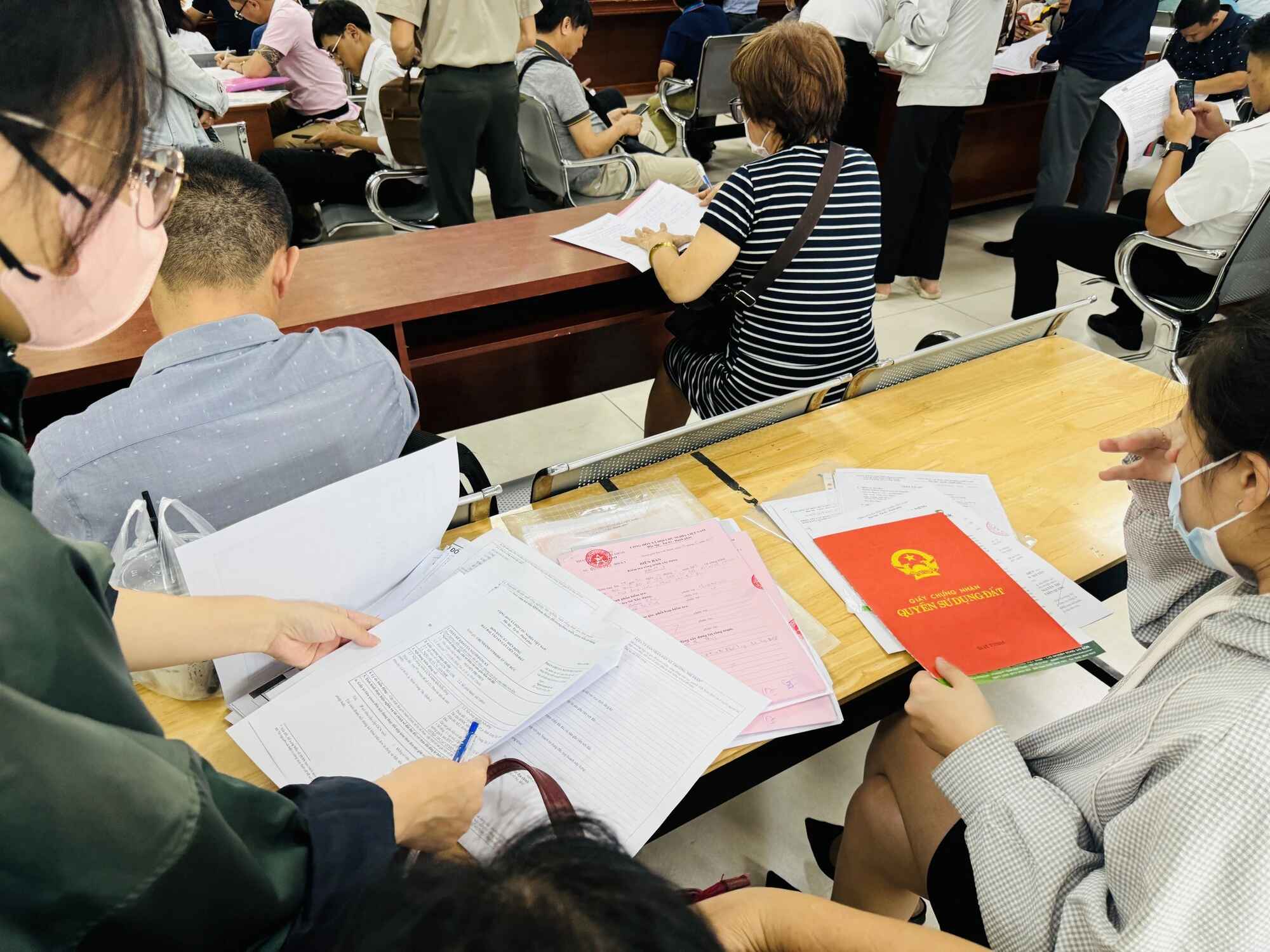
Currently, people are still not fully aware of real estate identification codes.
Photo: Dinh Son
Ms. Nguyen Thi Hoa (residing in Cat Lai Ward, Ho Chi Minh City) shared that she recently purchased a house and received a land ownership certificate, but the certificate only contains the same old information such as details about the house, land plot, and personal information… without a unique identification code. Previously, she imagined that when a house is issued a land ownership certificate, it will have an identification code similar to a citizen's ID number, and that when a property is assigned an identification code, the authorities will notify the owner for easier transactions later.
"I heard that houses and land now have identification codes, but I don't know if my house has one, and I'm not sure where to look it up. When I asked the ward officials, they didn't know either and haven't given me specific instructions," Ms. Hoa said.
A similar situation occurs in many places where people lack access to information, while official lookup channels are not yet widely available. Notably, according to information from the Ho Chi Minh City government, all land parcels now have identification codes, and these codes have been updated on VNeID. However, when people search the application, they cannot find the code, so they don't know where to find it or how to look it up.
According to Dr. Pham Viet Thuan, Director of the Institute of Resource and Environmental Economics , one of the main reasons for public ignorance is the lack of coordinated implementation, especially in the areas of publication and user guidance. Currently, real estate identification data is primarily managed within the internal systems of state agencies. Some localities have integrated it into land information portals, but the interface, search methods, and data scope are limited and not user-friendly. Furthermore, there is no unified national portal for citizens to easily access and search using basic information such as land title numbers, addresses, or plot numbers. The fact that citizens do not know their real estate identification codes not only causes inconvenience but also affects the effectiveness of the policy. The goal of identification is to create a foundation for electronic transactions, reduce administrative procedures, limit disputes, and prevent tax evasion. However, if people cannot access or use their identification codes, these benefits are difficult to realize.
Integration with VNeID will happen soon.
According to information from the Ho Chi Minh City Land Registration Office, the city has now synchronized its land registration system database with the national database, totaling over 3.8 million land parcels (168 out of 168 communes have been synchronized) and has created identification codes for over 4.2 million land parcels. From these identification codes, when real estate developers build apartment projects or land plot projects, townhouses, villas, or when people subdivide land, they will have additional information about the house or land plot to create real estate identification codes.
"This code consists entirely of letters and numbers, with 12 characters used to encode information such as land plot location, real estate information, etc. Currently, it mainly serves the management of construction and land administration, and will eventually be used for real estate transactions. The data is available but not yet widely accessible to the public. This requires more time to perfect the system and ensure information security," a representative from the Ho Chi Minh City Land Registration Office said.
Meanwhile, according to Mr. Nguyen Tien Huong, Head of the Housing and Real Estate Market Management Department (Ho Chi Minh City Department of Construction), Decree 357 (effective from March 1st) stipulates the issuance of real estate identification codes, including housing and floor area within construction projects. The Department is coordinating with relevant departments, agencies, and investors to issue real estate identification codes as soon as related documents are issued. Specifically, the Ho Chi Minh City Department of Construction has issued two notices and created a Zalo group with the participation of project investors and real estate businesses in Ho Chi Minh City. Through this group, the Department requests investors and businesses to provide information to be assigned accounts on the housing and real estate market information system managed by the Ministry of Construction . The Ho Chi Minh City Department of Construction has created and assigned more than 300 accounts to over 200 investors and real estate service businesses.
Simultaneously, the Ho Chi Minh City Department of Construction continues to coordinate with other departments and agencies of Ho Chi Minh City to collect information on project developers, thereby granting accounts and completing the database on housing and the real estate market of the city. More than 600 accounts have been created and handed over to management agencies, project developers, investors, and real estate service businesses. After being granted, the real estate identification code will be published on the housing and real estate market information system. The Ministry of Construction will grant data access rights to organizations and individuals in need, in accordance with regulations.
According to Mr. Le Hoang Chau, Chairman of the Ho Chi Minh City Real Estate Association, approximately 22 million land plot identification codes have been issued nationwide, out of a total of about 64 million land plots. Currently, the Ministry of Construction issues identification codes for houses, while the Ministry of Agriculture and Environment issues them for land. The two sets of codes from different agencies are therefore fragmented. A mechanism for interconnection and integration is needed. To resolve this issue, Mr. Le Hoang Chau suggests integrating the identification code into the house number (if the land plot has a house or construction). Simply typing the house number will then connect to the identification code. If the land plot does not have a house, but the land title certificate (paper or electronic) has a number, simply clicking on that number sequence will generate the new identification code. In the long term, it is necessary to integrate the identification code into VNeID and integrate it with the citizen identity card so that later on, it can be used to manage the taxation of second homes and so that people can look up and track how their land and property were granted, and where to check this information.
"It is necessary to quickly build a unified nationwide real estate identification code lookup system, similar to the citizen information portal. People should be allowed to look up basic property information through simple methods such as entering the number on the land title certificate, QR code, or personal identification. At the same time, there needs to be specific and easy-to-understand instructions so that people know how to use it. In addition, data connectivity between sectors such as tax, notarization, banking, etc., also needs to be accelerated so that the identification code truly becomes a 'digital key' in all real estate transactions," Mr. Chau said.
The policy of issuing real estate identification codes is a correct step in the digital transformation process. Improving infrastructure, making information public, and providing clear usage instructions will be key to ensuring the effectiveness of this policy in practice.
Source: https://thanhnien.vn/ma-dinh-danh-bat-dong-san-van-con-lung-tung-185260325222225894.htm
![[Photo] Solemn bathing ceremony and Buddha procession in Hue](https://vphoto.vietnam.vn/thumb/1200x675/vietnam/resource/IMAGE/2026/05/31/1780228263543_1-jpg.webp)


![[Image] Hanoi Police officially crowned champions of V-League 2025/2026](https://vphoto.vietnam.vn/thumb/1200x675/vietnam/resource/IMAGE/2026/05/31/1780244769054_ndo_br_039d561b692be875b13a-jpg.webp)
![[Photo] The General Secretary, President and his wife begin their state visit to the Philippines.](https://vphoto.vietnam.vn/thumb/1200x675/vietnam/resource/IMAGE/2026/05/31/1780230559452_anh-man-hinh-2026-05-31-luc-19-28-11.png)
![[Photo] Admire the coral "masterpiece" amidst the million-year-old heritage of Dak Lak province.](https://vphoto.vietnam.vn/thumb/1200x675/vietnam/resource/IMAGE/2026/05/31/1780221235105_anh-man-hinh-2026-05-31-luc-16-53-27.png)


















![[Video] Sunset at Lap An Lagoon – Where the sun sets over the fishing nets](https://vphoto.vietnam.vn/thumb/340x192/vietnam/resource/IMAGE/2026/05/31/1780192137701_beach-landscape-sea-water-nature-grass-745871-pxhere-com.jpeg)




































![[Photo] Admire the coral "masterpiece" amidst the million-year-old heritage of Dak Lak province.](https://vphoto.vietnam.vn/thumb/402x226/vietnam/resource/IMAGE/2026/05/31/1780221235105_anh-man-hinh-2026-05-31-luc-16-53-27.png)

































Comment (0)