


Through difficult times
In our conversation, Mr. Nguyen Xuan Cong, former Secretary of the Party Committee of Tam Son commune, frequently recalled the "numerous difficulties" faced by this area 40 years ago.
He said that the only way for people to buy, sell, or exchange goods with the lowlands, or to reach the commune center, was by ferry across Phu Ninh Lake.
When it was first established, the infrastructure for production and daily life was virtually non-existent. The economy was mainly based on small-scale agricultural production, with many newly reclaimed lands lacking the application of technology, resulting in very low crop yields. Consequently, the lives of the people were extremely difficult. At that time, electricity and roads were the greatest dreams of the people of Tam Son.
Mr. Nguyen Xuan Cong recounted: “At that time, the entire political system of Tam Son commune adhered to the resolutions of the Party Congresses of Nui Thanh district and Tam Son commune in each term to implement policies step by step, first and foremost focusing on production and opening roads for the people. However, resources were limited, so we could only meet the most essential needs.”
Since the country entered the period of reform, the Party and State have allocated many policies to mountainous areas, and Tam Son has also begun to transform. Notably, in April 2000, Tam Son commune received electricity.
By 2004, the Tam Anh - Tam Son road was completed; in 2009, the Thuoc Hot bridge was built, eliminating the barrier of crossing the river by ferry.
With funding from various sources, Tam Son continues to invest in bringing electricity to remote residential areas, constructing transportation infrastructure across rivers and streams, and building schools and health stations...
Mr. Tran Cong Hieu, Secretary of the Party Committee of Tam Son commune, observed: "To date, the DT617 road from Tam Hiep to Tam Tra via Tam Son and the DH3 and DH8 roads from Tam Anh to Tam Son, the road to Tam Lanh, Tam Dan (Phu Ninh)... have been renovated, upgraded, widened and paved with asphalt."
Thanks to the active participation of the people, nearly 27.4km of inter-village and inter-commune roads have been concreted and paved, breaking the isolation caused by the single-route transportation system during the rainy season. This is an important condition to stimulate socio-economic development and contribute to Tam Son's progress."
Mr. Tran Cong Hieu added that, in the field of production, Tam Son commune has invested in irrigation works to ensure water supply, and many rice fields now achieve yields of 45-50 quintals/hectare.
Recognizing the advantages of mountainous communes in developing forest-based economies, the local Party committee and government have determined the economic structure to be: forestry - agriculture - livestock and services.
Leveraging strengths
Leveraging its advantages in forestry, in addition to implementing reforestation projects under the Government's Programs 327 and 661 on greening barren land and hills, the people of Tam Son commune are focusing on expanding the area for planting raw material crops, primarily cassava and acacia. This has brought economic benefits, created jobs, and contributed positively to poverty reduction and improving the lives of the people.

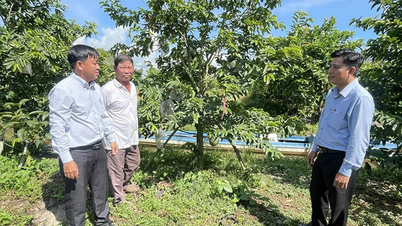
In addition, the locality also encourages and supports people in building economic models of hillside gardens, family farms, and large-scale farms. To date, 30 households have invested in livestock farms with a total herd of over 3,500 animals, and 23 households have developed high-income garden-based economies.
Mr. Nguyen Dai Hung (a resident of Thuan Yen Dong village) said that, encouraged by the local government to renovate his hillside garden and supported with policy loans, he and his wife diligently built an economic model in this direction.
"To date, we have a farm with 26 sows, maintain a herd of 200 fattening pigs, a pond for raising 100 eels, and a livestock feed dealership..., which generates hundreds of millions of dong in income per year," Mr. Hung shared.
In addition to focusing on supporting economic development, Tam Son also prioritizes building infrastructure to serve socio-cultural development. To date, 100% of households in the commune have access to electricity.
The postal and telecommunication networks cover all villages. The school system in the commune has been invested in and built to a high standard. In addition, the commune's health station basically meets the needs of medical examination, treatment, and primary healthcare for the people...
After 8 years of concerted efforts to build a new rural area, by 2021 Tam Son had achieved 19 out of 19 criteria and was recognized by the Quang Nam Provincial People's Committee as a commune meeting the standards of a new rural area. To date, the average per capita income has reached 47 million VND/year, and the poverty rate has decreased to only 4.2% (59 households).
"The people have stood by the Party Committee and the government for the past 40 years, so the Party Committee, with the highest determination, has identified the key task for the coming period as solving employment problems, stabilizing livelihoods, and increasing income for the people."
"At the same time, we will create positive changes in the fields of culture, education, and health so that people can benefit from the policies of the Party and the State dành for mountainous regions," Mr. Tran Cong Hieu affirmed.
Source

![[Image] Checking the security conditions at the exam site, ready for the 10th grade exam.](https://vphoto.vietnam.vn/thumb/1200x675/vietnam/resource/IMAGE/2026/05/28/1779943458889_z7872507660648-d764421a26e8cd7b61d70d142a48a685-jpg.webp)
![[Photo] Opening Ceremony of the National People's Council Conference on the Implementation of Directions and Tasks for the 2026-2031 Term](https://vphoto.vietnam.vn/thumb/1200x675/vietnam/resource/IMAGE/2026/05/28/1779939257690_ndo_br_bnd-1991-jpg.webp)








































































Comment (0)