
In Poland, archaeologists unearthed a mass grave containing numerous skeletons with skulls placed between their legs and coins in their mouths to prevent the dead from coming back to life.
A mass grave contains 450 skeletons of 'vampires'.
 VnExpress•12/06/2023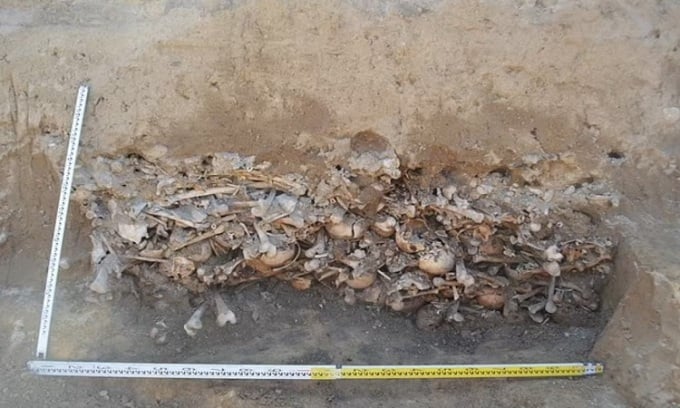
The skeletal remains in a tomb in the village of Luzino. Photo: Maciej Stromski
You may also like
The journey to restore the names of these heroes…Stay updated with the latest and hottest news on Social Life, Economy, Law, Education, World, Sports, Entertainment, Culture, and many other fields in Tay Ninh.

Poland has dealt a heavy blow to Ukraine.According to Stanislav Kuvaldin, a researcher at the Center for European Studies of the Institute of World Economy and International Relations (IMEMO) of the Russian Academy of Sciences, the extremist statements of some politicians who consider Ukraine an enemy of the state do not reflect the official position of Warsaw.

Scientists create artificial cells that can 'reproduce'.Scientists have successfully created synthetic cells that can grow, replicate DNA, and divide, marking a major advance in synthetic biology.
The remains of 450 people believed to be vampires were unearthed by road workers near a 19th-century cemetery in the village of Luzino in northeastern Poland, Ancient Origins reported on June 11. Researchers believe the deceased were vampires because each body was decapitated and had a coin stuffed in its mouth. This custom was intended to prevent the dead from rising from their graves and terrorizing the living.
Polish archaeologist Maciej Stromski said that researchers have found many similar examples. In rural Poland in the 19th century, the execution of vampires was common. Furthermore, the act of placing a coin in the mouth was believed to neutralize the vampire's curse, preventing them from resurrecting and spreading disease.
According to Stromski, about 30% of the graves remain unexcavated. Researchers also found bricks placed next to the feet, arms, and heads of the skeletons. Throughout Europe hundreds of years ago, various methods circulated to ward off vampires, such as placing garlic, crosses, or holy water near the deceased's body. In some parts of Poland, people believed that bricks could restrain vampires, acting as a barrier to confine them to their resting place and prevent them from returning to wreak havoc on the world of the living.
Vampire legends are often associated with people suffering from illnesses like tuberculosis, due to some of the disease's symptoms such as pale skin, coughing up blood, and a frail appearance. Last September, the remains of a female vampire, pinned to the ground with a sickle through her throat and a padlock on her toe, were also found in Poland.

Strengthening the friendship between Vietnam and the United States.On July 3rd, as part of the Pacific Partnership - Friends of the Pacific 2026 program, the U.S. Army Pacific delegation, led by Lieutenant General Joel Vowell, Deputy Commander of the U.S. Army Pacific, paid a courtesy visit to the Quang Tri Provincial Military Command.
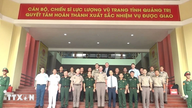
The U.S. Army Pacific delegation visits the Quang Tri Provincial Military Command.2026 marks the first time the Pacific Partnership-Friends of the Pacific program will be jointly organized in Quang Tri, creating a large-scale cooperation framework with 25 activities.

The Ministry of Foreign Affairs received a copy of the Letter of Credence for the U.S. Ambassador to Vietnam.On the afternoon of July 2nd, at the Ministry of Foreign Affairs headquarters, Mr. Le Cong Dung, Director of the State Protocol and Foreign Interpretation Department, received a copy of the Letter of Credence from Ms. Jennifer Wicks, Ambassador of the United States of America to Vietnam.
An Khang (According to Ancient Origins )
Source link



































































































Herring fishing season in Tien Dien commune

SHADOW PAINTING
