

Reuters reported that this was part of a mission by the US National Aeronautics and Space Administration (NASA) to resume moon landings after more than half a century of interruption. This was also the first trip by a privately owned vehicle.
According to plan, the Nova-C lander, named Odysseus, will lift off just before 1:00 AM local time. The spacecraft will be propelled by a SpaceX Falcon 9 rocket, launched from NASA's Kennedy Space Center at Cape Canaveral (Florida, USA). Weather conditions are predicted to be favorable with a 95% chance of success.
Nova-C is expected to reach its destination after a flight lasting approximately 7 days. The earliest possible landing date is February 22nd, when the spacecraft will land in the Malapert A crater near the moon's south pole.
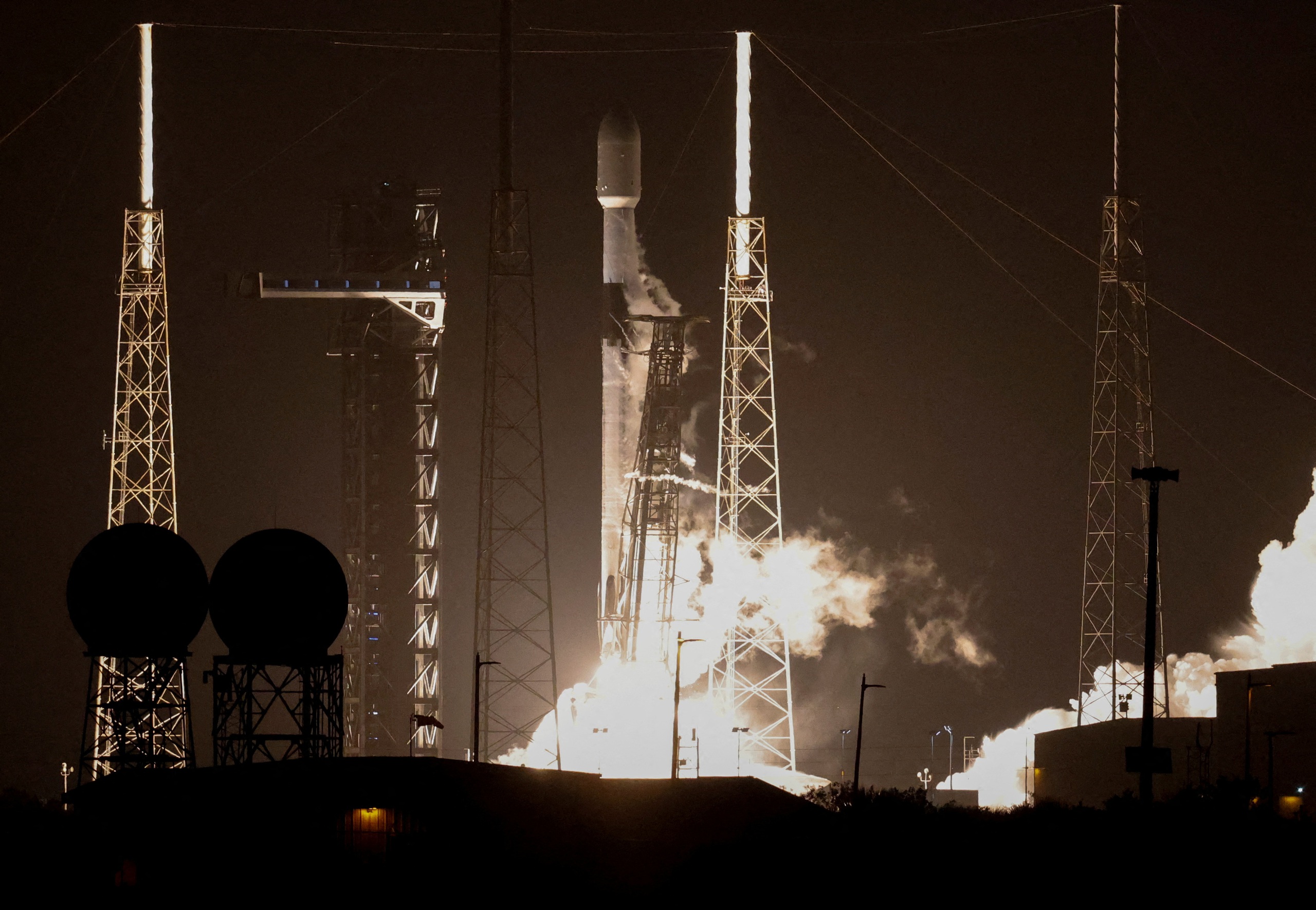
The SpaceX Falcon 9 rocket was launched from Cape Canaveral, Florida on February 8th.
If successful, the flight, codenamed IM-1, would mark the first time a US spacecraft has approached the lunar surface since the last Apollo crewed mission in 1972.
This achievement would also mark the first landing on the lunar surface under NASA's Artemis program, and comes as the U.S. strives to return astronauts to Earth's natural satellite before China does the same.
The launch took place one month after the Peregrine lunar lander, built by another private American company, Astrobotic Technology, suffered a system engine leak en route to the moon shortly after being placed into orbit, according to Space.com.
The failure of the Peregrine spacecraft, which was on a NASA mission, marks the third time a private company has been unable to make a "smooth landing" on the lunar surface, following attempts by companies from Israel and Japan.
These challenges highlight the risks NASA faces when it becomes more dependent on the commercial sector to realize its spaceflight goals.
The US lunar lander crashed and exploded in the Pacific Ocean .
IM-1 is the latest test in a strategy to use privately built and owned spacecraft to cut costs. During the Apollo era, NASA acquired and operated rockets and other technology from non- government manufacturers.
The Intuitive Machine's IM-2 mission is scheduled to land on the moon's south pole in 2024, followed by IM-3 later this year with several smaller probes.
Last month, Japan became the fifth nation to land a spacecraft on the moon, after its space agency JAXA successfully landed its SLIM probe.
Before Japan, four countries had successfully attempted to conquer the moon: the United States, the Soviet Union, China, and India.
Source link


















![[Photo] Prime Minister Pham Minh Chinh holds a phone call with the CEO of Russia's Rosatom Corporation.](/_next/image?url=https%3A%2F%2Fvphoto.vietnam.vn%2Fthumb%2F1200x675%2Fvietnam%2Fresource%2FIMAGE%2F2025%2F12%2F11%2F1765464552365_dsc-5295-jpg.webp&w=3840&q=75)
















































Comment (0)