 |
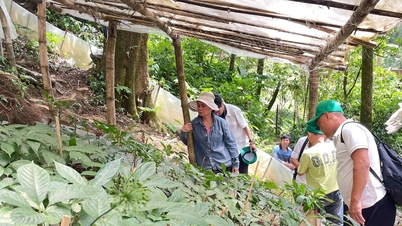
| By participating in the supply chain, farmers in Nghia Trung commune receive guidance on organic pepper cultivation from technical staff of Nedspice Processing Vietnam Co., Ltd. |
This advantage has enabled Dong Nai city to plan and establish 11 organic agricultural zones with a total area of nearly 19,400 hectares. Local authorities are paying attention to and creating favorable mechanisms and policies to attract businesses to invest and support farmers in building large-scale, sustainable organic agricultural supply chains; contributing to building a green agricultural brand for the new city of Dong Nai.
Towards sustainable development
In 2022, Mr. Huynh Ngoc Tay, a farmer in Dinh Quan commune, experimented with an organic pig farming model with nearly 10 pigs. Although starting on a small scale, his participation in the supply chain of Que Lam Group Joint Stock Company ( Ho Chi Minh City) allowed him to receive training and master the technical process of organic pig farming. This farming model has many advantages such as: the pigsties use biological bedding, so the farming process does not produce wastewater or foul odors. Livestock waste is used as organic fertilizer for crops. The pigs listen to relaxing music, have a misting system for cooling, and diseases are well controlled thanks to the biosecurity process. In particular, herbal supplements are added to the feed to increase the animals' resistance.
Mr. Huynh Ngoc Tay said: “From nearly 10 pigs initially raised as a pilot project, the farm has now increased its herd to about 100 pigs, including nearly 10 sows and gilts. I am confident in expanding my investment because the output is guaranteed by the company at a price higher than the general market price.”
In 2023, Mr. Tran Quang Hiep's durian orchard, spanning over 3 hectares in Xuan Que commune, received organic certification. This pilot model serves as a basis for replication among durian growers in the area. To date, approximately 60 hectares of durian orchards belonging to members of the Xuan Que Durian Cooperative are now cultivated using organic farming practices. Thanks to this transition, the cooperative's durians are prioritized for purchase by traders and businesses due to their quality meeting export standards for even the most demanding markets.
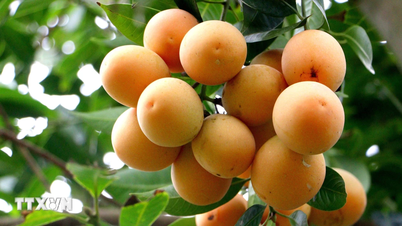
Not only focusing on production, many farmers and organic agricultural production facilities have invested in building brands and trademarks for clean agricultural products to ensure sustainable development. Mr. Truong Hoan Thien, owner of the Nui Cui agricultural production and processing facility in Gia Kiem commune, has two organic agricultural products, namely Buddha's Hand bananas and vegetables, that have been certified with 3 stars under the OCOP (One Commune One Product) program. With a production scale of nearly 3 hectares, the facility ensures a supply of organic vegetables and fruits, thus signing product purchase contracts with many businesses across the country. The facility also actively participates in conferences and programs promoting organic agricultural products and OCOP products, gradually making its mark on the market.
The new city's organic agricultural product brand.
To date, the Organic Agriculture Development Cooperation Program, based on a production-consumption linkage chain between Que Lam Group Joint Stock Company and the People's Committee of Dong Nai City, has been implemented for nearly four years. As a result, from initial pilot models, the program has established two sustainable organic rice production linkage chains covering a total area of over 55 hectares. The company has also supported farmers in establishing four linkage chains for developing fruit trees, focusing on key crops of the city such as pomelo, mangosteen, and durian. Furthermore, the company has assisted farmers in building organic pig farming linkage chains. These linkage chains have demonstrated economic effectiveness, a crucial factor ensuring sustainability and enabling the pilot models to be further developed and expanded in the future.
Mr. Hoang Dinh Hop, Deputy General Director in charge of the Southern region of Que Lam Group Joint Stock Company, affirmed: “To date, the cooperation program for developing organic agriculture through a production-consumption linkage chain between the company and the People's Committee of Dong Nai City has proven its effectiveness. Dong Nai becoming a city is a good opportunity for businesses to continue expanding cooperation in the development of organic agriculture. We hope that the new city will have more specific mechanisms and policies to support businesses in building and developing organic agricultural product brands.”
With the same objective mentioned above, since 2013, Nedspice Processing Vietnam Co., Ltd. (Dutch-invested) has collaborated with Dong Nai province (now city) to implement the Sustainable Pepper Value Chain Development Program to provide raw materials for the company's two large processing plants operating in Dong Nai and Ho Chi Minh City. To date, the program has established more than 50 clubs and cooperatives with 2,500 member households participating in the value chain. Of these, more than 1,000 households have received support to obtain organic product certification as well as other international certifications on product quality. Notably, by participating in the value chain, organic pepper farmers have their products purchased by the company at a price 17-25% higher than uncertified pepper.
Mr. Jos van Gulick, General Director of Nedspice Processing Vietnam Co., Ltd., shared: In 2025, the company aims to achieve a total export volume of spices and agricultural products of 28,000 tons. The company is planning to invest in an additional processing plant in Dong Nai City. During the 2026-2030 period, the company hopes to continue strengthening cooperation with the city government and other localities in Dong Nai to expand the safe organic pepper production chain, contributing to the development and branding of Dong Nai's pepper industry.
According to agricultural export businesses, major export markets such as the EU, the US, and Japan are continuously raising food safety standards. Requirements for product traceability are also becoming increasingly stringent. Therefore, developing organic farming models is essential to increase the competitive advantage of agricultural products when entering export markets.
Plains
Source: https://baodongnai.com.vn/xay-dung-nong-thon-moi/202605/nang-chat-trong-dau-tu-nong-nghiep-huu-co-f110104/



![[Photo] Ba Lang An Lighthouse - the "eye of the sea" amidst the "rock museum" of Quang Ngai province.](https://vphoto.vietnam.vn/thumb/1200x675/vietnam/resource/IMAGE/2026/05/29/1780038698840_anh-man-hinh-2026-05-29-luc-14-10-42.png)


![[Image] Pleasant weather helps students enter the 10th grade entrance exam with confidence.](https://vphoto.vietnam.vn/thumb/1200x675/vietnam/resource/IMAGE/2026/05/29/1780034401612_ngay-1-thi-lop-10-minh-duy-8-5009-jpg.webp)































































Comment (0)