

SHIFTING FROM "SOLITARY" TO PRODUCTION LINKAGES
Having been involved in fish farming on the Tien River for over 20 years, Mr. Ngo Van De understands the difficulties of this profession. Previously, people mainly relied on experience, often facing situations of "bumper harvests but low prices," disease outbreaks, and uncertain market outlets.
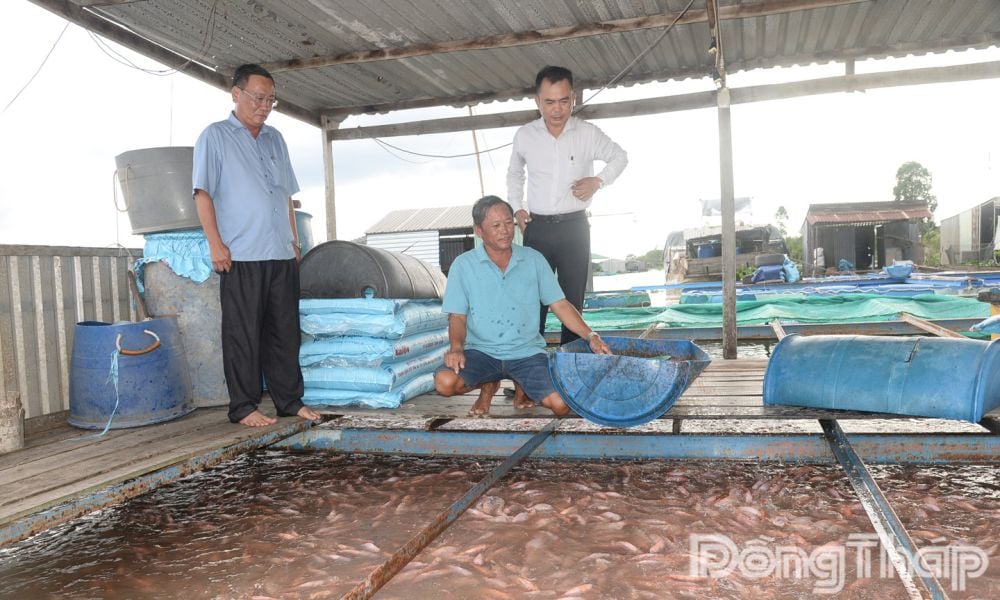
To reduce risks, Mr. De changed his production method to a "continuous staggered" farming model. Currently, his family maintains 6 rafts for raising red tilapia, with staggered stocking times to ensure year-round harvesting instead of harvesting all at once.
According to Mr. De, each raft is stocked with about 1 ton of fish fry, and after 6 months of care, it will yield more than 12 tons of marketable fish. The most important thing is to closely monitor the water environment and proactively handle diseases, especially in the current unpredictable weather conditions.
"Nowadays, fish farming can't rely solely on experience; it requires applying techniques and constantly updating environmental information to minimize risks," Mr. De shared.
Notably, fish farmers in Thoi Son have undergone a significant shift in their production mindset. Households are proactively linking up and sharing information about water quality, diseases, and markets through communication groups to respond promptly to any challenges.
In addition, the people also receive support from the Farmers' Association and local authorities in the form of preferential loans and technical training, gradually improving the quality of their products towards safety and meeting market demands.
A SUSTAINABLE PATH FROM ORGANIC COCONUTS
Not only on the water's surface, but also in the riverside areas of Thoi Son, many farmers are boldly switching to high-quality crops.
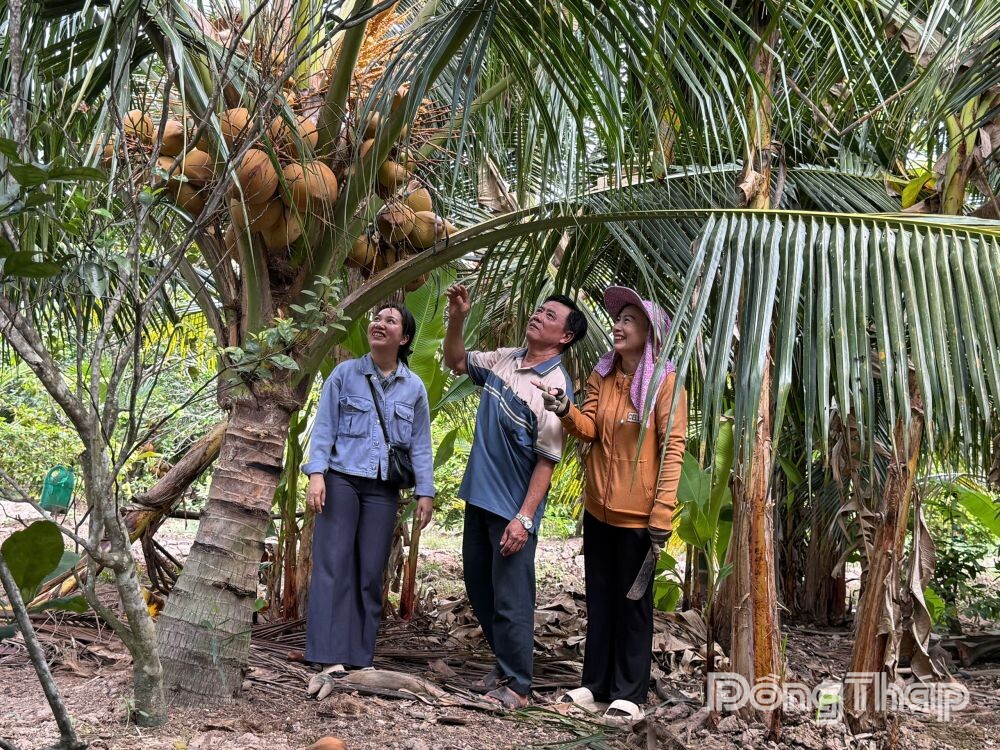
Previously, they switched to growing red Malaysian coconuts for export.
With over 4.6 acres of land in Thoi Binh neighborhood, Ms. Nguyen Thi Le Hoa has converted the entire area of her former mixed garden to growing red Malaysian coconuts for export.
After attending training courses and visiting successful models in many localities, Ms. Hoa realized that this coconut variety was suitable for the local soil conditions, was less susceptible to pests and diseases, and had a stable market, so she decided to invest in its development.
Notably, she steadfastly chose organic farming methods instead of overusing chemical fertilizers and pesticides. The entire garden uses microbial organic fertilizers combined with biological methods to control pests and diseases.
As a result, the soil in the orchards becomes increasingly fertile, the trees grow steadily, the fruits have beautiful colors, a sweet and refreshing taste, and meet the phytosanitary requirements for export.
Currently, her coconut garden yields an average of over 1,300 coconuts per month, selling for approximately 110,000 VND per dozen (12 coconuts), providing a fairly stable income.
According to Mr. Nguyen Minh Tri, Head of Thoi Binh neighborhood, based on the success of Ms. Hoa's model, the local authorities are encouraging people to cooperate in the production of red Siamese coconuts and Malaysian coconuts according to standardized technical processes to form a stable raw material area for export.
MULTI-VALUE INTEGRATION
Not content with simply increasing the value of agricultural products, many farmers in Thoi Son are boldly combining agricultural production with ecotourism and experiential activities to generate additional income. A prime example of this approach is the model of Mr. Nguyen Van Thanh Son.
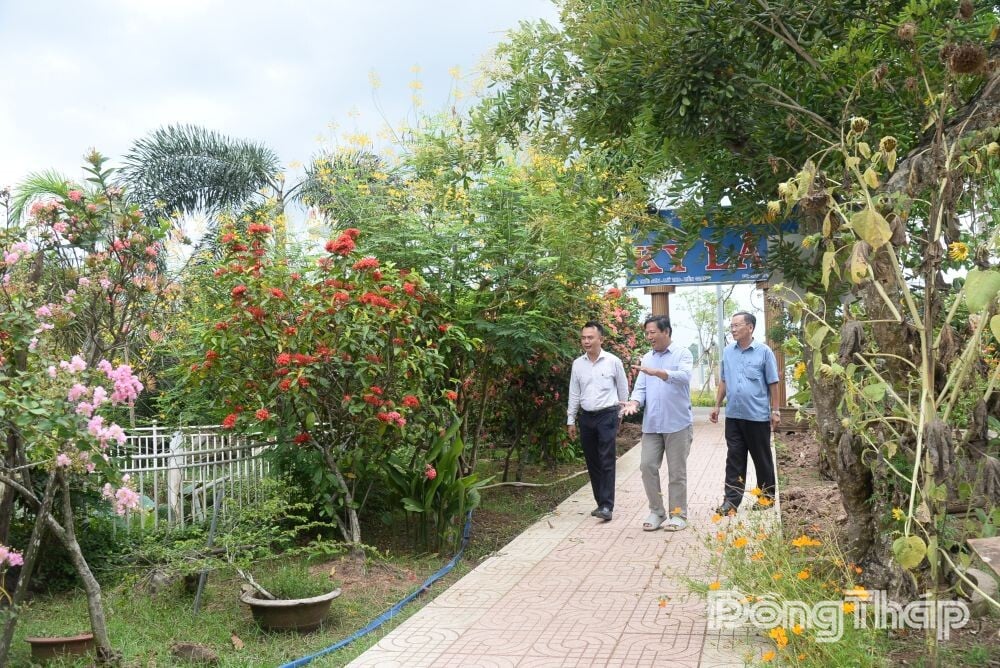
From a rented garden over 20 years ago, he has transformed it into a lush green eco-tourism destination with various fruit trees and beekeeping for honey production.
This model creates a highly effective circular ecosystem. The fruit trees provide flowers for the bees, while the bees help increase pollination and improve fruit quality.
However, the greatest value lies in the fact that Mr. Son has transformed the entire production process into an experiential tourism product. Here, visitors can tour the orchards, pick the fruit themselves, observe the honey harvesting process, and enjoy the product right on the spot.
According to Mr. Son, selling only raw agricultural products results in low profits and heavy reliance on market fluctuations. However, combining it with experiential tourism significantly increases the value of agricultural products. "Tourists don't just buy fruit or honey; they buy experiences and emotions. That's how we make our local agricultural products more valuable," Mr. Son shared.
His business model currently attracts a large number of domestic and international customers, contributing to promoting the image of the Mekong Delta region to tourists.
Here, visitors can tour the orchards, pick their own fruit, learn about the honey harvesting process, and enjoy the product on the spot. The lush green space, close to nature, and the genuine hospitality of the people of the Mekong Delta have created a unique appeal for this model.
Ms. Tran Thi Hue, a tourist from An Giang , shared: “I really like this model because it allows me to relax while learning more about the lives of farmers in the Mekong Delta. The fruits and honey here are delicious, and the atmosphere is peaceful and welcoming.”
Not only does it attract domestic tourists, but the model also impresses many international visitors. Vergel, a tourist from the Philippines, said he was particularly impressed with how the people of Thoi Son combine agricultural production with experiential tourism.
It is evident that the outstanding characteristic of Thoi Son farmers today is their bold shift in production mindset, knowing how to exploit multiple values on the same cultivated area instead of focusing solely on yield.
Green economic models linked to ecotourism not only contribute to increasing people's income but also create a positive effect on rural economic development, landscape preservation, and maintaining the cultural identity of the riverine region.
According to Nguyen Ngoc Phuc, Chairman of the Thoi Son Ward Farmers' Association, the locality is focusing on supporting people in accessing preferential loan sources, transferring science and technology, and connecting with businesses to expand markets for their products.
At the same time, the locality is also aiming to standardize its key products according to the OCOP program, improving the quality of agricultural products to meet the requirements for official export.
The dynamism, creativity, and innovative spirit of the farmers in Thoi Son today are opening up new directions for agriculture in Dong Thap.
It is no longer agriculture based solely on resource exploitation or production, but rather knowledge-based, green, and multi-valued agriculture – where the economy, environment, and culture coexist in sustainable development.
MORNING
Source: https://baodongthap.vn/thay-doi-tu-duy-nang-cao-hieu-qua-san-xuat-a241362.html
![[Photo] Life on both banks of the river returns to its bustling pace on the day the Long Bien Bridge opens to traffic.](https://vphoto.vietnam.vn/thumb/1200x675/vietnam/resource/IMAGE/2026/05/28/1779949763708_cau-long-bien-minh-duy-7-3610-jpg.webp)


![[Photo] The heat at the fireworks display site on the opening night of the Da Nang International Fireworks Festival 2026](https://vphoto.vietnam.vn/thumb/1200x675/vietnam/resource/IMAGE/2026/05/27/1779889741485_ndo_br_z7872039145157-fecaba5112f39e8352544099d7ef4738-5140-jpg.webp)





























































Comment (0)