

DNVN - NASA is taking another important step in understanding the deep mysteries of the Sun through the Parker Solar Probe, a spacecraft designed to get as close as possible to the central star of the solar system.
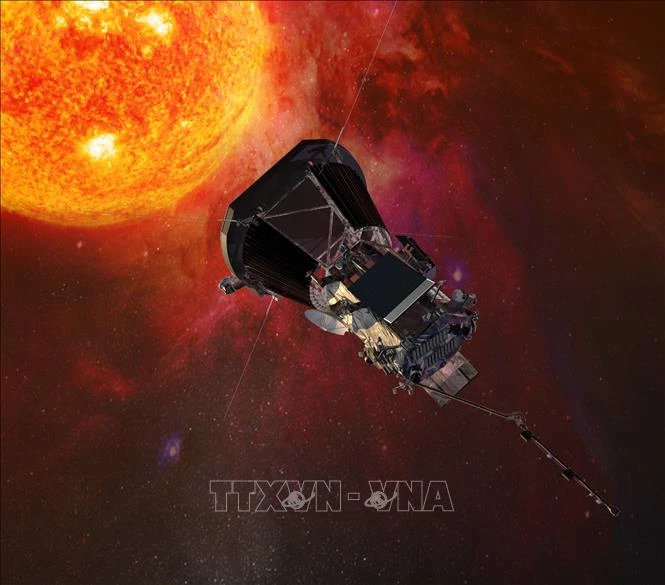
Launched in 2018, the Parker Solar Probe made its way through the corona – the outermost layer of the Sun's atmosphere that can only be observed during total solar eclipses.
On December 24th, the spacecraft is expected to set a remarkable milestone by crossing a record distance of just 6 million kilometers from the Sun's surface. Joe Westlake, a NASA expert, shared: "To put it simply, if you consider the Sun and Earth to be at opposite ends of a football field, Parker would be only about 3.6 meters from the Sun."
However, the mission control team will have to wait a few more days after the flight to receive a signal, because at its closest range, the spacecraft will be out of communication range.
This spacecraft was built to withstand the most extreme conditions. The Parker Solar Probe approached the Sun at least seven times closer than any previous spacecraft. At its closest approach, it traveled at a speed of 690,000 km/h, becoming the fastest man-made object ever built. To protect its internal systems, the spacecraft is equipped with a heat shield capable of withstanding temperatures up to 1,371 degrees Celsius, enough to melt many common metals.
More than just a marvel of space technology, the Parker Solar Probe mission also promises to unlock new insights into the Sun, such as why the solar corona is hundreds of times hotter than the Sun's surface, or what causes the solar wind – a high-speed stream of charged particles that affects the magnetic field and climate of near-Earth space.
These issues are not only theoretical but also have significant practical value. Powerful solar storms have the potential to disrupt radio communications, affect power grids, and impair the operation of satellites in orbit.
This star, despite being the source of life on Earth, also undergoes an 11-year activity cycle, including a period of peak activity. Currently, the increased activity of the Sun has created brilliant auroras in many places on the planet.
Westlake compared it to the sun, saying, "The sun is the friendliest neighbor, but sometimes it gets angry."
The Parker Solar Probe is expected to continue orbiting the Sun at this close distance until at least September 2025. Researchers expect the spacecraft to bring back more important data to better understand the structure and nature of the most important star in the solar system.
Linh Chi (compiled)
Source: https://doanhnghiepvn.vn/cong-nghe/nasa-va-su-menh-lich-su-kham-pha-mat-troi/20241224093805301




































































![[Photo] Hue: Admire the 2.4 trillion VND sea bridge, the longest in Central Vietnam.](https://vphoto.vietnam.vn/thumb/402x226/vietnam/resource/IMAGE/2026/05/24/1779614018347_anh-man-hinh-2026-05-24-luc-16-13-29.png)












































Comment (0)