

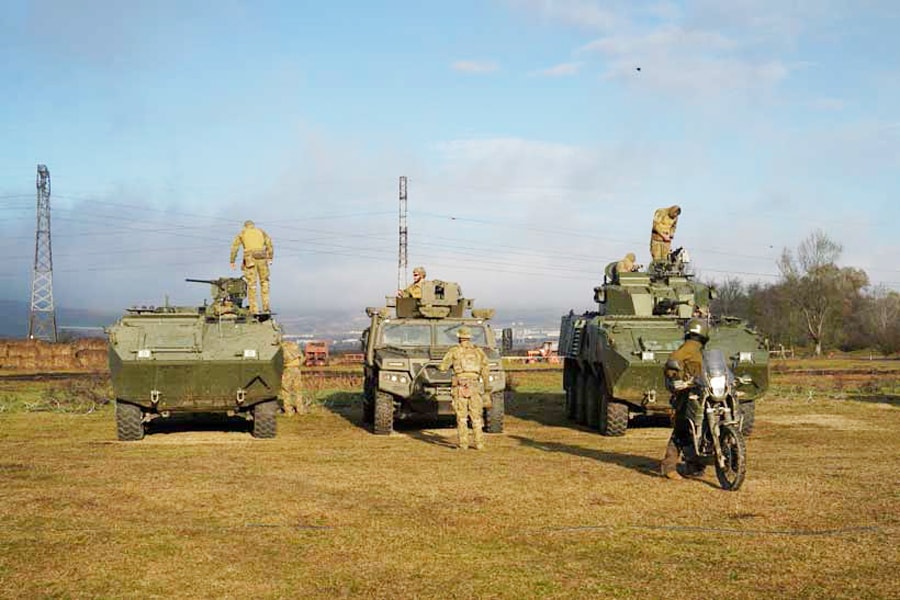
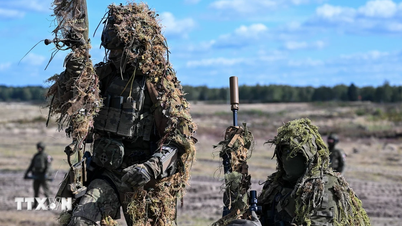
The German-Dutch Corps, based in Muenster, Germany, will officially assume the role of operational command from the middle of this year. Currently, all NATO forces in the three Baltic states of Estonia, Latvia, and Lithuania, along with northern Poland, are under the command of the multinational Northeastern Command, located in Szczecin, Poland.
NATO military officials believe that establishing an additional corps command will help the alliance shorten the time it takes to deploy large-scale forces to the Baltic region in the event of a security crisis. In other words, this move will enhance the ability to deploy large forces to the battlefield at a rapid pace – a factor considered particularly important in new defense plans.
According to its standard operational structure, the German-Dutch Corps would be one of NATO's largest multinational commands. When fully deployed, the corps could command three divisions, equivalent to approximately 40,000 to 60,000 soldiers. In peacetime, the corps does not maintain a full standing force but primarily operates as a command structure, with a core staff of officers and specialized units.
This system includes departments responsible for artillery, air defense, medical services, logistics, intelligence, electronic warfare, and communications. A notable feature is the corps model, which allows NATO to quickly transition from peacetime to wartime. In the event of a crisis, the command center can receive tens of thousands of troops and equipment from allied countries, organize coordinated operations, and deploy forces to the assigned area in a short time.
From NATO's perspective, the strengthening of the command system in the Baltic stems from assessments of the increasingly complex security environment in Europe. The alliance has repeatedly warned that Russia could restore significant military capabilities after the conflict in Ukraine and is capable of conducting large-scale military operations in the future.
According to many Western countries, Russia is accelerating the construction of military infrastructure in the Leningrad and Moscow Military Districts. Many new barracks are being urgently completed to accommodate military units expected to return from the Ukrainian battlefield after the conflict ends. However, these assessments have consistently been rejected by Russia. The Kremlin has repeatedly asserted that it has no intention of attacking NATO member states, while accusing the West of using the "threat from Russia" as a pretext for expanding its military presence in Eastern Europe.
For Moscow, NATO's addition of a corps command in the Baltic region is not only significant from a military technical standpoint but also signals that the organization is continuing to strengthen its military posture along Russia's borders in preparation for larger-scale confrontation scenarios in the future. Furthermore, many NATO member states have consistently increased their defense budgets to record highs in recent years. This context is likely to encourage Russia to further enhance its military capabilities in the region bordering NATO member states.
It is noteworthy that the actions of both sides risk creating a new cycle of military competition in Europe. As NATO strengthens its forces to bolster its deterrence capabilities, Russia will also seek to respond with corresponding measures to ensure strategic balance.
Against the backdrop of an unresolved conflict in Ukraine and a continued decline in strategic trust between Russia and the West, shifts in NATO's military structure in the Baltic region could increase feelings of confrontation between the two sides. While the risk of direct conflict remains low, the lack of effective dialogue and tension control mechanisms could lead to military actions from both sides that will make the European security environment more tense and unpredictable in the coming years.
Source: https://hanoimoi.vn/nato-tang-cuong-phong-thu-o-khu-vuc-baltic-buoc-dieu-chinh-cau-truc-quan-su-quy-mo-lon-976502.html
![[Photo] The General Secretary, President and his wife begin their state visit to the Philippines.](https://vphoto.vietnam.vn/thumb/1200x675/vietnam/resource/IMAGE/2026/05/31/1780230559452_anh-man-hinh-2026-05-31-luc-19-28-11.png)

![[Photo] Solemn bathing ceremony and Buddha procession in Hue](https://vphoto.vietnam.vn/thumb/1200x675/vietnam/resource/IMAGE/2026/05/31/1780228263543_1-jpg.webp)

![[Image] Hanoi Police officially crowned champions of V-League 2025/2026](https://vphoto.vietnam.vn/thumb/1200x675/vietnam/resource/IMAGE/2026/05/31/1780244769054_ndo_br_039d561b692be875b13a-jpg.webp)
![[Photo] Admire the coral "masterpiece" amidst the million-year-old heritage of Dak Lak province.](https://vphoto.vietnam.vn/thumb/1200x675/vietnam/resource/IMAGE/2026/05/31/1780221235105_anh-man-hinh-2026-05-31-luc-16-53-27.png)


















![[Video] Sunset at Lap An Lagoon – Where the sun sets over the fishing nets](https://vphoto.vietnam.vn/thumb/340x192/vietnam/resource/IMAGE/2026/05/31/1780192137701_beach-landscape-sea-water-nature-grass-745871-pxhere-com.jpeg)










































































Comment (0)