

Russia wants to strengthen mutually beneficial scientific cooperation in the Arctic region and is ready to consider proposals related to the Snowflake project.
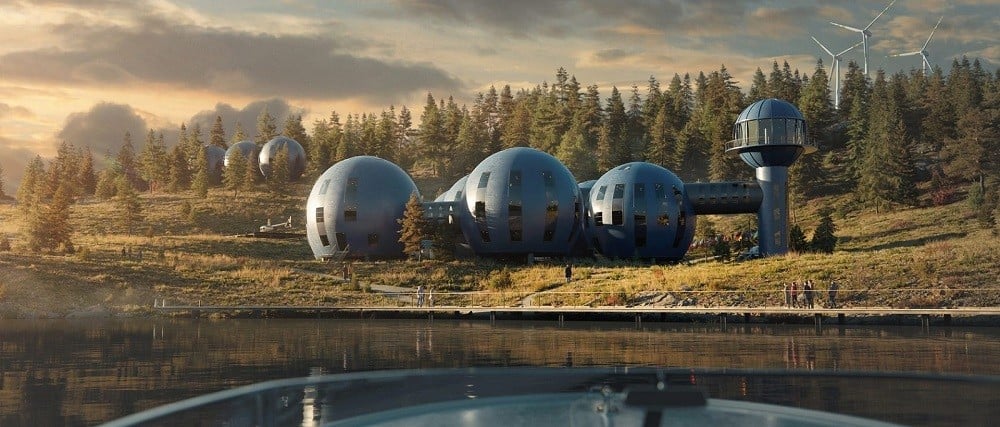 |
| Russia and China will cooperate on the Snowflake International Arctic Station project. (Source: arctic-mipt) |
On September 16, Russian Foreign Ministry Ambassador-at-Large Nikolai Korchunov announced that Russia and China are about to sign a cooperation agreement regarding the Snowflake International Arctic Station.
He stated: “A draft cooperation agreement has been agreed upon with China. The date and location for signing are being prepared. Interested scientific and educational organizations, as well as Chinese companies, are welcome to participate in this project.”
The Chinese Ministry of Science and Technology has now selected Harbin Institute of Technology as a partner with the Russian coordinating agency in the project.
Nikolai Korchunov stated that Russia wants to strengthen mutually beneficial scientific cooperation in the Arctic and is ready to consider feasible national proposals regarding cooperation on Snowflakes.
The Snowflake International Arctic Station (Snezhinka) is designed as a year-round research facility powered by renewable energy and hydrogen fuel. The station will comprise several interconnected dome-shaped buildings via walkways.
The buildings' location, viewed from above, resembles a snowflake. That's why the Arctic railway station project was given this name.
In related news, in an interview with the New York Times about relations with Russia, Finnish President Sauli Niinisto emphasized: "I'm not talking about a great friendship, but about the ability to be tolerant, even to understand each other a little."
The leader also added that trust is needed after the Ukraine conflict ends to ensure that "a new conflict does not wait behind the door."
Commenting on the risk of nuclear war, the Finnish president said that countries supplying weapons to Ukraine need to consider the possibility of the conflict escalating into "a bigger war, a world war."
He stated: “We are in a very sensitive situation. Even small things can change things drastically, and unfortunately, for the worse. That is the risk of large-scale war. The risk of using nuclear weapons is very high.”
Source















![[Photo] Prime Minister Pham Minh Chinh presides over the conference announcing the establishment of the International Finance Centre in Vietnam.](/_next/image?url=https%3A%2F%2Fvphoto.vietnam.vn%2Fthumb%2F1200x675%2Fvietnam%2Fresource%2FIMAGE%2F2025%2F12%2F21%2F1766309817714_ndo_br_dsc-3400-jpg.webp&w=3840&q=75)









































Comment (0)