


The State Bank of Vietnam is promoting Open APIs, paving the way for digital finance.
Within the framework of the technical assistance project “Promoting Inclusive Finance and Climate Financing” funded by the Asian Development Bank (ADB), the State Bank of Vietnam (SBV) organized the Fintech Networking Event, focusing on the theme “Data Sharing Towards Inclusive Finance and Innovation”. The event affirmed that data is a strategic resource to promote new business models such as Open Banking.
Mr. Pham Anh Tuan, Director of the Payment Department (State Bank of Vietnam), emphasized that the State Bank of Vietnam has long recognized the immense benefits of promoting data connectivity and interoperability to develop a digital ecosystem. This vision is clearly demonstrated in important documents including the Digital Transformation Plan for the Banking Sector until 2025 and, most recently, the Digital Transformation Strategy for the Banking Sector until 2030 (Decision 3579/QD-NHNN) and the Data Strategy for the Banking Sector until 2030 (Decision 3580/QD-NHNN).
The industry's consistent viewpoint is that "Data is the core foundation, a vital asset, and a strategic resource," and that "People and businesses are at the center."
The State Bank of Vietnam (SBV) has also built a solid legal foundation with the Law on Credit Institutions 2024, Decree 52/2024/ND-CP on non-cash payments, Decree 94/2025/ND-CP on controlled testing mechanisms (Sandbox), and especially Circular 64/2024/TT-NHNN on the implementation of open application programming interfaces (Open APIs). The Open API Circular creates a legal framework for establishing secure connections and interoperability between the banking sector and other sectors and fields.
The digital transformation strategy sets out the task of "Promoting research, integration, and expanded connectivity" to establish a digital ecosystem, aiming towards models such as Open Banking, Embedded Finance, and Banking as a Service (BaaS), in order to provide convenient, low-cost products. This is the direction for responsible data sharing, for the benefit of users.
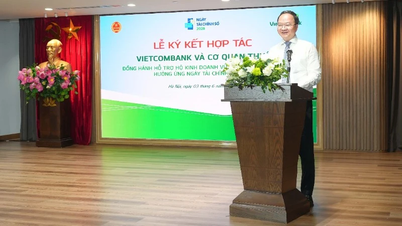
Sharing his practical experience, Mr. Pham Thanh Son, Deputy Director of the Information Technology Center at Vietnam Foreign Trade Commercial Bank ( Vietcombank ), said that Open APIs help banks connect with partners quickly, transparently, and in a controlled manner, creating a standardized data sharing flow, and are the foundation of an open financial ecosystem.
Responsible data sharing is a key solution to addressing financial inclusion, especially for the "credit-invisible" customer group (individuals without a credit history).
Modern credit scoring models are based on alternative data such as utility bills, mobile usage, and e-commerce. This expands access to credit for those with thin credit profiles and helps address the financing gap for small and medium-sized enterprises (SMEs) in Vietnam, which account for 95% of all companies. Global initiatives such as Accounts Aggregator (AA) and the Open Network for Credit Support (OCEN) are being explored to help lenders shift from collateral-based to cash-flow-based lending, which is crucial for SMEs.
Alongside innovation, the sustainability and security of payment systems are vital. The rise of digitalization and open APIs increases the impact surface of threats, such as major global disruptions or cyberattacks.
Therefore, building a sustainable payment system requires identifying critical business services, establishing risk tolerance thresholds (Risk Appetite), and developing crisis management plans for rapid response and recovery to maintain business operations and user trust.
The State Bank of Vietnam's Fintech networking event affirms that Vietnam is accelerating its digital transformation roadmap, with Open APIs and alternative data as key drivers for expanding inclusive finance, but this must always go hand in hand with security and a solid legal framework.
Source: https://vtv.vn/ngan-hang-nha-nuoc-day-manh-open-api-mo-loi-cho-tai-chinh-so-100251114191818287.htm



![[Photo] First session of the 14th Congress of the Vietnam Trade Union](https://vphoto.vietnam.vn/thumb/1200x675/vietnam/resource/IMAGE/2026/06/03/1780465947883_ndo_br_img-3852-jpg.webp)
![[Photo] General Secretary and President To Lam presides over a meeting with the Central Organizing Committee.](https://vphoto.vietnam.vn/thumb/1200x675/vietnam/resource/IMAGE/2026/06/03/1780482764658_a1-bnd-4741-3342-jpg.webp)
![[Photo] Secretary of the National Assembly Party Committee, Chairman of the National Assembly presides over the meeting of the Standing Committee and Executive Committee of the National Assembly Party Committee.](https://vphoto.vietnam.vn/thumb/1200x675/vietnam/resource/IMAGE/2026/06/03/1780480353201_ndo_br_bnd-2585-jpg.webp)














































![[Video] Sunset at Lap An Lagoon – Where the sun sets over the fishing nets](https://vphoto.vietnam.vn/thumb/1200x675/vietnam/resource/IMAGE/2026/05/31/1780192137701_beach-landscape-sea-water-nature-grass-745871-pxhere-com.jpeg)



























Comment (0)