

 |
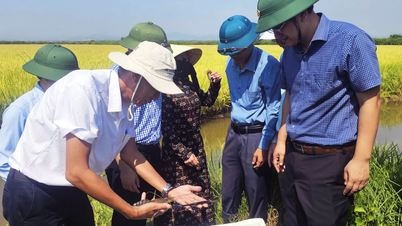
| Chrysanthemums are being planted in the rice paddies. Photo: Dao Tuan |
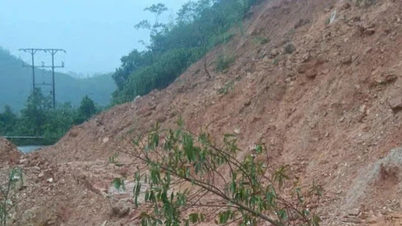
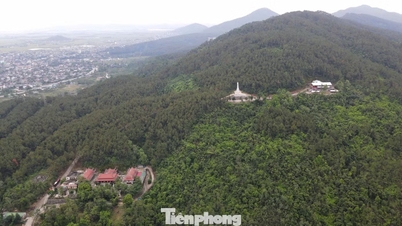
Cuc Duong is a mountainous commune located about 40km from the city. Most of the inhabitants are Tay ethnic people, nestled in an old-growth forest. The population is scattered, with only occasional stilt houses. From the city, following National Highway 1B to La Hien, after just a few kilometers, both sides of the road are lined with forest. Sunny days are manageable, but on rainy days, the road turns into a muddy mess. Cycling in this condition means carrying your bike on your shoulder for tens of kilometers. Perhaps the leaders anticipated a long-term stay and planned for a stable location? Later, the forestry department opened up roads for logging vehicles, making transportation much more convenient.
All the regional agencies, upon evacuation, were scattered throughout Cúc Đường commune and a few neighboring communes. Two agencies, the Department of Culture of the Viet Bac Autonomous Region and the Viet Bac Arts and Literature Association, were housed together in Bản Nhò, a remote and isolated area within the main base of operations. Here, all staff had to independently cut trees in the forest, gather reeds for roofing, and mix straw with earth to plaster walls, providing their own shelter. Although the huts were only a few meters apart, their location under ancient, densely packed trees—some so large a person could barely embrace them—gave them a sense of isolation. In the deep forest, it rained heavily. For months, the rain didn't stop, the air was damp, and for days on end, there was no sunlight. Unfortunately, each staff member only had a few sets of clothes, and with no place to dry them, they often had to wear clothes that weren't completely dry. There's nothing else we can do except hope that when we put it on, our body heat will absorb the moisture and it will dry itself.
Life for the staff in those days was difficult, so they had very few personal belongings. There were no cupboards or shelves, so all their blankets, sheets, and clothes were neatly folded on the headboard of their beds every morning. And it wasn't really a bed, though; it was just pieces of wood sawn and carved to make supports, with flattened bamboo and other similar materials used as a bed frame. Fortunately, because it was an agency involved in writing, each staff member was given a desk with drawers and a three-legged chair.
The Viet Bac Autonomous Region at that time comprised six provinces: Thai Nguyen, Tuyen Quang, Ha Giang, Bac Kan, Cao Bang, and Lang Son. Therefore, officials frequently had to travel between these provinces. The Viet Bac Arts and Literature Association published a magazine called "Viet Bac Arts and Literature," which was released every two months; the Department of Culture also published a bimonthly issue of the "Viet Bac Culture Newsletter." Regular contact with places like printing houses, post offices , and collaborators was quite difficult because all these agencies were scattered and sometimes tens of kilometers apart. Of course, transportation was by bicycle, but sometimes officials had to leave their bikes and walk because some agencies were located precariously on high hills. The work was therefore much more complicated than in the city, yet everyone adapted quickly, and there were no complaints.
At that time, the Viet Bac Literary Magazine had two editors: one was the writer Bui Cong Binh, formerly the editorial secretary of the Ha Giang Newspaper, and the other was the poet Quang Chuyen. Quang Chuyen was originally a student from Tuyen Quang who went to Thai Nguyen to study, graduating as valedictorian from the Viet Bac Teacher Training College. He wrote poetry while still a student, so two of his literature teachers, Khanh Kiem and Luong Thanh Nghia, who were also poets and members of the Viet Bac Literary Association, introduced him to the Association. Quang Chuyen was gentle, humble, and always willing to help others. He didn't know how to respond to jokes, only blushing shyly. I greatly appreciated Chuyen's helpfulness and love of reading, but unfortunately, we only stayed together in the Cuc Duong evacuation area for a short time because, at some point, he quietly donated blood to volunteer for the army. Even during a period of fierce warfare, after much persistence, his legitimate request was finally accepted by his superiors. Quang Chuyen left the Viet Bac Literary and Artistic Association to become a soldier in Regiment 132, building the North-South communication line along the Truong Son mountain range.
Life in the evacuation area back then was completely without electricity, radio, or telephones. During the day, besides the busy work, in the evenings, with nothing else to do, our cadres either went to bed early or simply played cards or chess to kill time. I'm sure few were as passionate about chess as the Tay writer Nong Minh Chau. Wherever there was a chess game, he was there; if he wasn't directly controlling the pieces, he would stand outside pointing and giving advice. Once, during a few days off, the San Diu poet Bang Bac Hai from the Literature and Arts Department of the Thai Nguyen Provincial Department of Culture cycled to the Viet Bac Literature and Arts Association's evacuation site to visit everyone. Being a skilled chess player himself, he accepted the invitation and stayed to play chess with Nong Minh Chau. The two men sat all night; even in the middle of the night, people could still see the flickering oil lamp and hear the clattering of chess pieces. The next morning, everyone still saw the two men half-asleep, sitting right next to the chessboard. And that wasn't all; they continued playing for almost the entire day. Writer Nong Viet Toai recounted that he called for lunch, but by noon, the two men still hadn't come to eat. He went to call them, but they were too engrossed in their game, saying, "Just leave it there, we'll eat it later." Fearing that the cook wouldn't see anyone else and would clear the food away, Mr. Toai had to painstakingly bring both meals back to their hut. Yet, by the afternoon, Mr. Nong Viet Toai still found the two meals untouched. Meanwhile, writer Nong Minh Chau and poet Bang Bac Hai were still engrossed in their chess game, forgetting to sleep and even forgetting to eat.
Deep in the forest, there are often periods of continuous rain, and the weather is always damp, so there are many snakes, insects, and other creatures. Once, I opened the drawer of my desk to get something, and there was a snake inside, I don't know how long it had been there. Seeing the movement, it immediately poked its head out, flicking its tongue and hissing as if about to lunge, making me recoil in fear. Luckily, the snake didn't attack me; instead, it quickly slithered across the desk, climbed onto the roof, and disappeared.
The Dao poet Tien Ban Tai Doan, Chairman of the Viet Bac Literary Association, was not so fortunate. One evening, returning from a meeting, he was almost at his hut when he was suddenly bitten on the leg by a snake. Unexpectedly, it was venomous. In excruciating pain, he groaned and fell to the ground. Fortunately, several people with him saw this and managed to help him up and carry him to his hut. Everyone gathered around, discussing how to treat him, but despite trying various methods, there was no improvement. Mr. Truong Lac Duong, a Tay poet who had recently transferred from the Editor-in-Chief of the Vietnam Independent Newspaper to become Vice Chairman of the Viet Bac Literary Association, even brought his newly raised chicks to try and suck out the venom. According to him, this was a local remedy. But even that didn't work. They had to use a tourniquet to prevent the venom from spreading. But then the bitten leg swelled up. The staff had to quickly carry him on a stretcher to the evacuation hospital several kilometers away. A day later, the old man's leg, instead of getting better, had swollen up to the size of a pillar, looking terrible. An order was given to take him to Hanoi urgently. That very night, I, along with Dr. Long from the Cadre Health Protection Department of the Zone, were assigned to accompany him in a command car. On the way, because the wound in his leg was so painful and the car was bumpy, I heard him groan a lot. I wanted to tell the driver to speed up, but what could I do? It was wartime, American planes were lurking day and night, so all vehicles on the road were kept hidden at night for safety. The car carrying him had to go very slowly. I heard his groans. Knowing the wound was causing him great pain, but not wanting to worry us, he tried to suppress his pain, only groaning very softly. We left in the evening, and it wasn't until the Vietnam National Radio's theme music started playing that the car finally arrived at the Vietnam-Soviet Friendship Hospital. As everyone knows, initially, because the bandage was too tight and left for too long, the wound had become gangrenous. With no other option, the hospital had no choice but to amputate one of his legs.
Sadly, in this mountainous region teeming with snakes and reptiles, the local ethnic people have extensive experience in treating snakebites. Yet, when poet Ban Tai Doan was bitten, he was not fortunate enough to receive timely treatment.
Source: https://baothainguyen.vn/van-nghe-thai-nguyen/sang-tac-van-hoc/202605/ngay-ay-o-cuc-duong-7a73f9c/
![[Image] "Journey of Hope" promotes the organ and tissue donation movement in Vietnam.](https://vphoto.vietnam.vn/thumb/1200x675/vietnam/resource/IMAGE/2026/05/20/1779294400833_1-8910-jpg.webp)
![[Photo] General Secretary and President To Lam works with the Party Committee of the Ministry of Health on the work of Vietnamese traditional medicine.](https://vphoto.vietnam.vn/thumb/1200x675/vietnam/resource/IMAGE/2026/05/20/1779294323718_a1-bnd-2978-3319-jpg.webp)
![[Photo] National Assembly Chairman Tran Thanh Man working with the Standing Committee of the National Assembly's Delegation Affairs Committee.](https://vphoto.vietnam.vn/thumb/1200x675/vietnam/resource/IMAGE/2026/05/20/1779294340023_ndo_br_1-1691-jpg.webp)

































































Comment (0)