

A nearly 400-year-old traditional craft village.
Phu Gia conical hat village (located in Phu Gia hamlet, Cat Tuong commune, Phu Cat district) is a source of pride for the people of Binh Dinh. This craft village has existed for nearly 400 years and is one of the oldest craft villages in Binh Dinh.
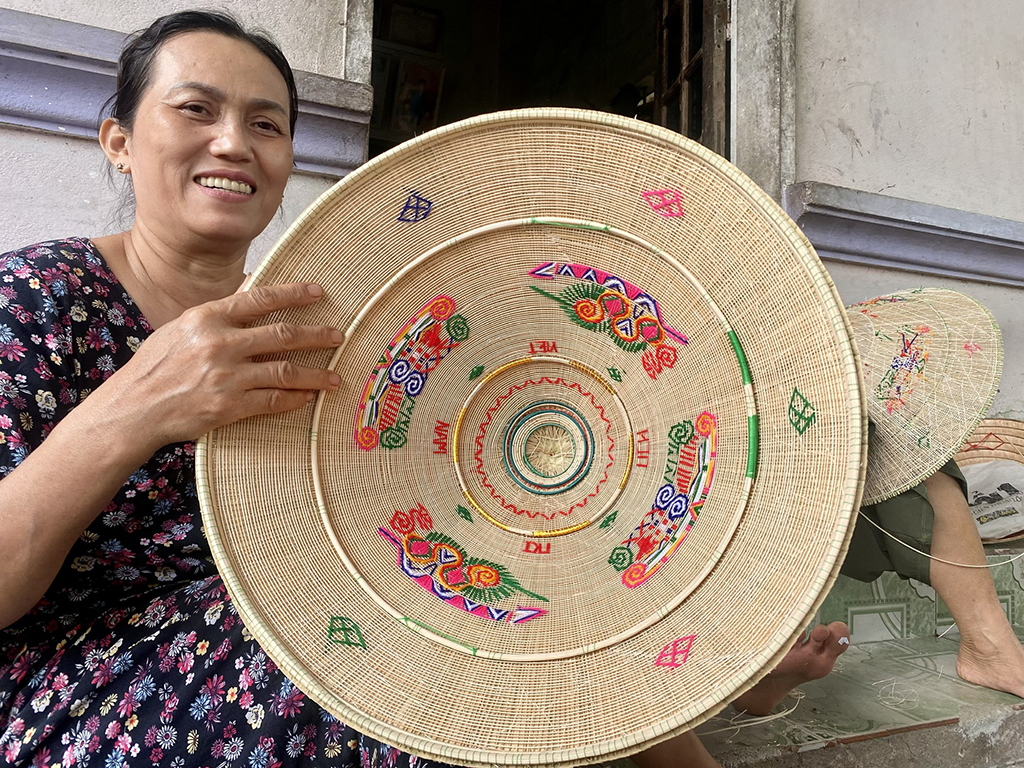
The horse-riding hats from Phu Gia craft village have very beautiful patterns.
The hat is called a horse hat because of its flexibility and durability, making it suitable for wearing while riding a horse. In the past, artisans here mainly made these hats for the king and officials to wear while on horseback. Especially during the reign of Emperor Quang Trung, the Phu Gia horse hat was closely associated with the swift Tay Son army.
The embroidered patterns on the horse-riding hats also varied, corresponding to the position and rank of each wearer. Later, before 1945, the image of village chiefs and district heads sitting on horseback, wearing silver-tipped horse-riding hats on the village roads, became a cherished memory in the rural areas of Binh Dinh.
While knitting the last of the conical hats to deliver to small traders in Hue for the Lunar New Year, Mrs. Phu Thi Bich Phong (from Phu Gia craft village) explained: "Phu Gia conical hats have a very special structure, making them extremely durable. The hats are made of 10 layers, and the materials used are naturally grown palm leaves from the mountains of Binh Dinh, bamboo, and pineapple roots. The palm leaves used for the hats must not be too old or too young; they are dried in the sun and dew to ensure they are both dry and have the necessary flexibility. The pineapple roots must be those that have been in the ground for 2-3 years, possessing good strength and elasticity."
Phu Gia horse hats are handcrafted through many elaborate steps, each requiring a different technique. Therefore, making the hats requires exceptional meticulousness; even one incorrect step can ruin the entire hat. When done well, the hat can last for 150-200 years.
Ms. Huynh Thi Hanh (65 years old, residing in Phu Gia craft village) cited: "Many horse-riding hats from 200 years ago are still preserved in Phu Gia village. Each generation of families making hats in Phu Gia, like the Lan family, keeps at least one pair of horse-riding hats (including a men's and a women's hat) as keepsakes."
Preserving the soul of the village
The days leading up to Tet (Lunar New Year) are also a busy time for those making horse-riding hats in Phu Gia village. Most of the hats are sold to Hue, because according to the people of Phu Gia, tourists visiting Hue during Tet love to wear the hats for photos, making them easy to sell.
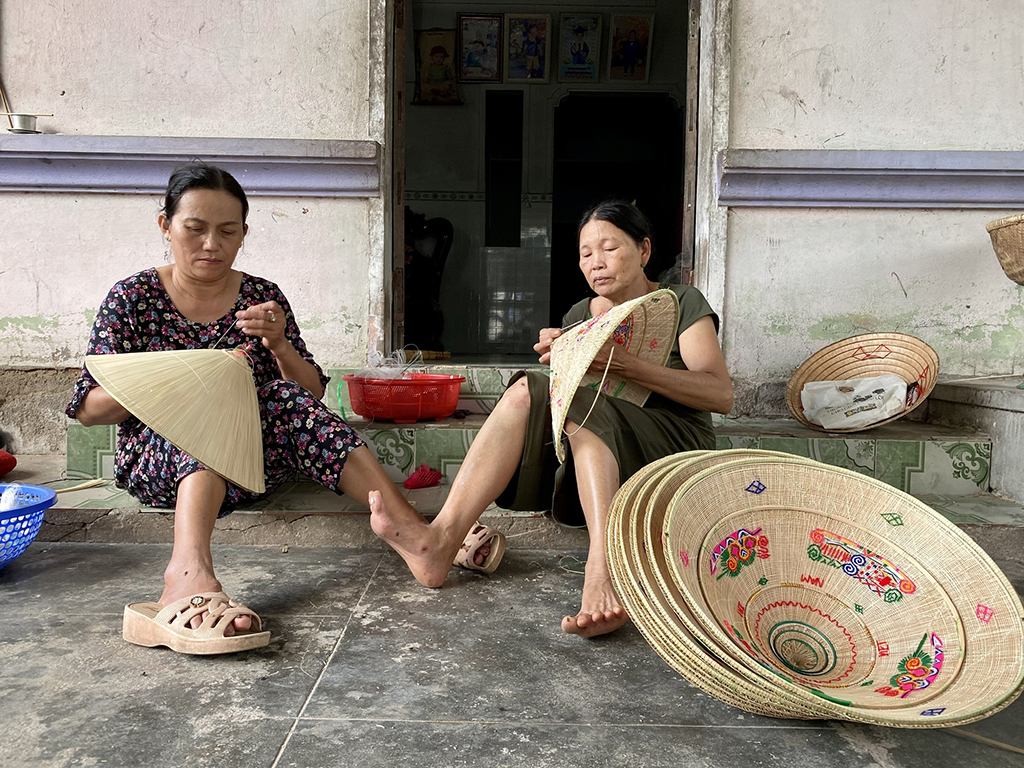
It takes more than a full day of continuous work to complete one horse hat.
Holding a conical hat in her hand, Mrs. Hanh explained that there are up to 10 steps in making a conical hat, from creating the frame to embroidering boats and attaching leaves… The patterns on the conical hats mostly feature images deeply rooted in Vietnamese culture, such as clouds, dragons, unicorns, turtles, phoenixes, lotus flowers, and wine gourds…
"It takes more than a day to finish one hat, even for people like me who have been doing this for decades. For those who do it less often or are not yet skilled, it takes 3-4 days, sometimes even a week," added Mrs. Hanh.
Despite the meticulous effort involved, each hat sells for only 200,000 - 300,000 VND. After deducting all expenses, each person only earns a little over 100,000 VND per day making horse hats. However, the biggest challenge remains finding buyers; only during major holidays are the hats easy to sell, allowing people to work day and night.
Ms. Bich Phong added: "Actually, we can only produce this much during the period leading up to Tet (Lunar New Year). On normal days, we rarely do it because we are facing many difficulties in finding buyers."
Both Ms. Phong and Ms. Hanh acknowledge that due to difficulties in finding buyers, fewer and fewer people are making conical hats. Now, most of the hat makers in the village are elderly. Preserving the traditional craft is also a challenge. However, when orders come in, the women in Phu Gia village still diligently make hats. For them, making hats is not only a way to increase their income, but also a way to preserve this traditional craft.
Currently, the Phu Gia horse hat making village has been recognized by the People's Committee of Binh Dinh province as a traditional craft village, achieving the title of Typical Vietnamese Craft Village and has been selected to build a model of a Vietnamese ethnic cultural and tourism village.
But after each Lunar New Year, the number of households making horse-shaped hats gradually decreases. This is a source of concern for the elderly people in Phu Gia village. (to be continued)
Orders for the Lunar New Year plummet, incense factory owner breaks down in tears: 'I wish the road ahead were easier.'
Source link


![[Video] Sunset at Lap An Lagoon – Where the sun sets over the fishing nets](https://vphoto.vietnam.vn/thumb/1200x675/vietnam/resource/IMAGE/2026/05/31/1780187239592_2222.jpeg)





















































































Comment (0)