

The flame of cải lương (Vietnamese traditional opera) will never die out.
In the spiritual life of the people of Southern Vietnam, cải lương (Vietnamese traditional opera) has always been an indispensable part of their culture. From Saigon-Chợ Lớn to the rural areas of the Mekong Delta, the sounds of the kìm and cò instruments, the rhythm of the song lang, and the poignant vọng cổ (traditional Vietnamese folk songs) have stirred and connected millions of hearts. At night, the theaters light up. Audiences jostle to buy tickets to see stage stars like Thanh Nga, Út Trà Ôn, Minh Vương, Lệ Thủy, Bạch Tuyết, Diệp Lang... perform. Traveling troupes traversing the waterways carry cải lương with them, as if carrying the very soul of the South.
Cai Luong (Vietnamese traditional opera) is a quintessential cultural heritage of Southern Vietnam. It embodies the essence of Southern Vietnamese folk music, traditional Southern Vietnamese songs, and modern theatrical art; it's a convergence of music , literature, acting, theatrical art, and the generous and compassionate philosophy of the Southern Vietnamese people. However, the development of modern life and the explosion of new forms of entertainment have caused Cai Luong to gradually lose its dominant position. Many theaters have closed, performing arts troupes operate at a reduced capacity, artists struggle to make a living, and theaters are sparsely attended. These difficulties stem from both market pressures and the Cai Luong stage itself. There's a lack of good scripts, outdated staging methods, and major works reflecting contemporary sensibilities. Many plays remain stuck in old motifs, failing to create a new, engaging theatrical language to appeal to younger audiences.
 |
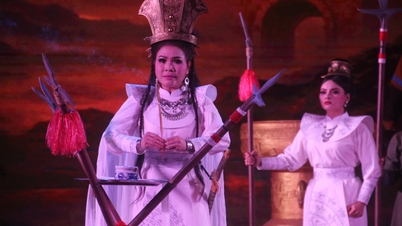
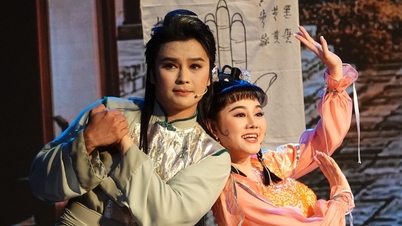
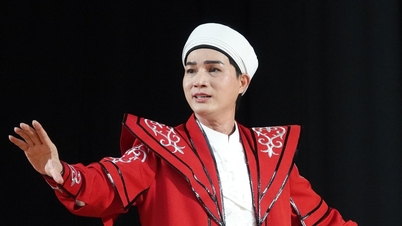
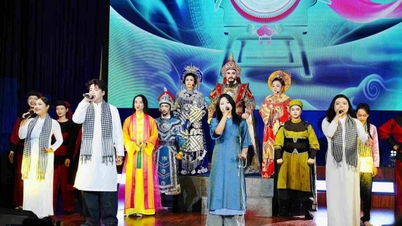
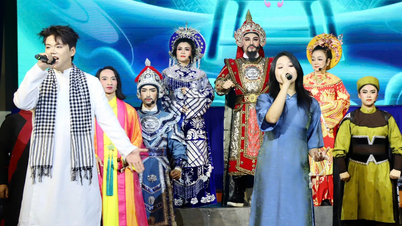
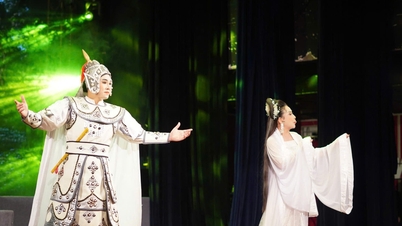
| The harmonious combination of singing, dancing, and the application of modern technology helps cải lương (Vietnamese traditional opera) appeal to the tastes of younger audiences. Photo: NGUYỄN LÊ |
This reality was once again clearly revealed at the 2026 National Cai Luong Actor Talent Competition. After 8 days of competition with 36 contestants from 12 professional art troupes, experts acknowledged the emergence of a new generation of energetic, skilled, and ambitious young actors who aspire to revitalize Cai Luong. However, many performances still relied on old formulas, both in script, staging, and acting. Some performances were overly reliant on props and stage costumes, leaving actors with insufficient space to express inner depth. This indicates that Cai Luong is lacking a sufficiently new and robust creative ecosystem: a lack of new scripts, a lack of commissioning mechanisms, a lack of young authors, and a lack of regular performance opportunities. This situation also shows that Cai Luong currently has significant gaps in the training, nurturing, and development of high-quality human resources. Current acting training is primarily based on small-scale, fragmented apprenticeships, lacking a systematic curriculum and a modern theoretical foundation.
However, looking deeper into the recent competition nights, we still see many encouraging signs. Despite the difficulties, cải lương (Vietnamese traditional opera) has never lost its flame. There are still young people choosing to follow this arduous path. There are still artists who persistently preserve the craft, passing it on to their descendants with a burning love for cải lương and a fervent enthusiasm...
Cai Luong (Vietnamese traditional opera) in the cultural industry ecosystem
In Ho Chi Minh City's ongoing cultural industry development strategy, performing arts are identified as one of the eight key cultural industries. Ho Chi Minh City aims to develop the cultural industry into a leading economic sector, contributing over 7.2% to the Gross Regional Domestic Product (GRDP) by 2030. The city has recently been recognized by the United Nations Educational, Scientific and Cultural Organization (UNESCO) as a Creative City in the field of cinema, a milestone that opens up significant opportunities for creative industries, including traditional theater.
Within that ecosystem, Cai Luong (Vietnamese traditional opera) cannot stand aside. Cai Luong is a cultural heritage, a resource with potential and strengths to create new value. In reality, programs combining Cai Luong with cultural tourism, pedestrian zones, or heritage experience activities have been attracting public attention, especially from international tourists. Many young artists are also beginning to bring Cai Luong to digital platforms, creating short video clips, traditional music videos, or online interactive programs to reach younger audiences. These are necessary directions in the digital age.
Ho Chi Minh City has many favorable conditions to become a center for the development of Cai Luong (Vietnamese traditional opera) within the cultural industry. The city is home to a large number of artists, has a system of theaters and art training schools, a large audience market, and a dynamic creative environment. In particular, city leaders have clearly identified cultural development as a strategic task alongside economic growth. In recent conferences, Comrade Tran Luu Quang, Member of the Politburo and Secretary of the Ho Chi Minh City Party Committee, emphasized the goal of making Ho Chi Minh City the first center for cultural industry development in the country. This necessitates the creation of cultural brands with unique identities. And Cai Luong is one of these brands rich in distinctive value.
A long journey requires a good horse.
The question of the vitality and future of traditional art, with the leading role of Cai Luong (Vietnamese traditional opera), is not a new one; it has been a cultural topic of interest for decades. Before the public's access to digital platforms, the socialized theater model in Ho Chi Minh City fueled the development of Cai Luong, allowing many Cai Luong artists to thrive, even become wealthy, thanks to their profession and fame. However, this very environment has also given rise to a problematic reality. Many Cai Luong artists rose to prominence because their "outside profession" was more prominent than their inside profession; Cai Luong became merely a pretext for them to venture into other art forms. After achieving fame, some went into acting in films and plays, while others became preoccupied with game shows... Their personal lives became comfortable, but the essence of Cai Luong in their blood gradually faded.
According to experts, cải lương (Vietnamese traditional opera) can only go far and become an important institution of the cultural industry when it is properly preserved and exploited in the right direction. All innovations and modernizations are merely forms, means to increase vitality, attractiveness, and convey the essence of cải lương. Therefore, we must say no to transforming cải lương into a facile, hybrid, "instant" entertainment product... Because what has given cải lương its vitality throughout the history of the Southern region is its humanistic depth and cultural identity. Cải lương is not simply singing and acting. It is the emotions, the spirit, and the fate of people in the upheavals of history and social life. If that essence is lost, cải lương will only be a stage shell modernized by technology. Therefore, innovation in cải lương must begin from artistic depth and be based on cultural identity. The effort to create new scripts that reflect the breath of contemporary life must preserve the aesthetic language of cải lương. The goal of searching for, nurturing, and training high-quality human resources is to create a generation of artists who are not only passionate and skilled but also possess modern, creative thinking.
In today's context, relying solely on a purely market-based mechanism makes it difficult for Cai Luong (Vietnamese traditional opera) to survive sustainably. This is a field that requires strategic investment from the State, especially in training, preservation, and the development of cultural institutions. Without talented artists, skilled authors, and a well-trained successor generation, the strategy for developing the cultural industry is difficult to realize. Therefore, competitions like the 2026 National Cai Luong Actor Talent Competition serve both as professional activities and as a platform for discovering, nurturing, and motivating the next generation of performers.
Discussing the position and direction of cải lương (Vietnamese traditional opera) within the cultural industry, many experts agree that what is most needed now is a synchronized ecosystem for cải lương. In this ecosystem, the State plays a policy-making role; theaters are creative centers; art schools train human resources; cultural enterprises participate in investment and promotion; and artists are the creative subjects. A mechanism for "special commissioning" cải lương works with high ideological and artistic value is needed. Investment in large-scale performances reflecting the times is necessary. Stable performance spaces should be established to ensure cải lương's regular presence in urban life. Simultaneously, cải lương should be boldly integrated into tourism and cultural festivals to broaden its audience. Furthermore, the application of digital technology is an urgent requirement. Building a digital database of Cai Luong (Vietnamese traditional opera), digitizing classic performances, developing online performance platforms, and promoting Cai Luong on social media are all tasks that need to be implemented systematically.
However, technology is merely a tool. The decisive factor remains the artistic quality and cultural integrity of the artist. Today's Cai Luong artists, in addition to their singing and acting skills, must possess political acumen, cultural knowledge, an integrated mindset, and a sense of responsibility towards their ancestral heritage. They must know how to innovate but not lose their roots. They must know how to adapt to modern life while preserving the spirit and essence of Southern Vietnamese culture. The vitality of Cai Luong lies not in flashy stage effects, but in its ability to touch the hearts of the public. When a single traditional song can still silence listeners amidst the hustle and bustle of urban life, when the characters portrayed on stage still evoke empathy and reflection, Cai Luong remains an essential part of the spiritual life of our people...
Source: https://www.qdnd.vn/van-hoa/doi-song/nghe-thuat-cai-luong-trong-cong-nghiep-van-hoa-1041678

![[Photo] Solemn bathing ceremony and Buddha procession in Hue](https://vphoto.vietnam.vn/thumb/1200x675/vietnam/resource/IMAGE/2026/05/31/1780228263543_1-jpg.webp)
![[Photo] The General Secretary, President and his wife begin their state visit to the Philippines.](https://vphoto.vietnam.vn/thumb/1200x675/vietnam/resource/IMAGE/2026/05/31/1780230559452_anh-man-hinh-2026-05-31-luc-19-28-11.png)

![[Image] Hanoi Police officially crowned champions of V-League 2025/2026](https://vphoto.vietnam.vn/thumb/1200x675/vietnam/resource/IMAGE/2026/05/31/1780244769054_ndo_br_039d561b692be875b13a-jpg.webp)
![[Photo] Admire the coral "masterpiece" amidst the million-year-old heritage of Dak Lak province.](https://vphoto.vietnam.vn/thumb/1200x675/vietnam/resource/IMAGE/2026/05/31/1780221235105_anh-man-hinh-2026-05-31-luc-16-53-27.png)











![[Video] Sunset at Lap An Lagoon – Where the sun sets over the fishing nets](https://vphoto.vietnam.vn/thumb/340x192/vietnam/resource/IMAGE/2026/05/31/1780192137701_beach-landscape-sea-water-nature-grass-745871-pxhere-com.jpeg)


























































Comment (0)