

 |
| In Vietnamese traditional theater, masks are a unique highlight that creates the soul of the performance. |
The painting
Coming from a family with a long artistic tradition, Meritorious Artist La Thanh Hung has not only achieved success through numerous performances but is also known as one of the few artists who master the technique of applying character masks in traditional Vietnamese opera. The son of the late artist La Chau, the last court opera artist of the Nguyen dynasty, Meritorious Artist La Thanh Hung began his acting career at the young age of 8 or 9.
He is very passionate about makeup and can do his own makeup. By watching the master makeup artists, he memorized, mastered the principles, and knew how to apply makeup to most of the masks for each character in Hue's traditional opera. Currently, he is considered the only person who can remember and meticulously draw every detail on each mask of hundreds of characters in dozens of Hue opera performances.
According to Meritorious Artist La Thanh Hung, in traditional Vietnamese opera, each character has a different mask. With three main colors—black, red, and white—each mask symbolizes the character's personality. A white face represents a villain; a red face represents heroic spirit and integrity; a black face represents toughness…
Meritorious Artist La Thanh Hung shared: “When creating masks for characters in traditional Vietnamese opera, I always keep in mind that no matter how successful the actor's performance is, if the mask isn't beautiful and doesn't match the character, the performance isn't successful. Each mask is a work of art connected to the character in the opera; whether the actor can convey the spirit of the character partly depends on the makeup artist. You have to understand the principles of drawing the molds for each mask and each character model to be able to create such elaborate makeup.”
The unique language of mask art is one of the core elements that contribute to the value of Hue's traditional theater art. Looking at a theater mask, the audience can discern the character's spirit – whether they are upright or sycophantic, representing good or evil. Therefore, the mask painter must possess skill, experience, and a deep understanding of the specific meanings of the patterns and motifs on each mask to convey the character and meticulous detail through each brushstroke.
Conveying the unique beauty of traditional Vietnamese opera.
Tuong (Vietnamese classical opera) is a unique traditional art form of the Vietnamese people. This art form appeared quite early, and during the Nguyen dynasty, it received even more attention and reached its peak as a theatrical art. Developing under special historical and political conditions, Hue's Tuong art possesses distinct characteristics compared to other regions. Hue's Tuong artists have secrets that create their unique features, which only those with deep understanding can recognize.
In Vietnamese traditional theater (Tuong), the art of mask painting is one of its distinctive and characteristic elements. Historically, mask painting in Tuong has been passed down orally and through imitation. Over time, due to a lack of understanding of the unique meaning in each detail of the patterns and brushstrokes, Tuong mask painters have gradually lost their traditional style and distinctive identity. Currently, very few young artists understand the techniques of painting Tuong masks.
According to Ms. Le Mai Phuong, Head of the Applied Research Department at the Hue Royal Court Traditional Arts Theatre, in the art of Tuong opera, the mask is the most important stage prop, a highlight that creates the soul and essence, conveying a unique beauty of this traditional theatrical art form. The faces in Tuong opera are also based on real-life models to create many different mask designs for each character.
Tuong (Vietnamese classical theater) stylized real-life skin tones to incorporate into the facial makeup of its characters: white skin, black skin, red skin, yellow skin… each with its own characteristic meaning. The white areas on the character's face represent the facial muscles. The brushstrokes in Tuong masks are often inspired by folk imagery such as dragons, unicorns, turtles, and phoenixes, symbolizing royalty, nobility, or strength and power. Tuong masks focus on the eyes to convey the character's spirit.
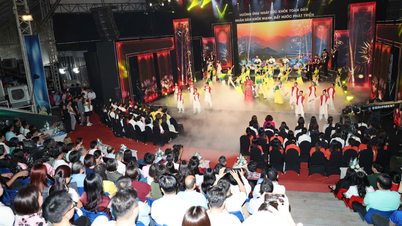
To introduce and honor Hue's traditional opera art, the Hue Royal Court Traditional Arts Theatre has crafted opera masks for public performances. In the "Echoes of the Past" program at the Hue Festival 2022, for the first time, a street performance of this ancient theatrical art form appeared, showcasing the beauty of the costumes and masks in vibrant and lively colors.
The highlight of the program is the artists and actors portraying 100 characters in traditional Vietnamese opera, using various costumes and masks to create a vibrant, colorful, and evocative portrayal of this once-popular art form. The masks reflect the diversity of character types, distinct personalities, rich colors, and balanced gender and age, fully depicting the characters in traditional opera, from leading female and male roles to flatterers and generals. Most of these masks were created by Meritorious Artist La Thanh Hung.
This year, the Hue traditional opera performance program "Echoes of a Thousand Years" will continue to be held within the framework of the Hue Festival 2023. Through these activities, the program organizers hope to create a vivid and engaging visual product that resonates with the audience, contributing to the honoring of national art and serving as the most practical way to preserve, protect, and promote the nation's cultural heritage.
Source
![[Photo] Prime Minister Pham Minh Chinh receives the Chinese Ambassador to Vietnam](https://vphoto.vietnam.vn/thumb/1200x675/vietnam/resource/IMAGE/2026/04/05/1775397481797_ndo_br_dsc-5512-jpg.webp)







































Comment (0)