

The loud alarm on his phone jolted Duc Phu awake, and at the same time, he realized the building he was in was shaking violently.
After his shift on New Year's Day, Duc Phu, a restaurant trainee in Kanazawa City, Ishikawa Prefecture, central Japan, returned to his apartment on the 7th floor to catch up on sleep. Around 4 PM on January 1st, Phu woke up feeling a slight tremor, but seeing that his phone hadn't sent any alert signals, he went back to sleep.
A short while later, a second tremor occurred, the strongest of the approximately 155 earthquakes that struck western Japan on the first day of 2024. At this point, Phu's phone rang loudly, broadcasting an urgent earthquake warning of magnitude 7.6.
"The building I live in shook violently, terrifying me. The alarm bells only added to my panic; all I could do was cling to the wall and recite Buddhist prayers," Phu recounted to VnExpress .
The tremors temporarily stopped, and Phu rushed out of the house, but the elevator had stopped working, forcing him to run down the emergency stairs from the 7th floor to the ground.
Phu ran out into the street and saw many people gathered outside in panic, due to the successive tremors occurring every 20-30 minutes. When the ground stopped shaking, Phu risked going back inside, grabbing important documents and essentials, stuffing them into his bag, and then rushing back out into the street.
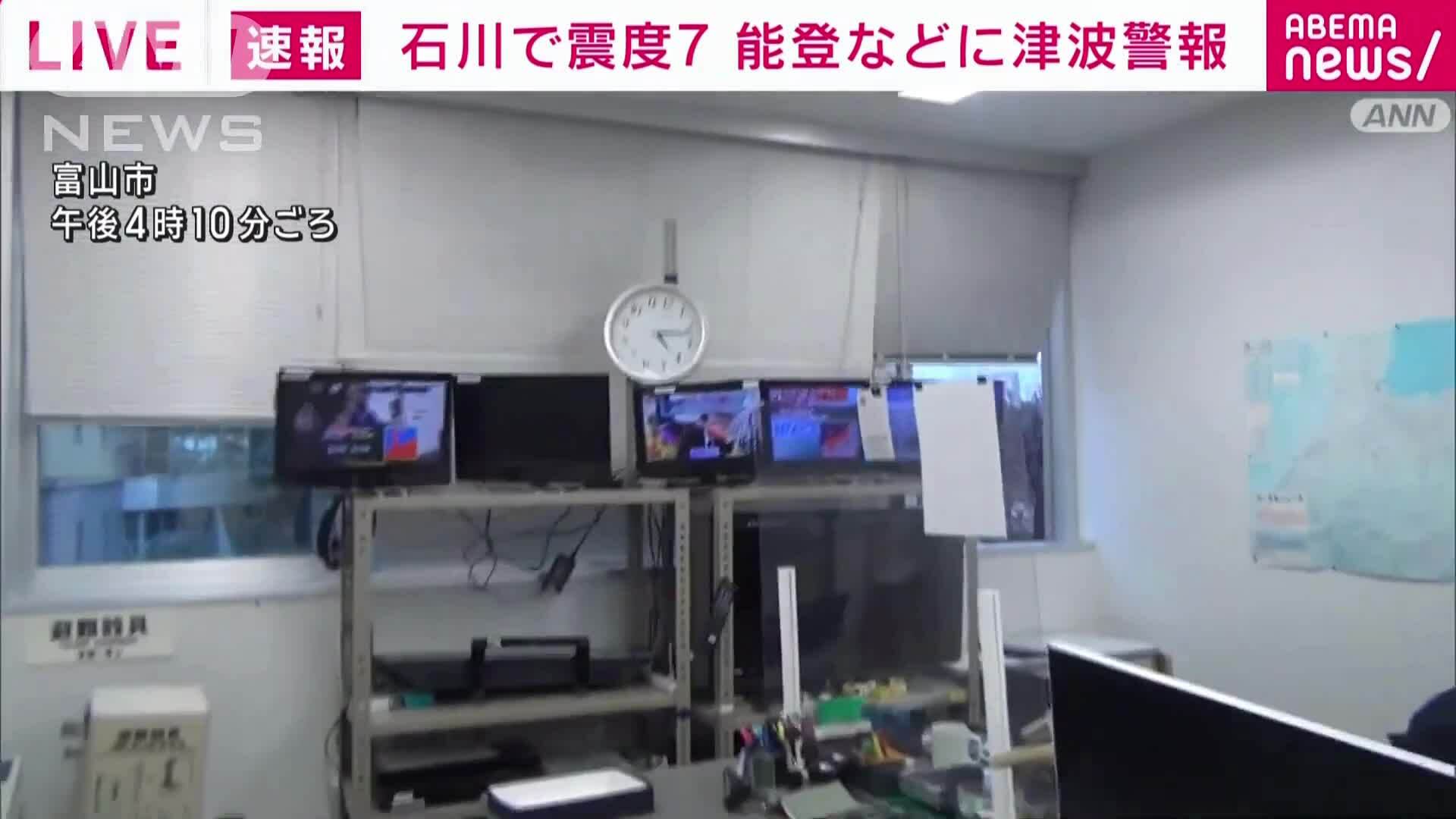
Severe tremors as earthquake strikes Japan on January 1st. Video : Reuters, Kyodo, ANN
In Houdatsu Shimizu, Ishikawa Prefecture, a major tremor occurred while 34-year-old Tran Thi Trang was shopping at the supermarket. Feeling the ground shaking, Trang panicked, thinking, "I'm going to die." A few seconds later, she regained her composure and rushed towards the parking lot where her husband and young child were waiting. The distance from the supermarket entrance to the parking lot was only a few dozen meters, but it was difficult to navigate due to the constant shaking of the ground.
"I was running while hearing screams in my ears, many people around me were falling over, unable to stand. Cars parked were swaying as if they were about to flip over," she recalled. "When I arrived, I couldn't get into the car right away either; I had to hold tightly to the door handle to steady myself. When I got into the car with my husband and children, my whole body was trembling with fear."
Following a series of strong tremors, the Japan Meteorological Agency (JMA) issued a tsunami warning for Ishikawa and four neighboring prefectures. Trang's family immediately drove home.
The country's television stations immediately switched to special programs. Along the way, the couple received constant warnings and saw many people driving in the opposite direction to reach the evacuation site, but they still decided to go home to gather some essentials.
The local refuge was a school, but it was near the sea, making it vulnerable to tsunamis. Trang's family, along with many other locals, had to move to higher ground.
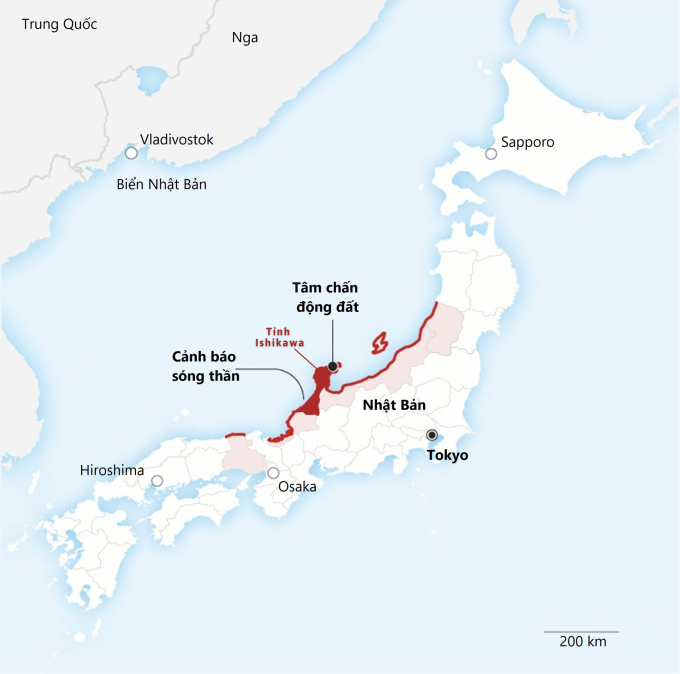
Location of Ishikawa Prefecture and tsunami warning zones in Japan. Graphic: CNN
Meanwhile, Duc Phu in Kanazawa contacted his company and, along with his colleagues, sought refuge. They flocked to convenience stores and found large crowds of locals already queuing.
"I had been in Japan for six years and had never encountered anything like this, so I followed the Japanese, thinking they knew what to do," Phu recounted. He and his colleagues then took refuge at the company director's private residence, 7 km away from their accommodation. Work at the restaurant had to be temporarily suspended because all the dishes had been broken.
Japanese officials confirmed today that at least 48 people have died in the earthquake, and the death toll could continue to rise. Tsunami warnings have been lifted, but at least six strong tremors were recorded this morning.
JIMA warned that more earthquakes could occur this week, especially in the next two to three days. Ishikawa Prefecture rarely experiences earthquakes; even many elderly residents say they have never felt tremors of this magnitude. "Even the director is panicked, only saying that we will have to adapt accordingly," Phu said.
Trang's family arrived home around 8 PM and had prepared all necessary supplies, ready to evacuate whenever a warning was issued.
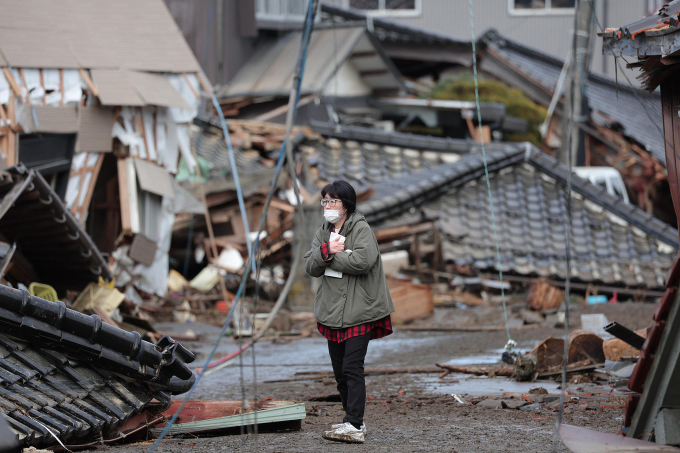
A woman returns to her home, destroyed by the tsunami and earthquake, in Suzu, Ishikawa Prefecture, on June 2. Photo: AFP
"My family has a car, but the interns and students who don't have transportation will face more difficulties," said Trang, a translator and administrator of a Vietnamese community in the Hokuru region, which includes the three prefectures of Ishikawa, Toyama, and Fukui, adding that there are about 200 Vietnamese people in the area.
Hoang Quan, an intern in Wajima, a city that suffered significant damage in Ishikawa Prefecture, was fortunate to escape the disaster as he had previously traveled to Hakusan to celebrate the New Year with friends.
The tremors occurred while the group was having their New Year's Eve dinner, causing the hot pot to tip over. Quân then received a call from his company, informing him that his house in Wajima had collapsed.
"I have to stay at a friend's house, and I don't dare go back to my hometown, so my work has come to a halt. Everything is very uncertain right now, I just hope there won't be any more tremors in the near future," he said.
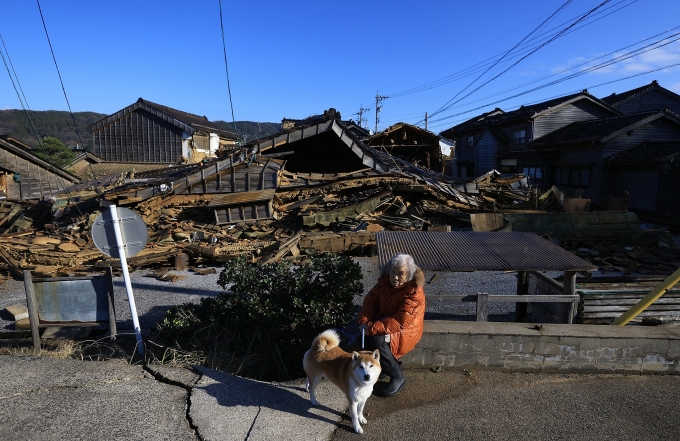
A woman and her dog sit in front of their house, which collapsed due to the earthquake, in Wajima city. Photo: AFP
Duc Trung
Source
![[Photo] Delegation attending the 14th Congress of the Vietnam Trade Union visits the Mausoleum of President Ho Chi Minh.](https://vphoto.vietnam.vn/thumb/1200x675/vietnam/resource/IMAGE/2026/06/03/1780451842301_ndo_br_img-3824-jpg.webp)


















































































Comment (0)