The Emergency Department of the Central Tropical Diseases Hospital (Hanoi) reported that the patient arrived at the hospital in a very serious condition. The patient's family stated that five days prior to admission, the patient developed blisters (the patient's younger sister had previously had chickenpox). Family members bought traditional medicine for the patient to take, but it didn't help, so they took her to a nearby medical facility. There, the patient was given dexamethasone (a corticosteroid with strong anti-inflammatory effects) in injectable form.

Photo: BVCC
After taking medication, the chickenpox suddenly worsened, with dense blisters appearing and a high fever of 40-41°C. The patient was unable to walk, had abdominal distension, constipation, and was taken to the provincial general hospital. Due to the very serious condition, the patient was transferred to the Central Hospital for Tropical Diseases, in a state of high fever of 41°C, blisters and many pustules all over the body (photo), mouth and throat ulcers, impaired consciousness, weakness in both legs, intestinal paralysis, and also showed signs of gastrointestinal bleeding, delirium, and agitation.
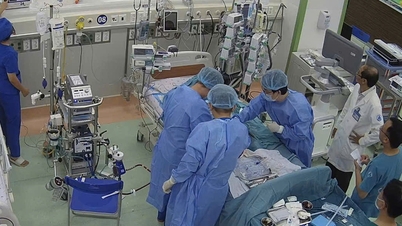
At the Central Hospital for Tropical Diseases, tests showed that the patient had severe blood clotting disorders, a drastically reduced platelet count, elevated liver enzymes, and organ failure.
Doctors diagnosed the patient with severe chickenpox with secondary infection, paralytic ileus, and a high risk of death. The patient received intensive treatment with intravenous acyclovir, antibiotics, correction of coagulation and bleeding disorders, respiratory support, and nutrition. After two weeks of treatment, the patient recovered well and was discharged from the hospital.
According to Dr. Tran Van Bac, Head of the Emergency Department at the Central Hospital for Tropical Diseases, chickenpox is an acute infectious disease caused by the Varicella Zoster virus, belonging to the Herpesviridae family. Chickenpox patients exhibit symptoms such as fever, body aches, loss of appetite, headache, muscle pain, and red, blister-like rashes on the skin and mucous membranes (mouth, eyes, urinary tract, etc.). The blisters usually appear on the head, face, and trunk first, then gradually spread to the rest of the body.
Chickenpox is transmitted directly from person to person through respiratory droplets (saliva, nasal secretions), through direct contact with chickenpox blister fluid, or indirectly through handling objects contaminated with blister fluid.
"The disease usually has a benign course. However, infants, pregnant women, immunocompromised individuals, or those taking immunosuppressant drugs are at risk of developing severe complications," Dr. Bac noted.
According to Dr. Bac, severe complications from chickenpox, such as severe pneumonia, encephalitis, meningitis, and arthritis, can lead to death. Pregnant women infected with chickenpox may experience an increased risk of miscarriage, premature birth, and especially birth defects. Therefore, when experiencing symptoms of chickenpox, patients should seek medical attention at a specialized healthcare facility for appropriate advice and treatment.
According to the Central Hospital for Tropical Diseases, when suffering from chickenpox, patients should not self-medicate with drugs of unknown origin and should carefully consider the use of medications containing corticosteroids to avoid the risk of severe complications.
Source: https://thanhnien.vn/nguy-kich-do-sai-lam-khi-dieu-tri-thuy-dau-185240512193949943.htm


![[Photo] National Assembly Chairman Tran Thanh Man attends the groundbreaking ceremony for the National Highway 1A spatial axis project.](https://vphoto.vietnam.vn/thumb/1200x675/vietnam/resource/IMAGE/2026/05/19/1779161360398_ndo_br_bnd-1412-jpg.webp)
![[Photo] General Secretary and President To Lam presides over a meeting on the implementation of Directive No. 34-CT/TW of the Party Central Committee.](https://vphoto.vietnam.vn/thumb/1200x675/vietnam/resource/IMAGE/2026/05/19/1779187768672_a1-bnd-2350-631-jpg.webp)

![[Photo] Capturing the moment the tide recedes at Yen Binh Son rapids - a million-year-old scenic spot in Quang Ngai.](https://vphoto.vietnam.vn/thumb/1200x675/vietnam/resource/IMAGE/2026/05/19/1779175463885_yen9-1199-jpg.webp)





















































![[Photo] General Secretary and President To Lam receives Indian Defense Minister Rajnath Singh](https://vphoto.vietnam.vn/thumb/402x226/vietnam/resource/IMAGE/2026/05/19/1779184046302_anh-man-hinh-2026-05-19-luc-16-46-58.png)


























Comment (0)