

It is this deliberate "deviation from the norm" that has made Du Sinh Church a unique architectural phenomenon for many decades, where the boundaries between East and West seem to be blurred, leaving behind a harmonious, tranquil, and profound space.

Du Sinh Church in Da Lat
PHOTO: MANH THI
When temples and pagodas "enter" the sanctuary.
According to documents in the History of the Diocese of Da Lat , Du Sinh Church, located on a hillside next to Huyen Tran Cong Chua Street (Cam Ly Ward - Da Lat, Lam Dong ), was started in 1956 and inaugurated on Christmas Day 1957. The bell tower was completed in 1962, giving the building its complete appearance. In March 2006, the church underwent major renovations, completed in May 2007, while still retaining its unique architectural features.
From afar, the church appeared distinctly different. Instead of the familiar soaring Gothic domes of Western cathedrals, it featured a curved tiled roof and ornate eaves reminiscent of ancient village communal houses. Right from the entrance, the three-arched gate, a familiar symbol in Vietnamese temple and pagoda architecture, opened up a space that was both solemn and welcoming.

The three-arched gate architecture, a characteristic feature of Vietnamese communal houses and pagodas, is clearly evident in Du Sinh Church.
PHOTO: LAM VIEN
The slope leading up to the cathedral is divided into several steps, flanked by sculpted, winding dragon figures. While in traditional culture, "two dragons worshipping the moon" is a familiar symbol, here, that image is transformed into "two dragons worshipping Saint Joseph holding the Child Jesus." A small detail, but enough to show the creativity and effort to harmonize folk beliefs with Christian faith.
Delving deeper into the main space, the striking feature is the bell tower standing in front of the hall, along with two statue towers on either side, forming a "second triple gate." The statue tower on the right houses Saint Dominic, and the one on the left Saint Francis. All are covered with curved tile roofs and soaring eaves—details rarely seen in Catholic architecture, yet deeply imbued with Vietnamese spirit.

The image features two sculpted dragons, winding and extending from the base up towards the bell tower.
PHOTO: LAM VIEN
Furthermore, the pillars inside and outside the church are adorned with balusters depicting bamboo, symbols of the resilience and fortitude of the Vietnamese people. The slender, upright bamboo stalks seem to support the entire space, creating a feeling of lightness yet solidity.
The corridors surrounding the church are decorated with interconnected circular "Longevity" characters, a familiar motif in traditional architecture. Inside, the main columns, shaped like golden bamboo, are also carved with biblical verses in Nôm script. This combination is not merely decorative, but also a declaration of cultural exchange, where faith is "localized" through the language and symbols of the Vietnamese people.

The system of pillars both inside and outside the church is adorned with bas-reed sculptures of bamboo and reeds.
PHOTO: LAM VIEN
Not only impressive for its architecture, Du Sinh Church also offers a unique, tranquil, and peaceful atmosphere amidst the bustling tourist city. Today, it is not only a place of religious worship for parishioners but has also become an attractive destination for tourists, especially international visitors.
THE MARK OF A REPUTABLE "MASTER ENGINEER"
According to the History of the Diocese of Da Lat , behind this unique architectural work lies the imprint of Father Thien Phong Buu Duong, who is considered the "chief architect" who brought Vietnamese culture into Du Sinh Church.
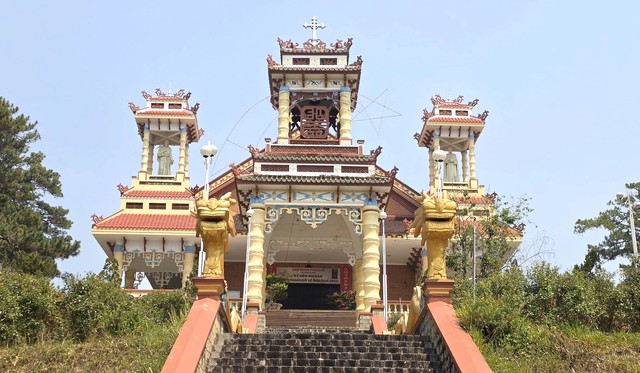
The Du Sinh church project reflects the open-minded and multifaceted perspective on religion and culture of Father Thien Phong Buu Duong.
PHOTO: LAM VIEN
Father Thien Phong Buu Duong, whose real name was Nguyen Phuc Buu Duong (1907 - 1987), came from the Nguyen dynasty royal family. He was the fifth son of Nguyen Phuc Ung Trinh and the grandson of Tung Thien Vuong. Growing up in a Confucian environment, he quickly gained a deep understanding of classical Chinese and Vietnamese literature, Eastern philosophy, and also studied Buddhism.
The turning point came in 1928, when he embraced Catholicism and joined the Cistercian Order in Phuoc Son ( Quang Tri ), later transferring to the Dominican Order and being sent to study in Lyon, France. In 1940, he was ordained a priest, and in 1945, he earned a doctorate in Theology.
Returning to Vietnam in 1951, he became the Superior of the Dominican Monastery in Hanoi and founded and served as the Rector of Minh Duc University in Saigon (in 1970). He adopted the pen name Thien Phong and left behind many famous works on philosophy, theology, and cultural studies such as: Philosophical Concepts , The Problem of Suffering , Commentary on the Four Books , etc.
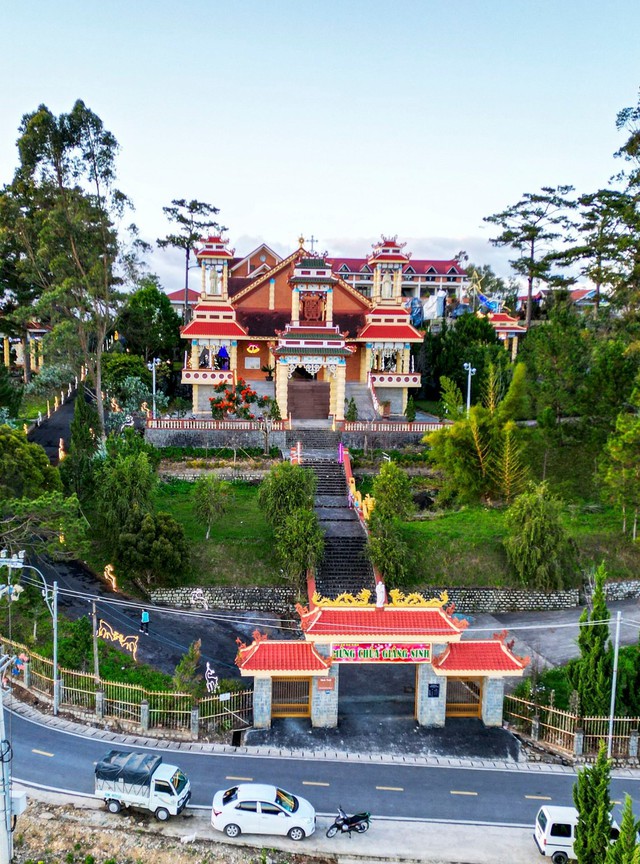
At first glance, Du Sinh Church resembles a Buddhist temple.
PHOTO: MANH THI
According to the History of the Diocese of Da Lat , stemming from the need to stabilize the spiritual life of the Du Sinh parishioners, Father Thien Phong Buu Duong initiated the construction of a church. But instead of choosing the familiar Western architectural style, he made a bold decision: to build a church deeply rooted in Vietnamese identity, a style he understood profoundly.
It wasn't a spontaneous act, but the result of a long journey of experience, from Confucianism and Buddhism to Catholicism, from Vietnam to Europe. He understood that for faith to take deep root in the hearts of the Vietnamese people, it needed to be expressed in the very language and culture of the nation.

Nearly 70 years have passed, yet Du Sinh Church still retains its unique character, becoming an indispensable part of Da Lat's cultural landscape.
PHOTO: LAM VIEN
Nearly 70 years have passed, and amidst the constant changes in Da Lat, Du Sinh Church still stands quietly, a witness to history, to migrations, and to the journey of searching for identity. The harmonious combination of Vietnamese communal houses and temples with Catholic churches not only creates a unique architectural work but also opens up a new perspective on religion: not in opposition, not separate, but capable of harmonizing and complementing each other. (to be continued)
Source: https://thanhnien.vn/nha-tho-mang-dang-dap-dinh-chua-doc-nhat-vo-nhi-o-da-lat-185260402213707908.htm

![[Photo] First session of the 14th Congress of the Vietnam Trade Union](https://vphoto.vietnam.vn/thumb/1200x675/vietnam/resource/IMAGE/2026/06/03/1780465947883_ndo_br_img-3852-jpg.webp)































![[Video] Sunset at Lap An Lagoon – Where the sun sets over the fishing nets](https://vphoto.vietnam.vn/thumb/1200x675/vietnam/resource/IMAGE/2026/05/31/1780192137701_beach-landscape-sea-water-nature-grass-745871-pxhere-com.jpeg)

























Comment (0)