

A new study published in the medical journal BMC Medicine has found the optimal bedroom temperature for heart health, especially in older adults.
In the study, Dr. Fergus O'Connor from Griffith University (Australia) assessed the impact of increasing nighttime bedroom temperature on heart rate and stress response, particularly in older adults, according to the medical news website Medical Express.
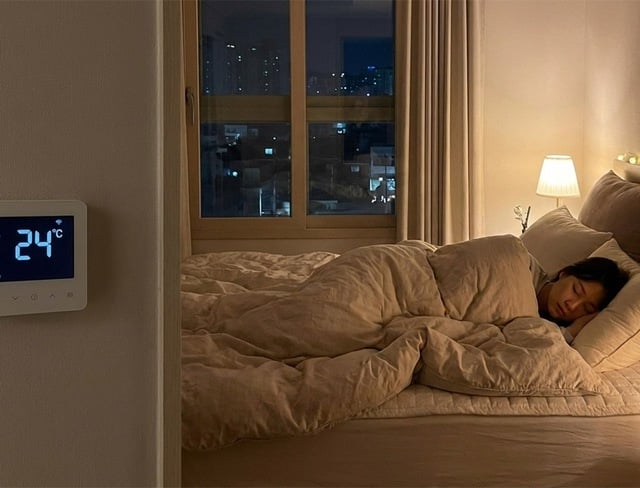
Maintaining the bedroom temperature at 24°C at night while sleeping helps reduce the risk of autonomic nervous system disorders and increased heart rate.
Photo: AI
Participants, aged 65 and older, wore devices that recorded their heart rate and heart rate variability during nighttime sleep periods from 9 PM to 7 AM the following morning, while sensors installed in their homes continuously measured bedroom temperature.
The findings revealed that maintaining a bedroom temperature of 24°C at night while sleeping helps reduce stress responses, thereby lowering the risk of autonomic nervous system disorders and increased heart rate in older adults, according to Medical Express.
Dr. O'Connor explains: When the human body is exposed to high temperatures, the normal physiological response is to increase heart rate. The heart has to work harder to try to circulate blood to the skin's surface to cool it down. However, when the heart has to work harder and for longer, it puts stress on the body and limits its ability to recover from the previous day's high-temperature exposure.
Dr. O'Connor concluded: For people 65 years and older, maintaining a bedroom temperature of 24°C overnight can help reduce the risk of experiencing increased stress responses during sleep.
While the World Health Organization provides guidance on a maximum indoor daytime temperature of 26°C, this study has now found the ideal nighttime temperature to be 24°C.
Source: https://thanhnien.vn/nhiet-do-phong-ngu-bao-nhieu-la-tot-nhat-cho-tim-185260112093318148.htm
































![[Photo] Reception to welcome General Secretary and President To Lam and his wife on their State visit to the Philippines](https://vphoto.vietnam.vn/thumb/1200x675/vietnam/resource/IMAGE/2026/06/01/1780295488620_vna-potal-chieu-dai-chao-mung-tong-bi-thu-chu-tich-nuoc-to-lam-va-phu-nhan-tham-cap-nha-nuoc-toi-philippines-8798060-7855-jpg.webp)



































































Comment (0)