

1982: Israel occupies Lebanon, Hezbollah is born.
Hezbollah emerged after Israel's 1982 attack on Lebanon in the Bekaa region of eastern Lebanon. By 1985, Hezbollah had established the Islamic Resistance in Lebanon as the spearhead in the fight against Israel.
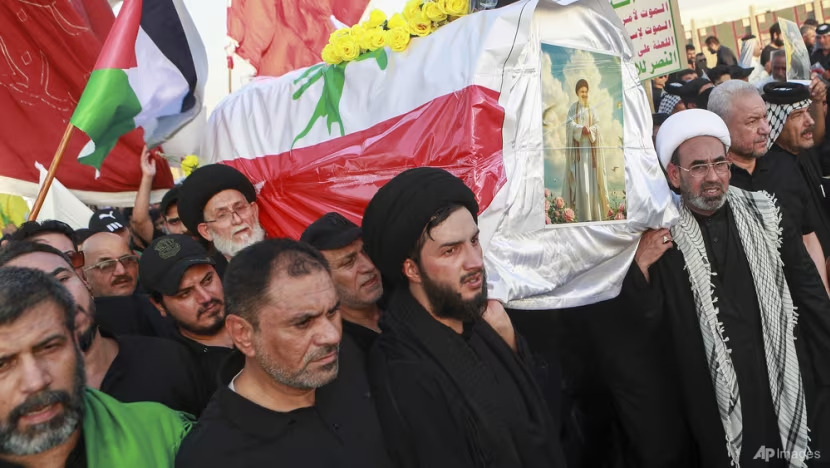
Shiite Iraqis held a symbolic funeral for Hezbollah leader Sayyed Hassan Nasrallah, who was killed in an Israeli airstrike in Beirut. Photo: AP
This group carries out suicide car bombings and attacks in the south targeting Israeli forces and their ally, the Southern Lebanon Army (SLA), a predominantly Christian militia.
1992: Nasrallah became the leader of Hezbollah.
In February 1992, an Israeli attack by combat helicopters killed the then-Secretary-General of Hezbollah, Sheikh Abbas al-Musawi.
At just 32 years old, Hassan Nasrallah was elected as the successor. A year later, Hezbollah fought against Israel's massive 7-day offensive in Lebanon, known as "Operation Incrimination," with three objectives: to defeat Hezbollah, destroy its hideouts, and expel Palestinian refugees to pressure Lebanon into punishing Hezbollah.
Hezbollah is the only group that has refused to lay down its weapons since Lebanon's 15-year civil war ended in 1990.
1996: Operation "The Grapes of Resentment"
On April 11, 1996, Israel launched Operation Grapes of Wrath, an offensive aimed at disrupting Hezbollah's military capabilities and preventing missile strikes on northern Israel.
Over 17 days, Israeli forces conducted 600 raids and fired 23,000 artillery shells, killing 175 people in Lebanon, mostly civilians. More than 300,000 refugees were forced to leave their homes.
International calls for a ceasefire intensified after shelling targeted a United Nations refugee camp where civilians were fleeing for shelter. More than 100 people were killed.
On April 26, an agreement was signed ending Israel's operations.
2000: Israel withdraws from Lebanon
The Israeli army withdrew in May 2000 after years of occupation aimed at ending the unrest, a move that cost them 1,000 men.
Nasrallah is considered to be behind this de-escalation, after the war of attrition waged by Hezbollah caused Israel to change its stance.
This pressure also led Israel to accept a 1998 United Nations Security Council resolution demanding its immediate withdrawal of troops from southern Lebanon.
2006: Israel-Hezbollah War
In 2006, Hezbollah captured two Israeli soldiers at the Israel-Lebanon border. Hezbollah stated that they wanted to exchange the two soldiers for prisoners held inside Israel, but this resulted in war.
The conflict lasted from July to August and resulted in 1,200 deaths in Lebanon, mostly civilians, and 160 in Israel, mostly soldiers.
Israel cannot defeat Hezbollah, a force that views this conflict as a victory.
2023-2024: New conflicts expand.
When the Israel-Hamas conflict broke out in the Gaza Strip on October 7, 2023, Hezbollah forces in southern Lebanon opened fire on Israel in support of Hamas.
After nearly a year of cross-border fighting, on September 23, Israel significantly escalated its deadly airstrikes against Hezbollah in Lebanon, citing the need to end attacks on Israel from southern Lebanon.
The Israeli military says it has killed most of Hezbollah's top leaders. Hezbollah leader Sayyed Hassan Nasrallah was killed in an airstrike on the group's southern Beirut stronghold.
Ngoc Anh (according to AFP)
Source: https://www.congluan.vn/israel--hezbollah-cuoc-chien-qua-nhieu-thap-ky-post314581.html
![[Photo] General Secretary and President To Lam presides over the meeting to approve the draft report on the results of the second inspection by the Politburo of the Standing Committee of the Hanoi City Party Committee.](https://vphoto.vietnam.vn/thumb/1200x675/vietnam/resource/IMAGE/2026/05/26/1779789811432_a2-bnd-4430-9620-jpg.webp)




















































































Comment (0)