

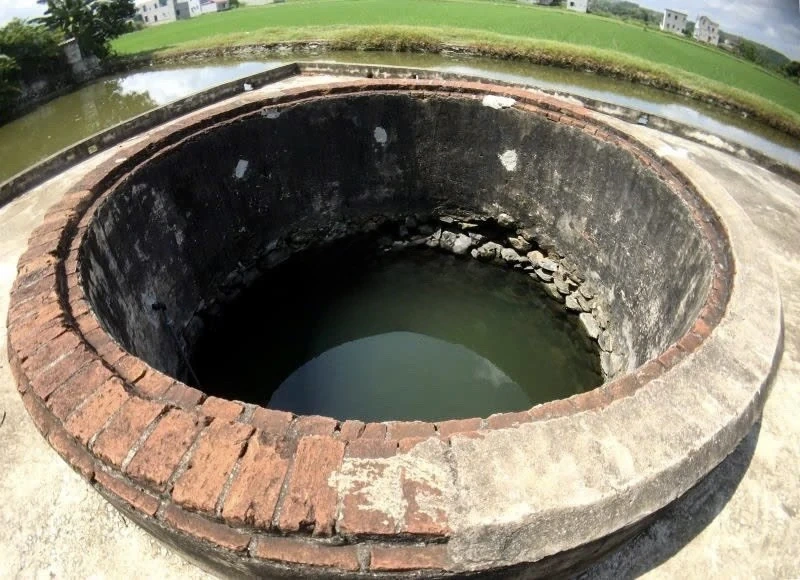
One of the village wells in Hoat Giang commune was built hundreds of years ago. Photo: Phuong Linh
Perhaps every village in Northern Vietnam has a well. Some villages have only one well, while others have up to three. My village still has three wells: the temple well, the communal house well, and the rice paddy well. The temple well is at the beginning of the village, in front of the temple. The communal house well is in front of the communal house, in the middle of the village, and the rice paddy well is at the end of the village, surrounded by rice fields. The rice paddy well is also called the bridge well. It's called that, but it has no connection to any bridge. The bridge here is a tiled-roof house with no walls, only six stone pillars. Later, I understood that the "bridge" here was actually a bridge connecting the earthly world to the underworld. Whenever someone in the village died, they would take the deceased to the cemetery. At the "bridge," they would lower the coffin, and the women would perform a ritual to send the deceased to the afterlife. They would walk around the coffin, singing an ancient song and scattering coins on the ground. The women in the village, whose children or grandchildren were sick, frail, or weak, would wait there and collect small coins to buy food for their healthy children and grandchildren. I witnessed this scene hundreds of times during my childhood in the village. As I grew older, each time I accompanied family members or relatives to the cemetery at the end of the village, I felt as if I could see the distant, endless afterlife filled with layers of white clouds.
The village well was the source of water for the villagers. When I was young, every time Tet (Vietnamese New Year) was approaching, my mother would clean the well, and my siblings and I would carry water from the well to fill it. Now, no one carries well water to fill the well anymore. The reason is that many villages now have piped water systems. Villages without piped water use private wells or drilled wells. Moreover, village wells are no longer as clean as they used to be; they are much more polluted. In the past, whenever a village well was dug, the elders would consult a feng shui master for a very thorough examination. They would examine the water source and wind direction before choosing a location to dig the well so that it would always have plenty of water and would not touch the "dragon's vein" (a geomantic energy line), which would ensure the village prospered and the children would achieve high academic success.
In some villages, after digging a well, they found that the villagers' lives were not going well, with many sad events or illnesses, so they decided to fill in the well and dig a new one. In Vinh village next to mine, the villagers suffered from an eye disease that no matter what remedies they tried, it wouldn't go away. One time, a feng shui master came to visit. The villagers kept asking him the reason, and he said, "With the village well like that, how can the disease be cured?" Hearing this, the elders in the village clasped their hands and begged the feng shui master for help. The feng shui master scooped up a bowl of well water, examined it, and said, "You must perform a ritual to appease the earth god to resolve this misfortune." The villagers then prepared the ritual as instructed by the feng shui master. The feng shui master performed the ceremony, wrote a petition, burned it, and threw the ashes into the well. He warned that women who were menstruating or men who had committed crimes in the village were not allowed to go down to the well to fetch water. A year later, Vinh village was free of the eye disease. This story is true, but the reason why remains unknown to this day. From then on, the village law of Vinh was established: women who were menstruating and men who had committed crimes were not allowed to approach the well.
One of the people worshipped in my village temple, though not the village guardian deity, is the one who decided to dig the well for the village. The villagers say he made a great contribution by "opening the dragon's vein" for the village. Since that well was dug, my village of Chua has undergone many significant changes. One of those changes is the increase in the number of people who have achieved high academic success. When I was a child, I witnessed the annual village festival, where the villagers held a ceremony by the well to worship the well god. The well god was a farmer from the village who had built the well. In the past, the villagers would place a jar of well water on their family altar along with wine, fruit, and sticky rice cakes during the New Year celebrations. On the 5th day of the Lunar New Year, the villagers had a custom called "road inspection." A group of elderly people, followed by young people, walked along the village roads to check if any families were encroaching on the village's common land. If any family planted a tree or built a brick on the village's common land, it would be demolished. After the "road inspection," they would "inspect the well." Anything that affects the structure, water source, and landscape of the village well is removed and prevented.
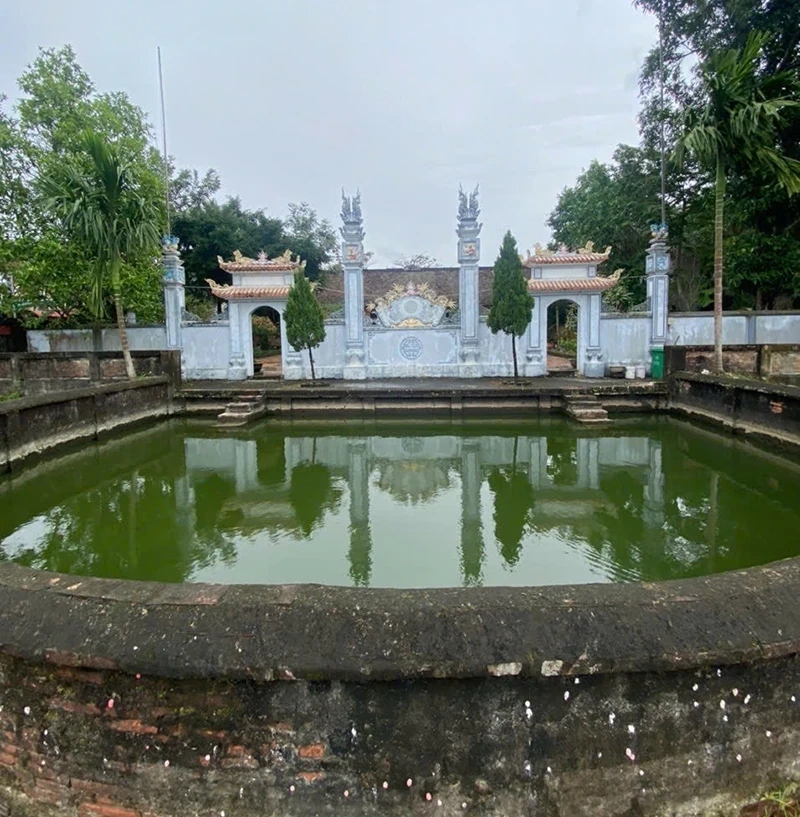
Village wells are repositories of the cultural messages of an entire rural area, anchoring the soul of the countryside in the hearts of each individual. Photo: Phuong Linh
The village well is a cultural space of the village. In the old days, many young couples used to hẹn hò (date) by the well. First of all, it's a space with beautiful scenery. People often planted lotus and water lilies in the well, and on clear, moonlit summer nights, there was no more romantic place for a date than the village well. Many beautiful poems have been written about the village well. It was also the place where many girls bid farewell to their lovers going to the front lines. There was a soldier from my village who went to the front lines and never returned. His lover would go to the well every afternoon to wait for him to come back. Later, she became an old woman, and occasionally, when villagers saw her sitting silently by the well, they said she was waiting for her lover to return from the front. Anyone passing by would bow their heads in sympathy. For a time, some villagers called the well at the beginning of my village "the waiting well." And the name "waiting well" became the name for a long time, even many years after the war.
Many village wells have been filled in. But many villages still preserve them as cultural heritage, as a memory. Therefore, quite a few villages have repaired and restored old village wells. My village, Chua, even has a "Regulations for the Protection of Village Wells." One clause in the regulations clearly states, "The well is the common property of Chua village. No one is allowed to build any structures or interfere with the structure and space around the well. Any violations may be prosecuted under criminal law." Perhaps this is the first time I've heard of "criminal prosecution" for protecting a village well. From the story of the village wells, I think about protecting the cultural heritage of a nation. The above rambling stories seem to be from a thousand years ago, but they are only a little over half a century old. A relatively short period of time, yet so much has changed. We are living in conditions that we could not have imagined half a century ago, and we are also losing so much of the cultural beauty that our ancestors spent thousands of years building up.
Nguyen Quang Thieu
Source: https://baothanhhoa.vn/nhung-con-mat-cua-lang-277170.htm
![[Photo] National Assembly Chairman Tran Thanh Man attends the groundbreaking ceremony for the National Highway 1A spatial axis project.](https://vphoto.vietnam.vn/thumb/1200x675/vietnam/resource/IMAGE/2026/05/19/1779161360398_ndo_br_bnd-1412-jpg.webp)
![[Photo] Capturing the moment the tide recedes at Yen Binh Son rapids - a million-year-old scenic spot in Quang Ngai.](https://vphoto.vietnam.vn/thumb/1200x675/vietnam/resource/IMAGE/2026/05/19/1779175463885_yen9-1199-jpg.webp)


![[QUIZ] Under what circumstances was Trịnh Công Sơn's passion for music "awakened"?](https://vphoto.vietnam.vn/thumb/402x226/vietnam/resource/IMAGE/2026/05/20/1779228580019_fb_thiet-ke-chua-co-ten-5072-jpg.webp)












































Comment (0)