

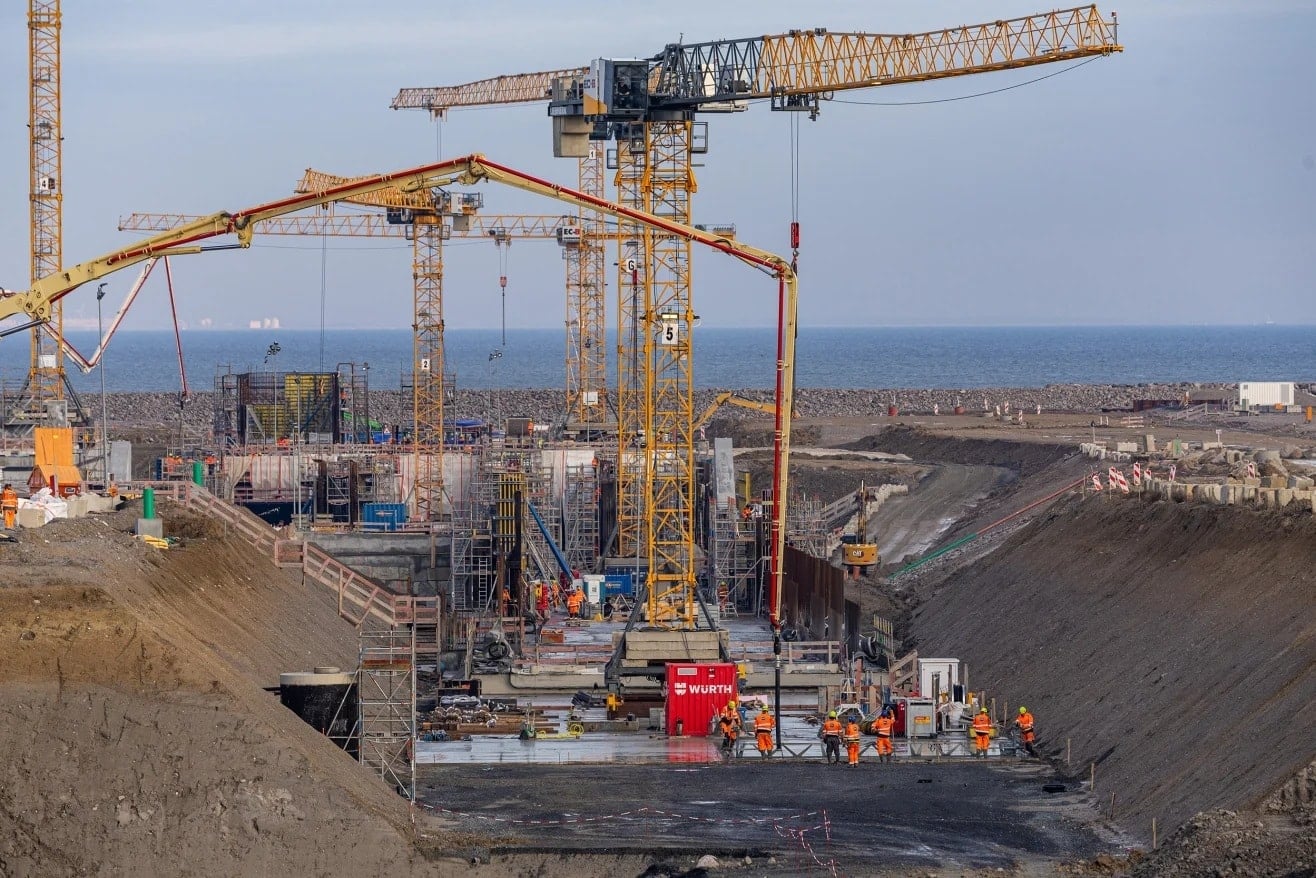
The race of the "super tunnels"
For many years, low-cost airlines have become almost the "backbone" of European transportation. Traveling between major cities like Paris (France) or Berlin (Germany) is often quick and convenient by air.
With climate change becoming a pressing issue, Europe must seek more sustainable transportation models. In this context, high-speed rail stands out as a strategic solution to encourage passengers to move away from short flights and instead travel by train between major cities.
However, this ambition faces a major obstacle: the extremely complex terrain. The Alps stand like a giant "stone wall" separating Northern and Southern Europe, while the Baltic Sea and the Gulf of Finland create large fault lines that disrupt regional connectivity.
Airplanes can easily overcome those natural obstacles, but trains cannot. To compete with air travel, the only way is to "travel through" mountains and the seabed. Therefore, a series of multi-billion dollar tunnel projects have been and are being implemented across the "old continent".
The most prominent example of the current wave of underground infrastructure in Europe is the Brenner Base Tunnel. According to Euronews , with a length of approximately 64km, the project will become the world's longest underground railway line when completed in 2032.
The project, running through the Alps and connecting Innsbruck (Austria) with Bolzano (Italy), plays a central role in the trans-European transport corridor from North to South, enabling faster train travel and significantly reducing truck traffic across the Alps. For many Europeans, this project demonstrates modern technological capabilities and the potential for cross-border cooperation, with the participation of 11 countries.
Not to be left out of this race, France has partnered with Italy on the ambitious Lyon-Turin project, focusing on building a tunnel approximately 58km long under the Alps, aiming to shift a large portion of freight transport from road to rail.
Beyond its groundbreaking efforts to traverse mountains, Europe is also witnessing a wave of audacious sea-crossing projects. According to CNN , the $9 billion Fehmarnbelt project will create a road and rail link under the Baltic Sea, significantly shortening travel between Copenhagen (Denmark) and Hamburg (Germany). Furthermore, plans to build a tunnel under the Gulf of Finland connecting Helsinki (Finland) with Tallinn (Estonia) and other Baltic states also demonstrate a vision for expanding connectivity.
Reshaping the European transport map.
From an economic perspective, these "super tunnels" open up new logistics corridors, enabling faster goods movement and reducing reliance on road transport, which consumes large amounts of fossil fuels. For industrialized economies like Germany or Italy, this is a strategically significant factor.
From an environmental impact perspective, this is an effort to reduce emissions in the transport sector, one of Europe's largest sources of emissions. If high-speed trains are fast enough, convenient, and efficiently connected, many people will choose rail for journeys of a few hundred kilometers. More broadly, these massive tunnels also contribute to creating truly interconnected spaces, where geographical borders are no longer barriers to trade, labor, or tourism .
Of course, this dream is not "cheap," as some projects have experienced significant cost overruns and geological difficulties. Furthermore, the challenge of synchronization is also significant, because a modern tunnel will struggle to be effective if the external connecting routes are not upgraded accordingly. The risk of a "isolated mega-project" exists if countries do not coordinate quickly and decisively.
Ultimately, through these projects, Europe is shaping its strategic future development, where economic growth must go hand in hand with green connectivity and sustainable transport for future generations. After thousands of years of being separated by mountains and seas, these new "underground arteries" promise to increase connectivity between countries and reshape the continent's transport map.
The European Union is aiming to build a high-speed rail network totaling approximately 56,000 km, connecting all the continent's capitals and major cities by 2050. This means the current high-speed rail network must be expanded at least threefold, with an estimated total cost of around $650 billion. According to CNN , the socio-economic benefits of the project over 20 years could reach approximately $886 billion. To realize this goal, in addition to capital and technology, it requires both political will and decades of cooperation.
Source: https://baodanang.vn/nhung-mach-ngam-ket-noi-trong-long-chau-au-3338333.html


![[Photo] Ba Lang An Lighthouse - the "eye of the sea" amidst the "rock museum" of Quang Ngai province.](https://vphoto.vietnam.vn/thumb/1200x675/vietnam/resource/IMAGE/2026/05/29/1780038698840_anh-man-hinh-2026-05-29-luc-14-10-42.png)
![[Image] Pleasant weather helps students enter the 10th grade entrance exam with confidence.](https://vphoto.vietnam.vn/thumb/1200x675/vietnam/resource/IMAGE/2026/05/29/1780034401612_ngay-1-thi-lop-10-minh-duy-8-5009-jpg.webp)



























































































Comment (0)