


Previously, when I first visited Y Tý commune, like many tourists, I thought that Y Tý was the highest place upstream of the Lũng Pô stream, as it has an average altitude of about 2,000 meters above sea level, with snow covering the mountains and forests in winter. But after visiting Y Tý many times and gradually exploring this land, I learned that there is an even higher area called Ngải Thầu, which in the Quan Hỏa dialect means "rocky cape". In particular, Ngải Thầu Thượng is the highest village in this area, and within it, Ma Cha Va hamlet is considered one of the highest Hmong villages in Vietnam.
From the center of Y Tý commune, there are three routes to reach Ngải Thầu Thượng, following three different directions like the three sides of a triangle. The first route, and the most familiar, is from the center of Y Tý commune to the old Ngải Thầu commune, then turning right and continuing up the precarious Chin Chu Lìn "horse-falling slope" to Ngải Thầu Thượng, a total distance of about 15 km. Viewed from above, this route resembles a "dinosaur's spine," with deep ravines shrouded in mist on both sides, but it has now been paved with concrete, making travel easier for the locals.
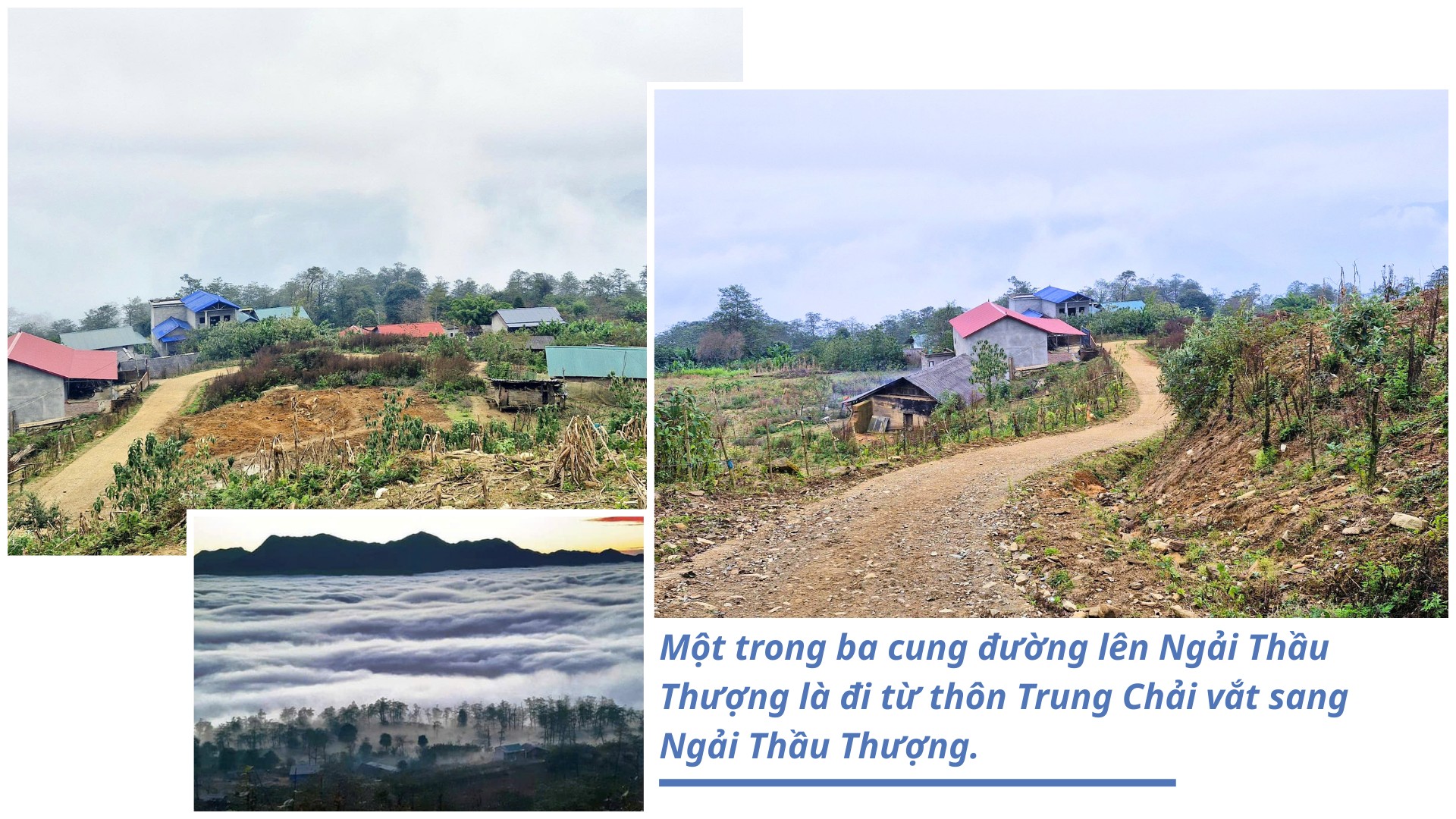
The second route is about 10 km long, from the center of Y Tý commune to Phan Cán Sử village, then continuing through the old forest to Ngải Thầu Thượng. This is the shortest route, but also the most difficult, as it's a narrow, winding road along the mountainside, with a section of about 4 km still being a steep dirt road. I remember a year ago, a tourist came to Y Tý thinking that an off-road pickup truck could conquer this route, but unexpectedly got stuck in the middle of the old forest. In the end, the villagers had to mobilize several buffaloes to pull the "iron buffalo" down the mountain.
Having already conquered two difficult routes to Ngai Thau Thuong, this time, arriving in Y Ty on a cold, rainy day, I was advised by the local officials to take the third route, which was also the easiest, from Trung Chai village to Ngai Thau Thuong. Following this route, from the center of Y Ty commune to Ngai Thau Thuong is about 20 km, but the road is easy to navigate, with only about 3 km of unpaved road and few steep curves, so the journey is quite fast.

The village of Ngai Thau Thuong has 94 households, with 40 in the lower hamlet bordering Ngai Thau Ha, and 54 in the upper hamlet near the towering peak of Ma Cha Va mountain. When I arrived in Ngai Thau Thuong, it was raining heavily, shrouded in fog, and the cold was like needles piercing my skin. Just a few days before, the area had been covered in frost, scorching the wild banana trees and vegetation, leaving them dry and yellow as if they had been roasted over a fire.
They say Ma Cha Va has three "mosts": it's the highest, the cloudiest, and the coldest. Often, when it snows on Fansipan, the "roof of Indochina," it snows here too. In some winters, the snow can reach a depth of 1 meter and last for over a month before melting. Perhaps that's why the Hmong people in Ma Cha Va live in earthen houses with walls up to 50 cm thick, and they burn fires and use blankets year-round to protect themselves from the Arctic-like cold.
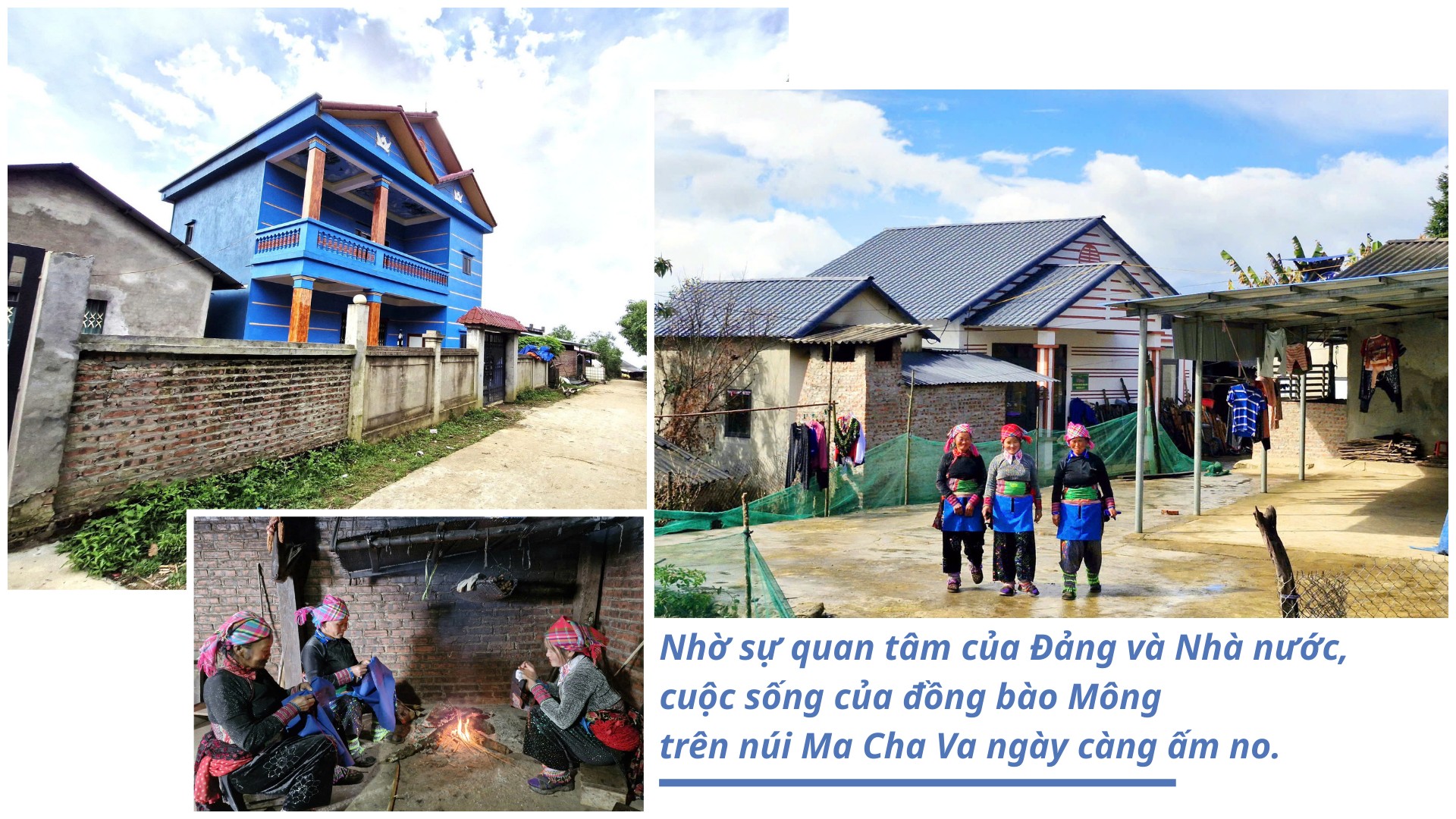
Beside the glowing embers of the fire, Mr. Ho A Sung, 63 years old, former head of Ngai Thau Thuong village, said: “Previously, Ma Cha Va hamlet was very deserted and isolated. Thirty years ago, there were only a few houses belonging to Mr. Sung A Lu, Mr. Sung A Tung, and Mr. Sung A De. Since 2008, after the historic flood, more than a dozen households from the landslide-prone area in Phan Can Su village, Y Ty commune, moved here to build houses. After that, seeing the spacious land in Ma Cha Va, some young families from Ngai Thau Thuong gradually moved here to settle down.”
I remember ten years ago, when the road to Ma Cha Va was still a gravel road, I visited this Hmong village. Back then, Ma Cha Va was quite lively, but it consisted mostly of mud houses, and the people's lives were very difficult. Returning today, Ma Cha Va has donned a "new look" with spacious, well-built houses.
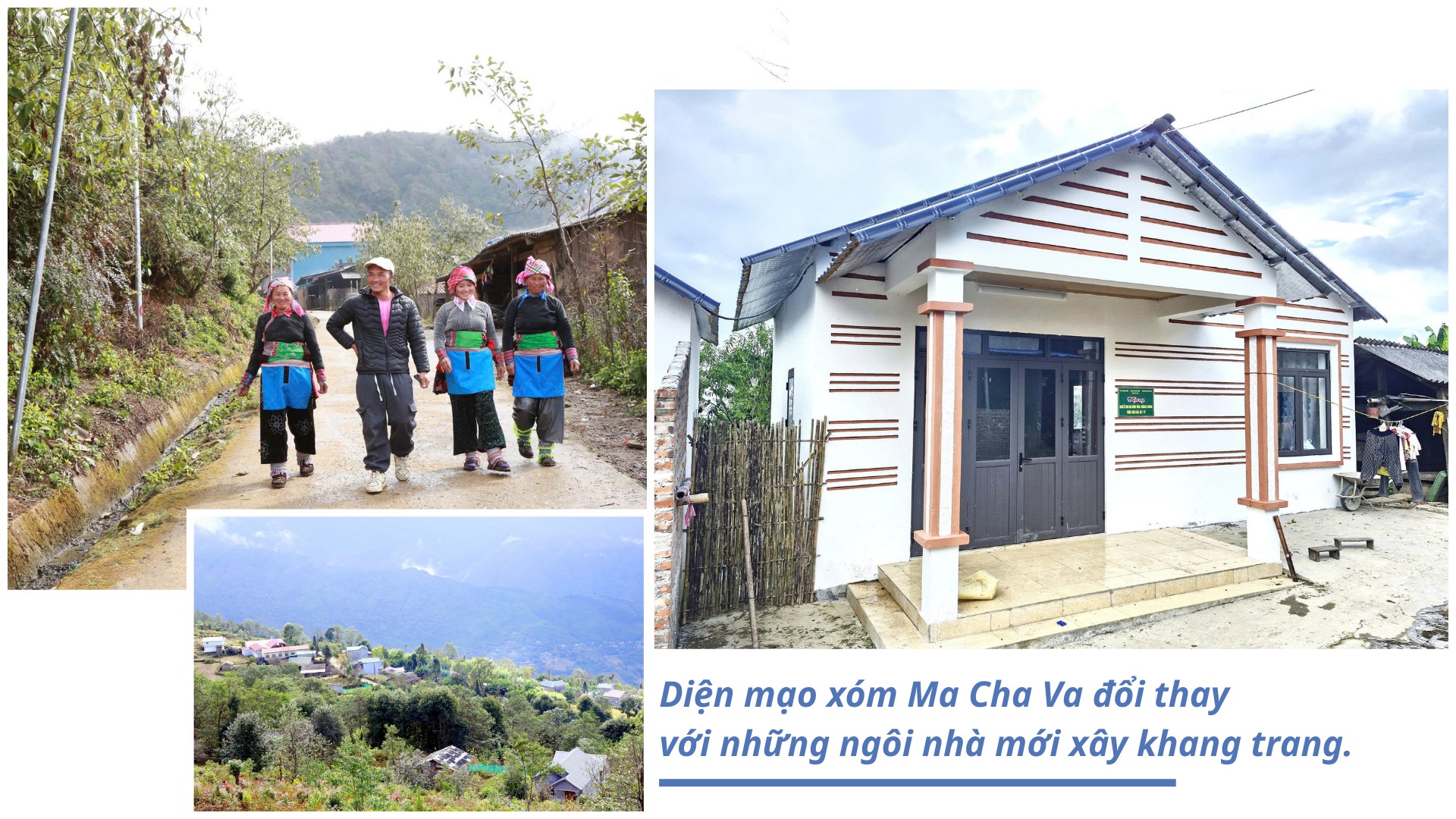
Mr. Sung A Qua, a villager, said his family has been attached to the land of Ma Cha Va for about ten years. Now, his family has built a sturdy house. In the village, there are also families like Sung A Gio, Sung A Tua, and Sung A Giao who have built large, beautiful houses. In 2025, thanks to government support from the program to eliminate temporary housing, the families of Sung A Pao, Sung A Sai, and Sung A Co will also be able to build new houses. The villagers are very happy because this year they will celebrate Tet in their dream homes.
Another reason for joy this year is that the Ma Cha Va hamlet welcomed four more families from landslide-prone areas in Phin Chai 1 and Can Cau villages. In his newly built house, still smelling of fresh paint, Mr. Trang A Khoa shared: “Previously, my family lived in Can Cau village, but in September 2024, our house was affected by a landslide, forcing us to move to a new place. Fortunately, the people in Ma Cha Va gave me this plot of land, and then, with support from Hoa Phat Group, the Provincial Border Guard Command, and Thanh Nien Newspaper, I was able to build a new, sturdy house. The land here is spacious, and there's no worry about landslides, so I feel very secure building my new life.”

Arriving in Ngai Thau Thuong today, I was given a tour of the village by the village head, Sung A Su. Looking at the newly harvested ginseng fields, Mr. Su explained that the land on Ma Cha Va mountain is vast, but the climate is harsh, so for many years the villagers could only grow corn and couldn't cultivate terraced fields.
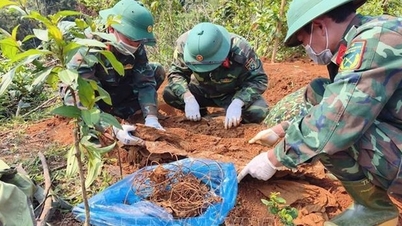
However, in the last five years, seeing that the Hmong people in Phin Ho and Trung Chai were selling ground ginseng at a good price, the locals have followed suit, converting their less productive corn fields to ground ginseng cultivation to increase their income. Ngai Thau Thuong ground ginseng, grown at an altitude of over 2,100 meters above sea level, absorbs wind, dew, and fresh air to grow. Some roots weigh over 1 kg, their flesh is golden like honey, and they taste intensely sweet. Traders buy them and sell them to provinces in the South.
In recent years, the area planted with ground ginseng on Ma Cha Va mountain has expanded, with annual production reaching hundreds of tons of tubers. Thanks to ground ginseng, the lives of the local people have become more prosperous. Each ground ginseng harvest brings in at least 20-30 million VND for every family. In particular, some households earn 80-100 million VND, such as Sung A Giao, Thao A Thenh, and Sung A Pao…
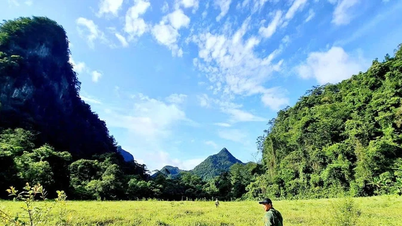
In Ngai Thau Thuong, especially in the Ma Cha Va hamlet, the weather is truly extraordinary. A sudden downpour can stop just moments later, the fog dissipates, and the sky unexpectedly turns clear blue with golden sunshine. From the top of the hill, the Ma Cha Va hamlet stands out like an "oasis" amidst a vast sea of white clouds.
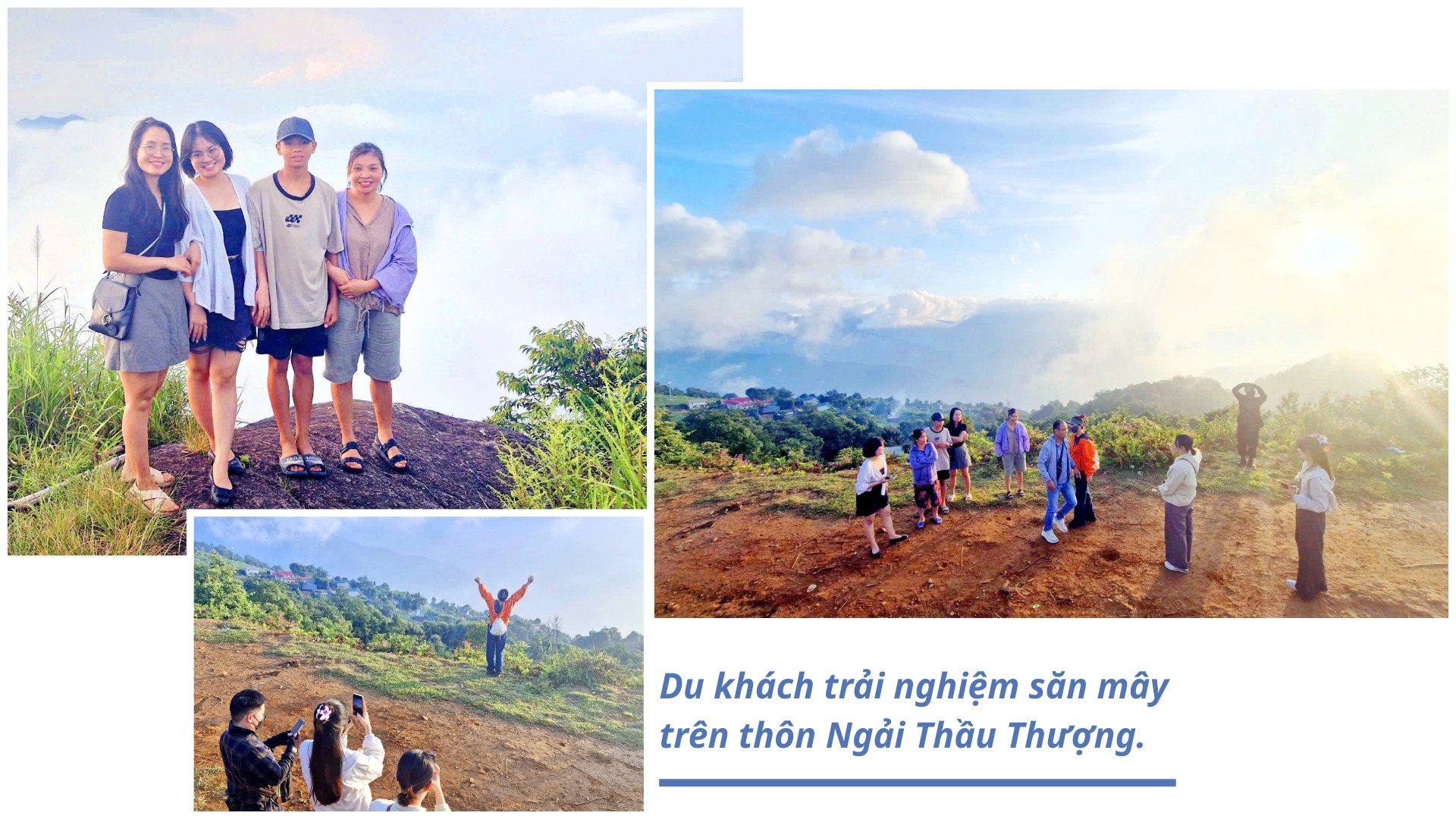
Looking at the clouds drifting across the valley, village head Sung A Su said: “Just by going to the high point near the ‘monkey garden,’ you can see down to the center of the old A Lu, Nam Chac, and A Mu Sung communes. On weekends and holidays, many tourists come here to camp, take photos by the ‘Instagrammable rock,’ the ‘lonely tree,’ and experience life in the highest Hmong village in Vietnam.” Currently, Y Ty commune is focusing on developing tourism in a green, cultural, and sustainable direction. The people of Ngai Thau Thuong also hope to “awaken the mountain fairy of Ma Cha Va,” developing tourism to increase income and make this place an attractive destination.
“This year’s Tet in the village has many new joys. The village has reduced the number of poor households by 15, and many households have built spacious houses. So every household plans to slaughter a big pig for Tet. We invite journalists to come and celebrate Tet with the Mong people of Ngai Thau Thuong, and climb to the top of Ma Cha Va to admire the wild peach blossoms,” said Sung A Su, smiling brightly amidst the golden sunshine and clear blue sky.
On Ma Cha Va mountain, ancient wild peach trees are bursting with color, welcoming the arrival of spring.
Performed by: Khanh Ly
Source: https://baolaocai.vn/niem-vui-moi-tren-nui-ma-cha-va-post890480.html
![[Photo] The General Secretary, President and his wife lay flowers at the Ho Chi Minh Monument in Manila.](https://vphoto.vietnam.vn/thumb/1200x675/vietnam/resource/IMAGE/2026/05/31/1780219759477_anh-man-hinh-2026-05-31-luc-16-29-07.png)







![[Video] Sunset at Lap An Lagoon – Where the sun sets over the fishing nets](https://vphoto.vietnam.vn/thumb/340x192/vietnam/resource/IMAGE/2026/05/31/1780192137701_beach-landscape-sea-water-nature-grass-745871-pxhere-com.jpeg)





















































Comment (0)