

What terrible thing happened to this island?
Live Science reported on November 8th that a group of high school and university students realized that the Russian island of Mesyatsev in the Arctic no longer exists when they compared satellite images for the RISKSAT project of the Moscow Aviation Institute.
The Russian Arctic island has completely disappeared.
Mesyatsev Island, a mass of ice and dust, was once connected as an iceberg to the larger Eva-Liv Island and was part of Russia's Franz Josef Land archipelago, which comprises about 190 islands in the Arctic Ocean. It is possible that the island became a separate entity before 1985, according to an article published in the journal Geosciences in 2019.
In 2010, the surface area of Mesyatsev Island was approximately 1.1 million square meters, equivalent to the size of about 20 American football fields.
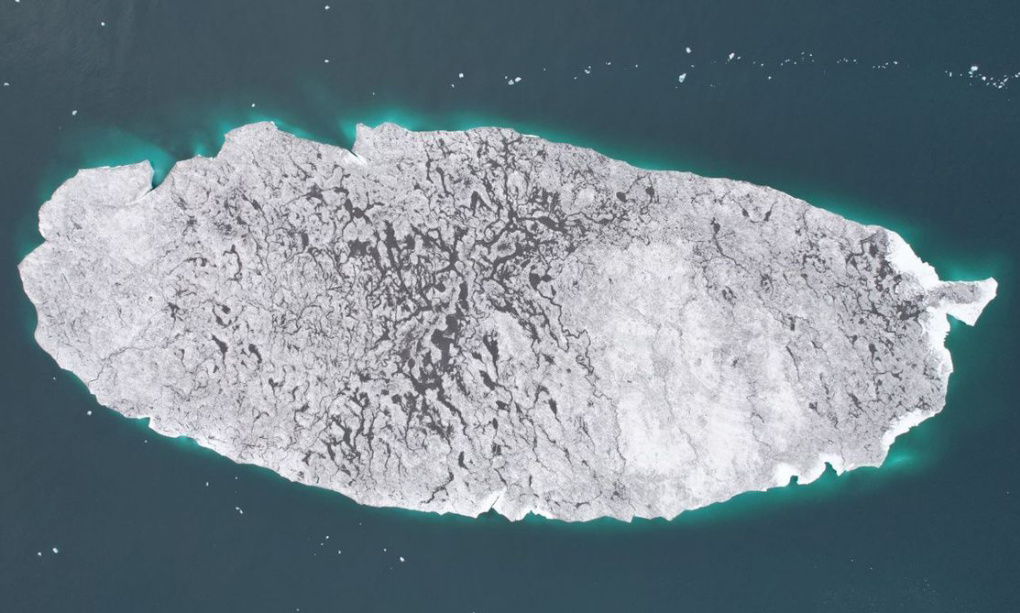
The surface area of Mesyatsev Island is approximately 1.1 million square meters. (Photo: RGO)
Mesyatsev Island began melting when it separated from Eva-Liv, and this process has accelerated in the last 10 years. By 2015, the island's area was only about 530,000 square meters, less than half of what it was in 2010.
By 2022, the island's size had shrunk to the point that scientists stopped monitoring it, predicting it wouldn't last much longer. Therefore, the students' discovery that the island was still visible in satellite images this August came as a surprise to them.
Scientists are still unable to definitively determine why Mesyatsev Island has lasted longer than expected. One hypothesis is that the dust layer on the island's surface may have been washed away by ocean waves or rainwater, contributing to slowing its melting process. In 2021, this dust made the island darker and therefore absorbed more solar radiation. It's possible the dust was blown to the island from elsewhere or formed from melting ice.
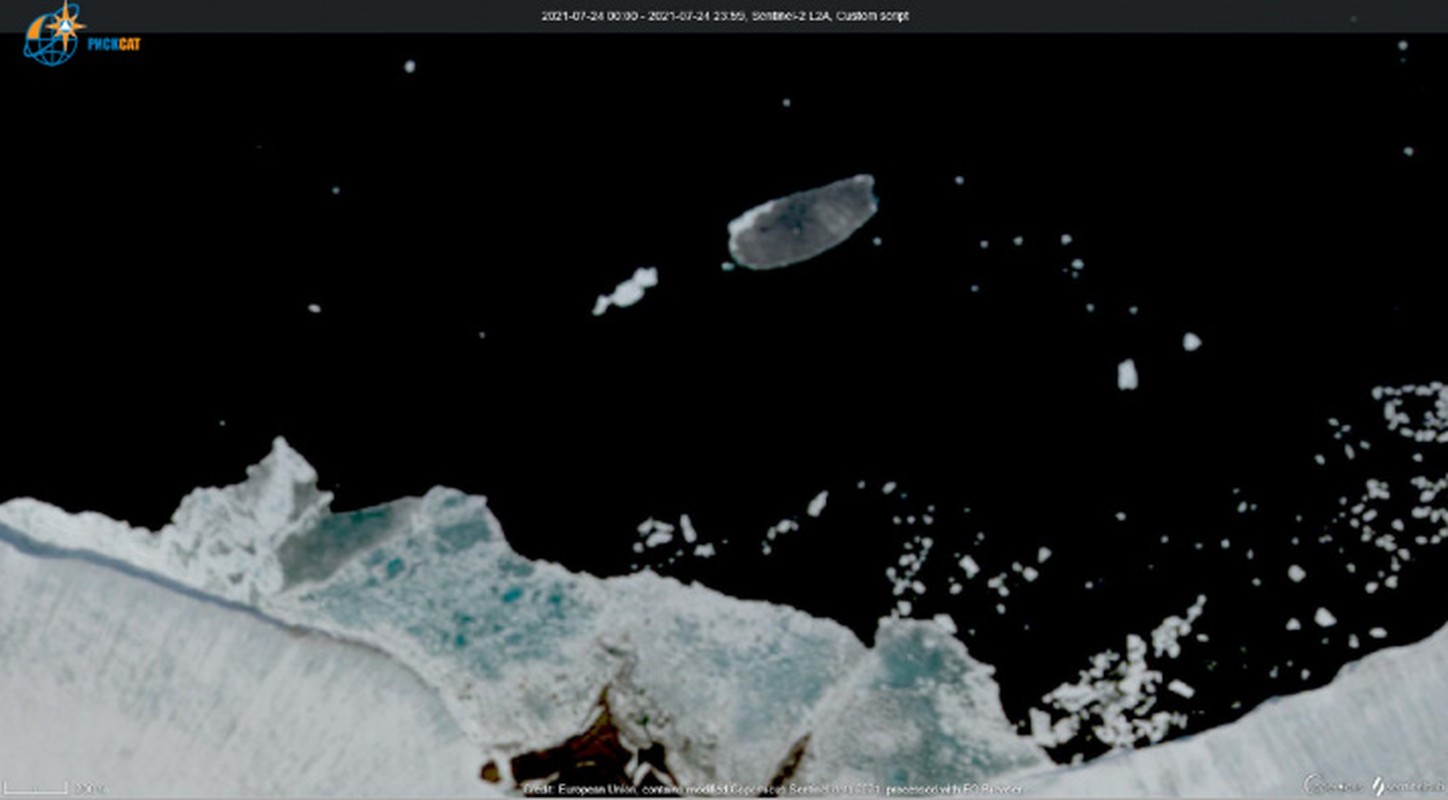
By September 3rd, newer images showed that Mesyatsev Island had completely disappeared. (Photo: GRO)
Associate Professor, PhD in Engineering Sciences Alexey Kucheiko and his team of experts have been monitoring ice melt in the Franz Josef Islands since 2020 using satellite imagery. They discovered that a 53-hectare ice area on Mesyatsev Island has completely disappeared, creating a blank space on the Arctic map. This loss was warned about by the research team as early as 2020, and now nautical charts for the area need to be updated to reflect the change.
Since 2020, a team of experts led by Associate Professor, Associate Doctor of Engineering Sciences Alexey Kucheiko has been observing the ice melt process in the Franz Josef Islands through satellite imagery. They realized that a 53-hectare ice mass on Mesyatsev Island no longer appears on Arctic maps, a change that had been warned about since 2020. Therefore, navigation maps for ships in this area need to be updated to reflect this change.
As of August 19, 2015, Mesyatsev Island still maintained its area of 53 hectares. However, satellite observations on August 12, 2024, showed that the island's area had shrunk to only 3 hectares. Just one month later, on September 13, 2024, Mesyatsev Island was no longer visible in satellite images and had completely disappeared, marking the end of this ice region in the Arctic.
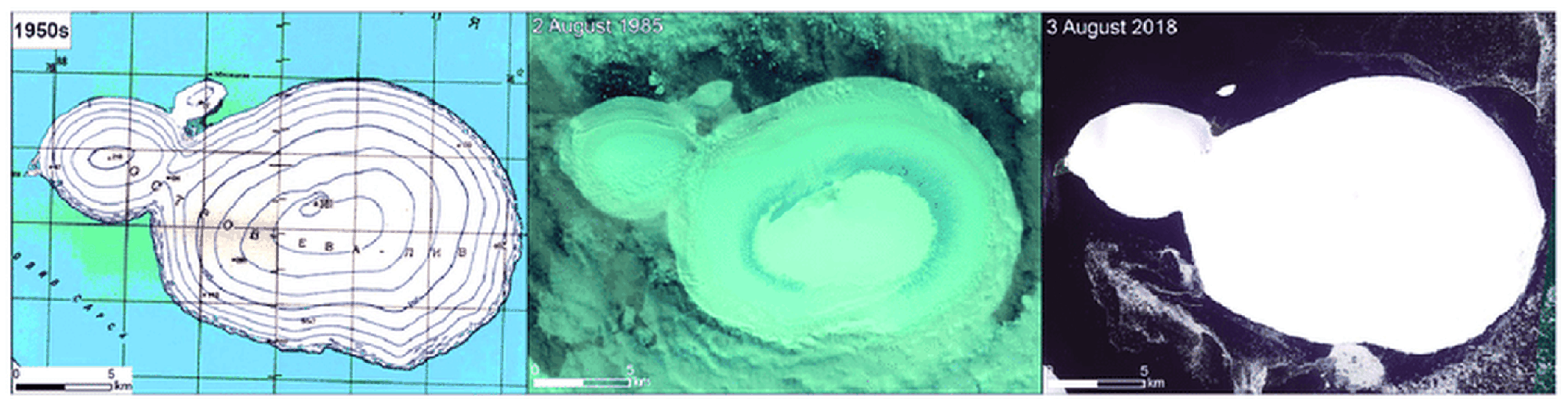
Mesyatsev Island began melting after separating from Eva-Liv Island, but the rate of melting has accelerated over the past decade. (Photo: RGO)
Based on calculations, the Mesyatsev ice island was melting at a rate of 5 to 13 hectares annually. Before disappearing, this island was located near Eva-Liv Greater – one of the northernmost islands of the archipelago.
The research team explained that the main reason for the disappearance of Mesyatsev Island was global warming in the Arctic. The increase in temperature caused glaciers to melt and sea levels to rise, leading to erosion and the loss of icy landforms.
Alexey Kucheiko, a researcher at the Moscow Aviation Institute, claims that the island has completely melted.
The team of experts also affirmed that they will continue their research to verify the complete disappearance of Mesyatsev Island and to assess any potential future changes.
Hai Xia (Compilation)
Source: https://giadinh.suckhoedoisong.vn/hon-dao-voi-kich-thuoc-20-san-bong-bau-duc-bien-mat-khoi-ban-do-chuyen-gia-noi-no-da-hoan-toan-tan-chay-172241119072946195.htm



![[Photo] General Secretary and President To Lam presides over the meeting to approve the draft report on the results of the second inspection by the Politburo of the Standing Committee of the Hanoi City Party Committee.](https://vphoto.vietnam.vn/thumb/1200x675/vietnam/resource/IMAGE/2026/05/26/1779789811432_a2-bnd-4430-9620-jpg.webp)





























































































Comment (0)