

The joy of harvesting early lychees.

Arriving at Mrs. Nguyen Thi Hao's lychee orchard in Quat Du 2 village, Phuc Hoa commune, Bac Ninh province at 3 a.m., the sounds of people harvesting lychees filled the air with laughter and chatter, each carrying a flashlight. Some climbed the trees to pick the fruit, others picked the fruit, and still others arranged and packed the lychees into styrofoam boxes. The festive atmosphere of the harvest, along with the joy of the farmers, seemed to dispel any fatigue.
Dressed in sweat-drenched clothes, with twinkling lights peeking through the lychee trees, Mrs. Nguyen Thi Hao said that this year her family planted 0.5 hectares of lychees. In recent years, her family has partnered with export companies, ensuring a stable market for their produce. They only need to focus on caring for the trees to ensure the lychees meet the highest quality standards.
"This year, the weather has been erratic, much warmer, so from the time the flower buds differentiate until harvest, the care has been much more difficult. The lychee yield of our family has also decreased significantly. But my family is very lucky because we still have lychees to sell, unlike other orchards that have lost everything," Mrs. Hao confided.

For the past three days, the weather has been intensely hot, so her family has hired seven additional workers to help with harvesting and transporting the lychees to ensure timely harvesting, quality, and export standards. During this period of intense heat, the lychee fruit is prone to sunburn, so her family usually harvests the fruit between 3 AM and 10 AM.
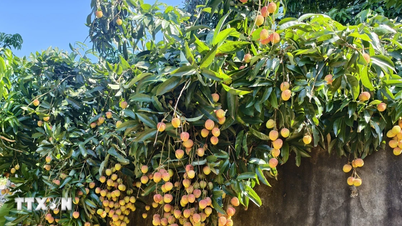
With faces flushed red from the sun and sweat streaming down, Truong Minh Thang, from Tan Yen commune, Bac Ninh province, nimbly handles the task, one hand holding scissors, the other selecting each bunch of plump, ripe, pink lychees to cut.
Mr. Thang said that although the lychee yield decreased this year, thanks to focusing on cultivation techniques and strictly adhering to quality control procedures, the product still achieved higher quality than last year.
According to Mr. Thang, the fact that the "sweet fruits" of lychee are well-received by both domestic and international markets, including demanding markets like Japan, the US, and Canada, not only brings joy to growers but also contributes to maintaining the brand of Bac Ninh lychee in the market.
For the family of Ms. Nguyen Thi An in Lan Thinh village, Phuc Hoa commune, harvesting early-season lychees has been a familiar task for nearly a week now. Every day, her family employs five workers to harvest the lychees.
Ms. An said that her family was very happy that last year their family was selected as one of the most beautiful lychee orchards by the commune. With the criteria for a beautiful lychee orchard not only focusing on appearance but also on the quality of the fruit, this is also an encouragement and recognition from the government for her family.
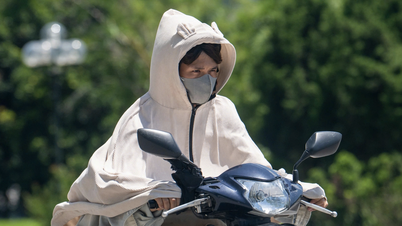
Wearing a loose, oversized air-conditioned jacket, with a mini fan whirring in the midday sun, Mrs. Nguyen Thi An still moved nimbly through her orchard of ripe red lychees. Everyone was busy with their assigned task – some cutting, some gathering, some carrying – as Mrs. An's family gathered the plump, pink lychees in their small yard to trim the branches and pack them. Under the scorching sun exceeding 40 degrees Celsius, both on the lychee hills and inside the house, the sounds of people calling out to each other as they harvested created a bustling scene of the lychee harvest season.
Thanks to support and technical training from the local authorities, over 0.5 hectares of lychee trees belonging to Ms. An's family are planted and cared for according to VietGAP standards, focusing on safe production, improving quality, and building the Phuc Hoa lychee brand. As a result, even with reduced yield, the family's lychees still maintain a selling price of around 40,000-45,000 VND/kg.
Boosting lychee sales channels

At the weighing stations, the atmosphere is equally bustling. Trucks line up, waiting to transport goods for domestic consumption and export. Traders constantly update prices throughout the day. Baskets of bright red lychees are stacked high in the yards, creating a characteristic scene of the harvest season.
Mr. Nguyen Van Cung, the owner of a weighing station in Phuc Hoa commune, said: "In previous years, during the peak season, my family weighed 50 tons of goods every day, but this year, due to crop failure, we only buy 17 tons per day, enough to fill a truck for sale. The purchase price at the station is 20,000 - 25,000 VND/kg."
In 2026, the total lychee growing area in the province will be 29,800 hectares; the estimated production will reach approximately 95,068 tons out of 160,000 tons, equivalent to 59.5% of the plan. Of this: early-season lychee will be 8,200 hectares, accounting for 27.5%, with a production of approximately 40,048 tons; main-season lychee will be 21,600 hectares, accounting for 72.5%, with a production of approximately 55,020 tons.
In Phuc Hoa commune, the capital of early-ripening lychees, people have harvested nearly 6,000 tons of lychees so far. The average selling price ranges from 30,000 to 45,000 VND/kg; while export lychees remain stable at around 37,000 VND/kg to markets in China, Japan, Canada, and the United States.
Although the yield decreased compared to the previous year, the lychees still maintained high quality. Farmers are increasingly adopting new scientific and technological advancements, resulting in improved appearance and quality that meets consumer demands. Farmers are selling their lychees at high and stable prices.

According to Mr. Nguyen Bien Thuy, Vice Chairman of the People's Committee of Phuc Hoa commune, Bac Ninh province, this year, the consumption of lychees from Phuc Hoa commune has been quite favorable and shows many positive signs, especially in both out-of-province and export markets. Approximately 60% of the commune's lychee production is consumed domestically, mainly in major markets such as Hanoi , Ho Chi Minh City, Da Nang, and Dong Nai, through wholesale markets, supermarkets, and retail systems.
Regarding exports, although the traditional market of China still accounts for a large proportion, Phuc Hoa lychees continue to expand strongly into demanding markets such as Japan, Canada, and the United States. This is considered an important step because these markets have very high requirements for quality, traceability, and plant quarantine; in particular, from the beginning of May 2026, the first batch of early-ripening lychees from Phuc Hoa was exported to Canada, opening up favorable conditions for the entire season. At the same time, the approval of the US side for the irradiation facility in Hanoi to process fresh fruit for export also helps reduce logistics costs and creates more favorable conditions for bringing lychees into the North American market.
To promote and sell lychees, the 2026 lychee season in Phuc Hoa commune organized many outstanding activities such as auctioning the right to exploit the ancestral lychee tree, selecting the most beautiful lychee orchard, organizing a gala to welcome the early lychee season, a running race, and sports activities linked to tourism development in the lychee-growing area, spreading the value and image of early-ripening lychees from Phuc Hoa commune. These activities attracted hundreds of groups with more than 10,000 visitors to tour and experience picking lychees in the orchards.
Source: https://baotintuc.vn/kinh-te/nong-dan-chay-dua-voi-nang-thu-hoach-vai-som-20260527140330964.htm

![[Photo] The courage of new recruits of Brigade 144 on the training ground.](https://vphoto.vietnam.vn/thumb/1200x675/vietnam/resource/IMAGE/2026/05/27/1779881651341_anh-man-hinh-2026-05-27-luc-18-32-52.png)
![[Photo] The heat at the fireworks display site on the opening night of the Da Nang International Fireworks Festival 2026](https://vphoto.vietnam.vn/thumb/1200x675/vietnam/resource/IMAGE/2026/05/27/1779889741485_ndo_br_z7872039145157-fecaba5112f39e8352544099d7ef4738-5140-jpg.webp)















































![[Photo] The courage of new recruits of Brigade 144 on the training ground.](https://vphoto.vietnam.vn/thumb/402x226/vietnam/resource/IMAGE/2026/05/27/1779881651341_anh-man-hinh-2026-05-27-luc-18-32-52.png)























Comment (0)