

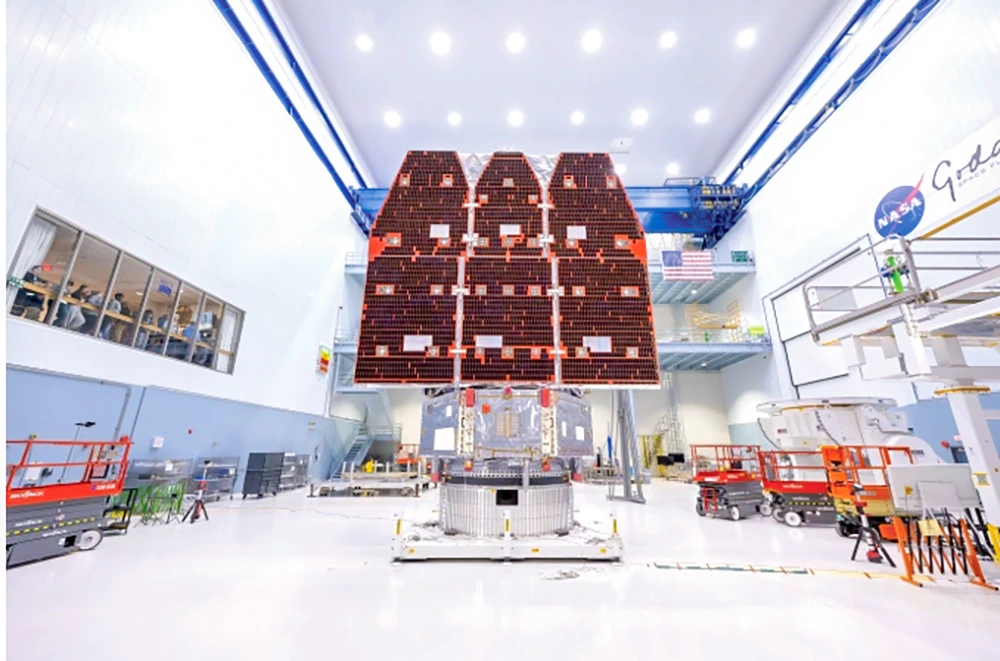
The Roman Telescope, a $4 billion telescope from the US. Photo: NASA
Canadian officials say the new legal framework is considered key to securing the country's position in the rapidly developing space economy , while building on Canada's long-standing contributions to space technology.
Canada has previously sent equipment to the Moon, but still lacks the capability for independent space launches. It is also the only G7 nation without the capability to launch spacecraft and remains dependent on foreign partners, primarily the United States, to get vehicles into orbit.
Meanwhile, China has made significant strides, launching equipment and supplies into orbit in early April for five medical research projects aimed at building the world's first space hospital.
Not stopping there, on April 23, the National Astronomical Observatory of China announced a cosmic simulation project called "Tian Yan," marking a new breakthrough in the field of computational astronomy and supercomputing. Thanks to the enormous computing power of supercomputers, this model can closely simulate the structure and evolution of the universe over the past 13.8 billion years, from the Big Bang to the present day. All the important stages of the universe's development are recreated using digital data, providing researchers with a "guide map" to explore the great mysteries of space.
Meanwhile, on April 21, the US National Aeronautics and Space Administration (NASA) announced a new telescope called Roman, capable of scanning vast regions of the universe in search of new planets outside the solar system and uncovering unsolved mysteries. The device, which cost over $4 billion to develop, is expected to be launched into space in September.
With a field of view at least 100 times wider than the Hubble telescope, Roman will scan vast regions of space from a position 1.5 million kilometers from Earth, sending back 11 terabytes of data each day—more data than Hubble sent out in its entire lifespan. NASA hopes Roman will help discover tens of thousands of new planets outside our solar system, revealing billions of galaxies, thousands of supernovae, and tens of billions of stars.
Europe, of course, is unwilling to remain perpetually behind. Late last year, the European Union decided to increase the budget for the European Space Agency (ESA) to nearly $26 billion over the next three years. According to ESA Director-General Josef Aschbacher, this demonstrates that space is a "very rapidly developing economic sector. Space is also increasingly important for security and defense, and this is an area where Europe needs to catch up."
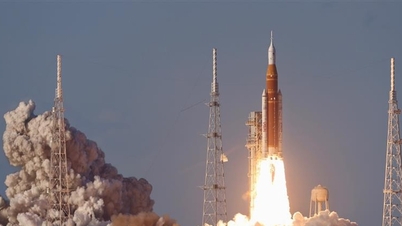
In 2025, ESA marked its milestone with 46 new satellites launched into orbit. And in NASA's recent Artemis II mission, which sent four astronauts into lunar orbit, ESA also participated by providing a service module for the Orion spacecraft.
Singapore is "nurturing" space talent through its educational system.
Singapore is accelerating its strategy of developing a space economy from the secondary school level, with the School of Science and Technology recently opening a Space Technology Centre to enable students to conduct space observations. This move follows the official launch of the Singapore National Space Agency in early April, aligning with the government's vision of building space capabilities as a pillar of emerging technology.
NATIONAL DAY (Compilation)
Source: https://baocantho.com.vn/nuoc-giau-dua-nhau-kham-pha-vu-tru-a203204.html


![[Photo] General Secretary and President To Lam presides over the meeting to approve the draft report on the results of the second inspection by the Politburo of the Standing Committee of the Hanoi City Party Committee.](https://vphoto.vietnam.vn/thumb/1200x675/vietnam/resource/IMAGE/2026/05/26/1779789811432_a2-bnd-4430-9620-jpg.webp)





























































































Comment (0)