

On her 2.4-hectare plot, Ms. Lam Thi Huong (51 years old), residing in Ban A hamlet, dedicates 1 hectare to raising clams, while the rest is dammed up to raise tiger prawns and crabs. “I’ve been raising clams and prawns here for over 26 years. Before, I did it out of habit, just releasing them when the water was good, without any measurements,” Ms. Huong recounted. In recent years, her prawn and crab farming has consistently failed. Ms. Huong believes that fluctuating water levels, possibly affected by wastewater from industrial facilities, coupled with erratic weather, have rendered the old model ineffective. Aquaculture then becomes like gambling with nature; success or failure depends entirely on luck.

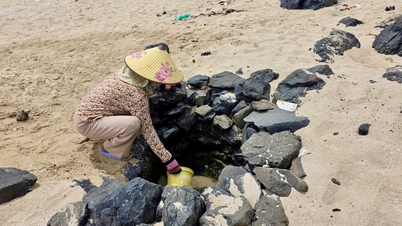
Ms. Lam Thi Huong shares her experience in raising blood cockles in combination with tiger prawns and crabs. Photo: AN LAM
The turning point came when her family participated in a livelihood support project for coastal households. Not only did she receive 40% support for the cost of oyster spat, but she also received probiotics, bran, four bottles of starter culture, and a test kit for each hectare of oyster farming. More importantly, she received training in safe farming techniques, including measuring salinity before stocking, water management, using biological products to create a suitable environment, cultivating algae for oysters to eat, and cultivating rice snails and tubifex worms as natural food for shrimp. “What surprised me most is that I can now farm shrimp at a density of over 100 shrimp/ m² , whereas before I had to stock them very sparsely. Thanks to the probiotics, the environment is stable, the shrimp are less prone to disease, and the oysters grow evenly,” Ms. Huong said. In the last farming season, one hectare of oysters alone brought Ms. Huong a profit of approximately 200 million VND.
Not only Mrs. Huong's family, but five households in this hamlet bordering the protected forest are participating in the model, covering a total area of 5 hectares. The common point is that they have all shifted from farming based on intuition to farming based on data. Water must be measured, the environment must be created, the fry must be released at the right time, and the care process must be strictly followed.

Residents of Tan Thanh commune harvest blood cockles. Photo: AN LAM
Sharing her experience in oyster farming with local people participating in a project combining coastal forest protection and mangrove restoration in the province, Ms. Thai Kim Hien, residing in Hamlet 9A, Tan Thanh Commune, said: “In my opinion, the best time to release oysters is in May-June of the lunar calendar. In recent years, the water has changed, and farming is no longer as profitable as before, so we must keep the environment under the forest canopy very clean for the oysters to thrive.” Ms. Hien's concern is the uncertain market for her products. A stable market would give people peace of mind to invest, allowing them to both protect the forest and make a living from the profession.
From 2023 to 2025, the Provincial Agricultural Extension Center implemented six demonstration sites for blood cockle farming under mangrove forests in Tan Thanh and Dong Thai communes, each covering 5 hectares. Results showed a stocking density of 100 cockles/ m² , 2-3 times higher than outside the model; a survival rate of 44-49%, nearly double; an average yield of 4.5-4.8 tons/ha; and profits ranging from 200-287 million VND/ha, 78-142 million VND/ha higher than traditional farming. Models combining blood cockle and tiger shrimp farming under mangrove forests achieved an average profit of up to 348 million VND/ha.
In 2025, a project to cultivate tiger prawns and blood cockles under mangrove forests, linked with product consumption, was implemented on 25 hectares in Tan Thanh commune, with 16 households participating. The households received support covering 50% of the cost of the fry and 50% of essential supplies and biological products. Although the farming season is not yet complete, environmental and growth indicators show positive results, with survival rates and growth rates meeting and exceeding the project's targets.
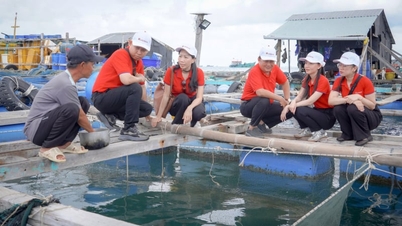
According to Nguyen Phuoc Thanh, Deputy Director of the Provincial Agricultural Extension Center: “The project aims at the long-term goal of preserving the province's valuable forests and seas. But for sustainability, farmers must cooperate in production and consumption. Sufficient shrimp and shellfish production and standardized production processes are necessary to secure contracts with businesses and achieve stable prices. We cannot do it for them; we can only support and accompany them.”
AN LAM
Source: https://baoangiang.com.vn/nuoi-tom-so-duoi-tan-rung-a474039.html
![[Photo] Solemn bathing ceremony and Buddha procession in Hue](https://vphoto.vietnam.vn/thumb/1200x675/vietnam/resource/IMAGE/2026/05/31/1780228263543_1-jpg.webp)
![[Photo] Admire the coral "masterpiece" amidst the million-year-old heritage of Dak Lak province.](https://vphoto.vietnam.vn/thumb/1200x675/vietnam/resource/IMAGE/2026/05/31/1780221235105_anh-man-hinh-2026-05-31-luc-16-53-27.png)

![[Photo] The General Secretary, President and his wife begin their state visit to the Philippines.](https://vphoto.vietnam.vn/thumb/1200x675/vietnam/resource/IMAGE/2026/05/31/1780230559452_anh-man-hinh-2026-05-31-luc-19-28-11.png)
![[Image] Hanoi Police officially crowned champions of V-League 2025/2026](https://vphoto.vietnam.vn/thumb/1200x675/vietnam/resource/IMAGE/2026/05/31/1780244769054_ndo_br_039d561b692be875b13a-jpg.webp)


















![[Video] Sunset at Lap An Lagoon – Where the sun sets over the fishing nets](https://vphoto.vietnam.vn/thumb/340x192/vietnam/resource/IMAGE/2026/05/31/1780192137701_beach-landscape-sea-water-nature-grass-745871-pxhere-com.jpeg)






































![[Photo] Admire the coral "masterpiece" amidst the million-year-old heritage of Dak Lak province.](https://vphoto.vietnam.vn/thumb/402x226/vietnam/resource/IMAGE/2026/05/31/1780221235105_anh-man-hinh-2026-05-31-luc-16-53-27.png)




























Comment (0)