

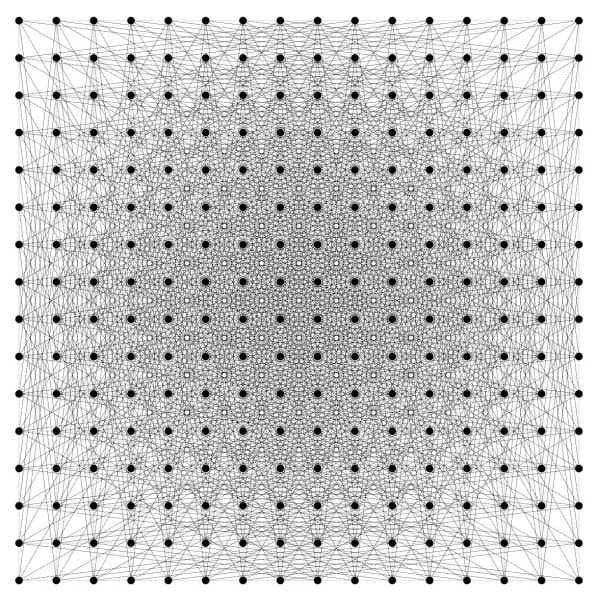
According to The New York Post , this is the "unit distance problem on a plane" posed by Paul Erdős, a Hungarian mathematician, in 1946.
The problem is as follows: If you randomly mark a number of points on a piece of paper, what is the maximum number of pairs of points that are the same distance apart?
A seemingly simple question has challenged mathematicians since 1946 and has become one of the most famous problems in combinatorial geometry.
At that time, Erdős proposed the hypothesis that the number of these point pairs would grow at a slightly faster rate than the total number of points awarded.
For nearly 80 years, mathematicians have continuously tried to prove or disprove hypotheses related to this problem, but without a clear result. The best solution ever devised was to arrange the points into a square grid.
However, OpenAI's AI model found a completely different solution by relying on different branches of mathematics to discover a group of configurations that transcend the limitations of Erdős' original hypothesis.
This breakthrough not only refutes a long-standing mathematical hypothesis but also proposes a completely new sorting method.
OpenAI states that the calculations are performed by a general-purpose inference model capable of automatically breaking down complex problems into smaller steps, rather than a tool specifically trained for mathematics.
OpenAI's work has been officially recognized by mathematicians, including Thomas Bloom, the mathematician in charge of the website hosting the Erdős problems and who had previously been a harsh critic of OpenAI's claims about the Erdős problem.
This time, he acknowledged that the AI system achieved outstanding results by "persisting in pursuing approaches that humans easily overlook, deeming them unworthy of exploration."
However, this expert also noted the role of humans: Although the initial evidence provided by AI was entirely valid, it has been significantly improved by researchers at OpenAI and many other mathematicians. Humans still play a crucial role in discussing, absorbing, and refining this evidence, as well as exploring its implications.
Source: https://baodanang.vn/openai-dat-buoc-dot-pha-khi-giai-bai-toan-80-nam-tuoi-3337673.html

![[Photo] Ba Lang An Lighthouse - the "eye of the sea" amidst the "rock museum" of Quang Ngai province.](https://vphoto.vietnam.vn/thumb/1200x675/vietnam/resource/IMAGE/2026/05/29/1780038698840_anh-man-hinh-2026-05-29-luc-14-10-42.png)

![[Image] Pleasant weather helps students enter the 10th grade entrance exam with confidence.](https://vphoto.vietnam.vn/thumb/1200x675/vietnam/resource/IMAGE/2026/05/29/1780034401612_ngay-1-thi-lop-10-minh-duy-8-5009-jpg.webp)


























































































Comment (0)