

(NLĐO) - The exoplanet Gliese 12b has an atmosphere similar to Earth's and orbits a cold red dwarf star.
According to Sci-News, a research team led by Dr. Masayuki Kuzuhara from the Center for Astrobiology (Tokyo, Japan) has identified Gliese 12b in the massive dataset collected by NASA's Transiting Exoplanet Survey Satellite (TESS).
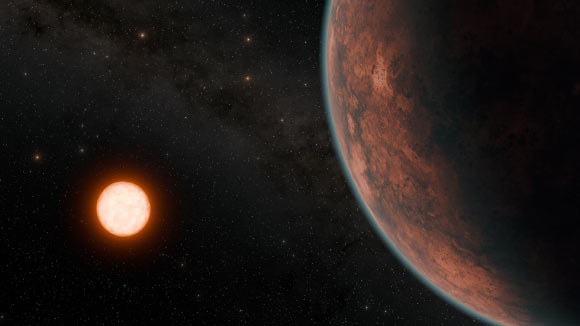
Gliese 12b and its red parent star - Graphic image: NASA
Gliese 12b has an orbital period of 12.76 days around its parent star and an equilibrium temperature of approximately 42 degrees Celsius, which is considerably warmer than Earth (the average surface temperature of Earth is 15 degrees Celsius).
However, 42 degrees Celsius is still enough for Gliese 12b to have liquid water on its surface and many temperate zones suitable for life, even fragile, Earth-like life forms.
It receives 1.6 times more energy from its parent star than Earth receives from the Sun, and about 85% of what Venus receives.
However, Gliese 12b has a significant atmosphere, which can influence surface temperatures. The temperatures calculated above do not take this atmosphere into account.
Calculations also suggest the planet is about the size of Earth or slightly smaller, around the size of Venus, adding another factor supporting its habitability.
In addition, scientists also considered the aggressive nature of its parent star, Gliese 12.
As a red dwarf, Gliese 12 may exhibit extreme "behavior" aimed at stripping the planet of its atmosphere, causing it to become dehydrated and ultimately die out like Venus, even if it manages to regenerate its atmosphere.
However, models suggest that this red dwarf star is not prone to doing so.
Further, more specific observations will be needed to confirm whether any life exists on this intriguing planet.
But we have a huge advantage: The parent star Gliese 12, also known as TOI-6251 or GJ 12, is located just 40 light-years from the Sun, in the constellation Pisces.
This makes it one of the star systems closest to the Solar System, and of course, observing the planets around it with available instruments will be much more convenient.
The discovery of this potentially habitable planet was recently published in the scientific journal Astrophysical Journal Letters.
Source: https://nld.com.vn/phat-hien-hanh-tinh-on-doi-bang-trai-dat-co-the-song-duoc-196240525081314618.htm


![[Video] Sunset at Lap An Lagoon – Where the sun sets over the fishing nets](https://vphoto.vietnam.vn/thumb/1200x675/vietnam/resource/IMAGE/2026/05/31/1780192137701_beach-landscape-sea-water-nature-grass-745871-pxhere-com.jpeg)

















![[Video] Sunset at Lap An Lagoon – Where the sun sets over the fishing nets](https://vphoto.vietnam.vn/thumb/800x450/vietnam/resource/IMAGE/2026/05/31/1780192137701_beach-landscape-sea-water-nature-grass-745871-pxhere-com.jpeg)














































![[Video] Sunset at Lap An Lagoon – Where the sun sets over the fishing nets](https://vphoto.vietnam.vn/thumb/402x226/vietnam/resource/IMAGE/2026/05/31/1780192137701_beach-landscape-sea-water-nature-grass-745871-pxhere-com.jpeg)





























Comment (0)