

To enter the new era, in the face of breakthroughs and epochal changes in the world economic system that are reshaping the order, we cannot help but strategically position the country, first of all the economy, in the contemporary world. This determines the country's position and strength as a developed, high-income country. In the vision to 2045, and immediately to 2030, on the basis of socio-economic conditions, there is an urgent need for comprehensive, strong, and profound innovation in thinking and viewpoints, innovation in inclusive institutions, and synchronous and unified implementation of policies and solutions to create the foundation and driving force for the country's economic development. This is an opportunity, but also a difficult and harsh challenge.
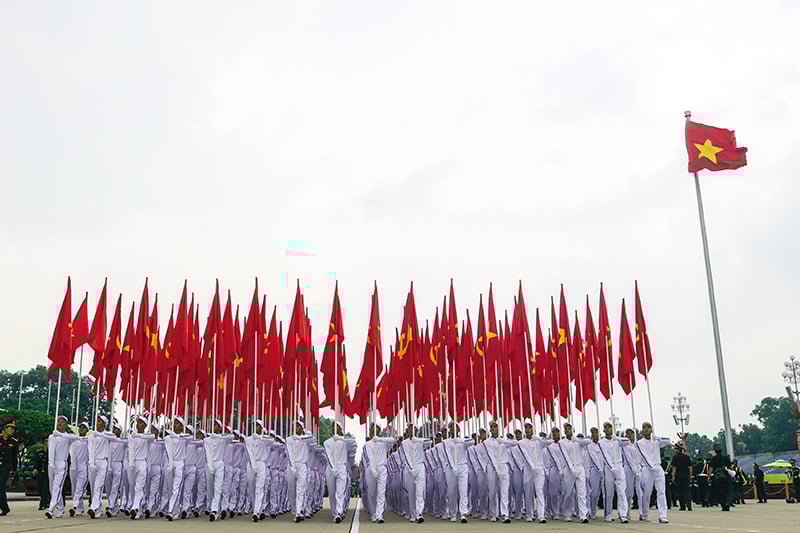 |
| For Vietnam, development is not simply about getting rich, but about survival and strategic positioning, elevating the nation's standing in the world in the 21st century. |
Lesson 1: Thinking about growth and development in building a prosperous economy
If growth is an indicator, an increase in economic scale, then development is about quality, about sustainability in the economy, society, culture, environment, and human aspects. Growth is only a surface manifestation; development is the core essence of social progress.
Strategic vision for development
The vision of developing a prosperous and globally-positioned nation by 2045 means that Vietnam will not only be economically wealthy, but also strong politically , culturally, socially, institutionally, in terms of its people, and in terms of national competitiveness. In other words, it is a combination of growth, equity, sustainability, culture, and people, to challenge all limits of development.
Therefore, Vietnam must develop in a modern, open, and deeply integrated direction, based on its internal strengths, with the economy as its foundation, and transform those factors into soft power, continuously improving the national development value system.
No economy can be considered prosperous and sustainable if it is not based on its own strong foundation, meeting the development needs of its people, aligning with international values and standards, and ensuring overall balance in any situation and circumstance. The development of the Vietnamese economy is no exception to this principle.
The measure of a prosperous Vietnamese economy should be an economy with a high per capita income that is continuously and steadily increasing. This should not only be reflected in GDP figures, but also in a healthy and highly competitive economy.
On the other hand, economic growth must be high, utilizing all resources efficiently, and competitiveness must be highly ranked. The economic structure must shift towards efficiency and continuous improvement, aligning with the country's values and international supply chains. Above all, strategic balance must be ensured, with high-speed development that is sustainable and humane.
Growth and development
If growth is an indicator, an increase in economic scale, then development is about quality, about sustainability in the economy, society, culture, environment, and human aspects. Growth is only a surface manifestation; development is the core essence of social progress. Chasing after growth while neglecting the foundation of development is self-destructive.
In the context of globalization and strategic competition, it is important to note that strategic competition is not just about technology or trade, but also about competition in development models. Understanding trends, seizing opportunities, and renewing consumer dynamics are of particular importance to economic growth and development.
 No economy can be considered prosperous and sustainable if it is not based on its own strong foundation, meeting the development needs of its people, aligning with international values and standards, and ensuring overall balance in any situation and circumstance. The development of the Vietnamese economy is no exception to this principle.
Therefore, to avoid a growth model that relies too heavily on resources, public investment, cheap labor, and lacks sustainability, innovation, and endogenous momentum, we need to move towards a development model based on knowledge, technology, people, effective governance, and a culture of development. This is the sustainability of development that aligns with international economic trends in today's era of rapid technological advancement.
Therefore, development for Vietnam is not simply about getting rich, but about survival and strategic positioning, elevating the nation's standing in the world in the 21st century.
Economy and culture, and culture and economy, go hand in hand with politics, security, and national defense.
A prosperous and strong Vietnam is one with a wealthy people, a powerful nation, a radiant culture, and a confident capacity for integration without assimilation. Therefore, inevitably, economics and culture are inseparable, but rather permeate, nurture, and support each other. They are two sides of a unified development.
The economy in culture – the foundation and soul of Vietnamese identity. For culture to develop, it needs an economic mechanism: cultural industries transforming creative values into competitive products domestically and internationally (films, music, tourism, cuisine, fashion, etc.); the economic development of heritage, not through crude commercialization, but through the development of cultural tourism and services linked to preservation; and investment in creativity (a strong economy provides the conditions for the development and dissemination of art, education, and heritage preservation).
The economy provides the resources, tools, and environment for culture to exist, spread, and develop, ensuring the reality and vitality of cultural values. No prosperous nation can rely solely on material growth without cultural depth; and no strong culture can endure if the economy is weak.
In short, the economy not only provides a material foundation for culture, but also a civilized market mechanism that creates incentives for creativity and cultural preservation, leading to shared development.
In the context of economics, culture is not only the foundation and driving force, but also the identity of all economic activity. A strong economy without a cultural identity will lack depth and be vulnerable to market fluctuations. Culture in economics is the "effervescent agent" and "soul" of economic development. It is the ethics, character, and lifestyle of the nation that are transformed into economic strategies, ensuring that every economic policy is imbued with national spirit, business ethics, respect for people, and nature.
At the same time, every economic product and service bears the mark of Vietnam, from aesthetics and packaging to branding. On the other hand, in economic relations, merchants and businesses must maintain trustworthiness and prioritize mutually beneficial cooperation. Without a culture of integrity in the economy, society can easily pursue short-term profits, leading to moral decay and a misguided economic development.
The goal of a prosperous and strong Vietnam is the confluence of two fundamental factors: economy and culture, and culture and economy, aiming to ensure political stability and national defense strategy. This confluence is increasingly becoming a strategic "turning point." The economy must be imbued with cultural spirit to create a soft competitive advantage in the global market; culture must become a direct resource for growth, not just a spiritual element; building a national brand that is both materially rich and humanistically rich; enriching the culture of nation-building while simultaneously developing the culture of national defense.
Vietnam can only achieve prosperity and strength if culture guides the economy and the economy nurtures culture in a unified manner, worthy of being the pillar of political stability and maintaining national security and defense. Economic development towards 2045 must be imbued with the philosophy of economic and cultural coexistence, anticipating and avoiding two ills: an indifferent economy (pure growth, but detached from and losing its cultural roots); and a poor culture (rich in spiritual values, but lacking the capacity to sustain itself).
It can be viewed from three perspectives:
Firstly, development must be proactive – not dependent on others. The state must be a proactive state that fosters development, not one that provides subsidies or bureaucratizes the economy. We need to unleash productive capacity – liberate thinking – and liberate people.
Secondly, development must be synchronized between economic sectors and cultural, environmental, and social aspects. A nation cannot be considered developed if its environment is destroyed, its culture is eroded, and social injustice is left unchecked. Therefore, people must be at the center, culture as the foundation, and technology as the springboard, all built upon a national mindset and a national mentality focused on development and comprehensive development.
Thirdly, development requires political stability and modern institutions. There can be no rapid growth if politics lacks stability and institutions are incompatible. To achieve rapid and sustainable growth, institutional reform is essential – reforming the apparatus, governing mindset, operating mechanisms, and power control – in which the human factor holds a fundamental position and the institutional system plays the primary driving role.
Vietnam's sustainable development should not only adhere to international standards but also be based on national values with three pillars of sustainable development: economic independence; sustainable culture; and political stability.
Based on development experience and future demands, Vietnam must avoid dependence on foreign economic models, but also avoid closing itself off in order to develop a unique Vietnamese model. Instead, it must seamlessly combine modern nationalism with a spirit of innovation, openness, integration, and creativity.
To build a rapidly developing and sustainable economy, we need vision, a strategic mindset, a system of values, ethics, aspirations, and resilience. To put it figuratively, this requires a Vietnamese economy that develops rapidly, but sustainably, humanely, and with a soul.
(To be continued)
Source: https://baodautu.vn/phat-trien-kinh-te-viet-nam-tam-nhin-nam-2045---bai-1-tu-duy-ve-tang-truong-va-phat-trien-trong-kien-tao-nen-kinh-te-phu-cuong-d398460.html

























![[Video] The craft of making Dong Ho folk paintings has been inscribed by UNESCO on the List of Crafts in Need of Urgent Safeguarding.](https://vphoto.vietnam.vn/thumb/402x226/vietnam/resource/IMAGE/2025/12/10/1765350246533_tranh-dong-ho-734-jpg.webp)








































Comment (0)