

Unsustainable supply chain
In recent times, although there are no established models of integrated goat and sheep farming in the province, people have maintained a production chain linking goat and sheep farming with product consumption. For example, the Bich Huyen goat and sheep slaughterhouse in Do Vinh ward (Phan Rang - Thap Cham city) and the Le Thi Hoa facility in Phuoc Vinh commune (Ninh Phuoc district) have partnered with farmers to supply breeding stock and organize product procurement, effectively meeting market demand both within and outside the province. Participating in this integrated goat and sheep fattening value chain, the slaughterhouse owner provides each farmer with 25-50 breeding goats and sheep, weighing 10-15 kg each, at market price, and then repurchases them when ready for slaughter. Farmers invest in barns, feed, and veterinary medicine, and after 4-5 months of raising, the average weight reaches 28-40 kg per animal. After deducting all expenses, farmers earn a profit of 0.5-0.6 million VND per animal.
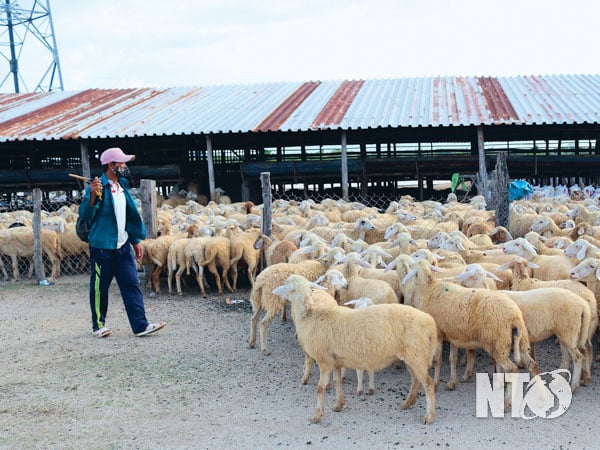
Sheep farm in Phuoc Trung commune (Bac Ai district). Photo: Contributor.
Compared to traditional methods, this approach is more efficient, allowing farmers to proactively secure breeding stock, shortening the rearing time; goats and sheep gain weight faster, are less susceptible to disease, and have a guaranteed market for their products. Farmers also utilize the manure to fertilize grass and sell it to increase their income, which is why farmers support this initiative. However, this linkage currently only involves over 200 households raising goats and sheep, along with traders in various localities, with approximately 13,000 goats and sheep participating annually. The linkage between Trieu Tin Enterprise and local farmers in raising goats and sheep for meat was once highly anticipated as part of a value chain model where farmers provide barns, labor, and land for growing grass, while the enterprise supplies breeding stock to farmers for production and fattening. However, the Trieu Tin goat and sheep business is currently closed... In the province, there is currently Nhat Thanh Food Company, which slaughters and processes fresh goat and sheep meat products for packaging and distribution to the market. This is a specialty product of the province that has been certified as an OCOP product; it uses the certified trademark "Ninh Thuan Goat" issued by the Department of Animal Husbandry and Veterinary Medicine, but it has not yet established a value chain link with producers.
Mr. Phan Dinh Thinh, Head of the Department of Livestock and Veterinary Medicine, stated: "The current difficulty in the livestock supply chain is the habit of livestock and poultry farmers who, once their animals are ready for slaughter, usually only sell to traders, and the price is determined by the traders. Livestock and poultry meat in the province is mainly consumed in markets and supermarkets inside and outside the province. Goat and sheep meat, in particular, is mainly exported to Ho Chi Minh City, Da Nang, Nha Trang, Da Lat, Binh Thuan, Hanoi ... with only a small amount consumed in restaurants and eateries within the province. The products sold on the market are simply whole sheep, fresh meat; there are no processed goat or sheep products for customers to choose from..."
Value chain creation solutions
To develop livestock production in a safe, efficient, and economically valuable direction, the agricultural sector is encouraging livestock and poultry production along value chains and circular economy principles; attracting businesses to invest in the livestock sector (providing breeding stock, feed, veterinary medicine, and product distribution) in a concentrated manner, including slaughtering, processing, and consumption, in order to create a linked chain in livestock production and consumption and to build brands for the products. The goal is to develop the goat herd to reach 130,000 head by 2025 and 160,000 head by 2030, with an average growth rate of 2.93% per year; and an average annual increase in goat meat production of 3.5%. The goal is to develop the sheep herd to reach 150,000 head by 2025 and 220,000 head by 2030, with an average annual growth rate of 8.3%. Increase lamb production by an average of 4-5% per year.
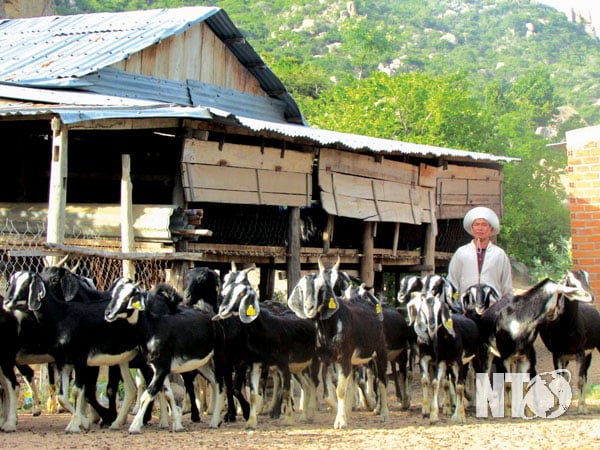
A model of goat fattening by farmers in Phuoc Hau commune (Ninh Phuoc). Photo: Anh Thi
According to Mr. Phan Dinh Thinh, to create a value chain in livestock products, the province continues to attract large-scale enterprises to invest in the development of goat and sheep farming. Maintaining and developing goat and sheep as Ninh Thuan's distinctive products, developing the certified brand "Ninh Thuan Goat" and the "Ninh Thuan Sheep" brand is crucial. Policies and support solutions are needed to create favorable conditions for organizations, individuals, and businesses involved in the production, slaughter, processing, and consumption of goat and sheep products. This will enable them to invest and effectively link with farms and households from input to output, especially in a closed-loop livestock chain. Investment should also be made in establishing 1-2 processing facilities for goat and sheep meat in the province. Districts, cities, and commune-level People's Committees must build human and financial resources, form cooperative groups and cooperatives to lead and link with livestock farmers, acting as a bridge to guarantee the purchase of livestock products from businesses in the localities. In addition, it is necessary to strengthen disease prevention and control, aiming to control some dangerous infectious diseases in animals, ensuring food safety and hygiene. In production, it is necessary to reorganize production methods into strong, cohesive groups among members and between farmers and slaughterhouses, to create a value chain that brings high economic efficiency and contributes to the restructuring of the agricultural sector.
Mr. Tuan
Source



![[Image] Nearly 125,000 Hanoi students completed the Literature exam for the 10th grade entrance exam.](https://vphoto.vietnam.vn/thumb/1200x675/vietnam/resource/IMAGE/2026/05/30/1780117233041_ndo_br_thiet-ke-chua-co-ten-2-png.webp)


















![[Photo] Admire the coral "masterpiece" amidst the million-year-old heritage of Dak Lak province.](https://vphoto.vietnam.vn/thumb/1200x675/vietnam/resource/IMAGE/2026/05/30/1780107638639_y25-jpg.webp)


































































Comment (0)