

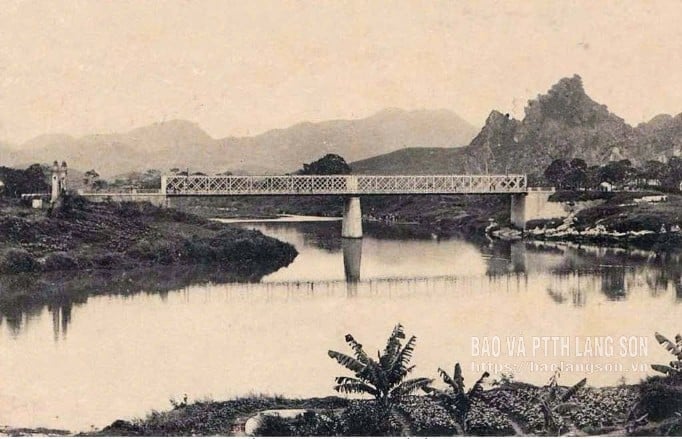
Muoi Street is located right on the northern bank of the Ky Cung River, now in Tam Thanh ward, Lang Son province. In the past, crossing the river from Doan Thanh and reaching the Ky Cung wharf led to Muoi Street. From there, going a little further, past the Lao Ly stream, would lead to the famous Ky Lua market street, established by Than Cong Tai in the late 17th century.
Salt Street is a place name formed from the folk name referring to a street specializing in selling salt. According to ancient texts, the buying and selling of salt and other goods in the area along the Ky Cung River has existed for a very long time. From the 10th to 11th centuries, this was a place where the exchange and trade of goods and products between Vietnam and China took place. The book "Lingwai Daida" by Zhou Qufei (Song Dynasty, China) wrote: "The people of Giao Chi brought precious items such as incense, ivory, rhinoceros horns, gold, silver, and money to exchange for fabrics. Only salt was heavy. Salt was only used to exchange for ordinary fabrics. Salt was packed into baskets, each basket weighing 25 catties…" We called it the "border market," the Song Dynasty called it the "border trading market." Professor Tran Quoc Vuong believes that this was the predecessor of today's Ky Lua market street. Perhaps that is the origin of the current Salt Street.
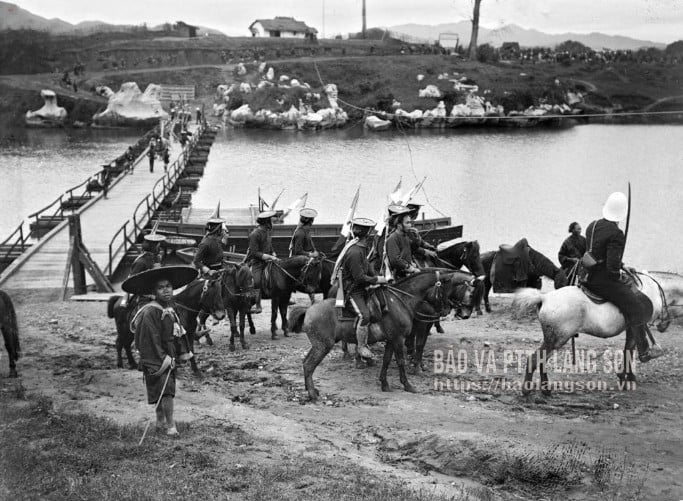
Salt Street is located right on the Ky Cung riverbank. In the book Dai Nam Nhat Thong Chi (National History Institute of the Nguyen Dynasty), "Ky Cung wharf" is mentioned as one of the 15 ferry crossings in the province. In the poem "Tran Doanh Bat Canh" (Eight Beautiful Sceneries of the Town Camp), the Governor of Lang Son, Ngo Thi Si, honored Ky Cung rocky wharf as one of the eight beautiful scenes of Lang Son town in the late 18th century.
Doan Thanh left the temple,
Temple of the temple,
Sincere and peaceful mountain,
Ky Cung Stone Crossing,
Thanh, Thanh Nham Tuyen,
Fairy, Fairy Dance
Horizontal Hall of Cultivation,
Duong Linh Pavilion...
(Doan Thanh Inn)
Ky Lua Townhouse
Within the small mountain town,
Ky Cung Stone Wharf
Thanh Thanh clear stream
Tien Tien Cave Pagoda
Hoanh Duong hamlet
(Duong Linh watchtower...)
The Ky Cung wharf was located on the vital transportation route from Thang Long (Hanoi) to the Nam Quan Pass and into China. Goods transported from the lowlands to the Ky Lua market passed through this river wharf. Among them, salt was one of the prominent traditional commodities, closely linked to the essential needs of the people in the mountainous region. On market days, salt was transported from the lowlands by traders, and after arriving at Ky Cung wharf, it was gathered and sold right on the street by the river. From here, the salt was bought by merchants and traders to sell in districts and counties within the province, and transported to places such as Cao Bang , Guangxi, and Guilin (China)... Over time, this place became a market specializing in selling salt, so the locals called it Salt Street. "First, proximity to the market; second, proximity to the river; third, proximity to the road," Salt Street combined all three elements: market, river, and road, making it increasingly crowded and bustling with activity.
The traces of Muoi Street are not only in its name, but also associated with many other relics and artifacts of ancient Lang Son. Right by the riverbank, there is a white stone pillar that the city's residents commonly call "The Stone Dog." It is a natural rock formation jutting out from the Ky Cung stone wharf. People have utilized this rock to create a sturdy stake used to anchor boats, ferries, and rafts carrying people and goods across the river to Ky Lua market town.
Perhaps due to the prolonged use of the anchor ropes, they gradually wore down, the knots becoming too tight, resembling a dog's head at the top and a dog's body at the bottom, which is why the ancients called it a "stone dog," and over time, it became a familiar name.
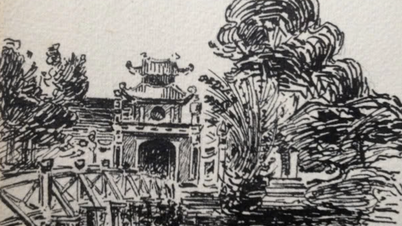
Archival photographs of Ky Cung Wharf and Ky Cung Bridge, taken during the French colonial period (late 19th, early 20th centuries), show a rather large "stone dog," almost as tall as a human head. Its shape resembles a seated figure, facing south, waiting for boats to cross the river. The scenery here is spectacular; the riverbank is geologically formed from natural rock, making it very convenient for boats to dock. The riverbed is crisscrossed by protruding rocks, creating beautiful and majestic white foam as the waves crash against them, earning it the reputation of Ky Cung Stone Wharf.
Under the independent feudal dynasties of Vietnam (10th-19th centuries), all diplomatic missions between Vietnam and China traveled along the single-lane road through Ky Cung Wharf. Right on the rocky wharf stood the Ky Cung Temple, a renowned and sacred temple dedicated to the river god. The book Dai Nam Nhat Thong Chi (compiled in the late 19th century) records: “The Ky Cung Temple is on the left bank of the Ky Cung River in Vinh Trai commune, Thoat Lang district. A mythical dragon has dug a cave there. The temple is very sacred and has been bestowed with many honors. Diplomatic missions passing through here first perform a ritual of announcement before crossing the river.” Typically, after disembarking on the North bank or preparing to cross the river to Doan Thanh, the envoys would make their announcements at the Ky Cung Temple.
According to the book "Lang Son Doan Thanh Do" (compiled by Nguyen Nghiem in 1758), Ky Cung Temple was one of the 17 sacred temples of the district: "All envoys, when passing through here on horseback, had to announce their arrival before crossing the river." Thus, throughout history from the 10th to the 19th centuries, the boats and ships of Vietnamese and Chinese envoys anchored at this very riverbank. Could the stone dog have also served as anchors for their boats? Currently, the traces of the stone dog no longer exist. However, the image of the old riverbank associated with the sacred Ky Cung Temple, the rows of salt, and the stone dog-shaped anchors for boats and ships remains deeply ingrained in the minds of the people of Lang Son. In 1993, Ky Cung Temple was classified as a national historical and cultural relic. Currently, the Ky Cung stone wharf has become an important component of this complex of relics.
Today, Muoi Street is just a small street running from Tran Dang Ninh Street – the beginning of Ky Cung Bridge – to Nhi Thanh Street. However, in the past, Muoi Street was much larger, encompassing the entire area from Ky Cung Temple to what is now Nhi Thanh and Tam Thanh. The Lang Son Historical Records from 1942 listed all the historical sites of Muoi Street: Ky Cung Temple, Nhat-Nhi-Tam Thanh Pagoda, Mac Dynasty Citadel, Muoi Street communal house… Expanding the area of Muoi Street is its connection to Ky Lua Market, Ta Phu Temple (Ky Lua Ward), Van Mieu Temple (Dong Kinh Ward); Thanh Pagoda (Luong Van Tri Ward) is linked to the Cong Quan House – where envoys stopped before crossing the river to Ky Cung Wharf… These historical sites and artifacts are closely related, creating a unique cultural space of Lang Son Province along the poetic Ky Cung River.
Pho Muoi (Salt Street) was not only a center of trade but also the site of national-level political events: the ceremonial presentation of envoys at the sacred Ky Cung temple. This is one of the typical cultural phenomena that clearly reflects the social life and economic activities of Lang Son in the past, especially during the 17th and 18th centuries. This was a period of rapid urbanization and trade development in Lang Son. Pho Muoi – a riverside market associated with the historical route of envoys – has become a valuable heritage of the province, embodying both the common traditional culture of Vietnam and the unique, rich identity of the border region of Lang Son.
Source: https://baolangson.vn/pho-muoi-tren-ben-ky-cung-5068602.html

![[Image] Checking the security conditions at the exam site, ready for the 10th grade exam.](https://vphoto.vietnam.vn/thumb/1200x675/vietnam/resource/IMAGE/2026/05/28/1779943458889_z7872507660648-d764421a26e8cd7b61d70d142a48a685-jpg.webp)
![[Photo] Opening Ceremony of the National People's Council Conference on the Implementation of Directions and Tasks for the 2026-2031 Term](https://vphoto.vietnam.vn/thumb/1200x675/vietnam/resource/IMAGE/2026/05/28/1779939257690_ndo_br_bnd-1991-jpg.webp)



























































Comment (0)