

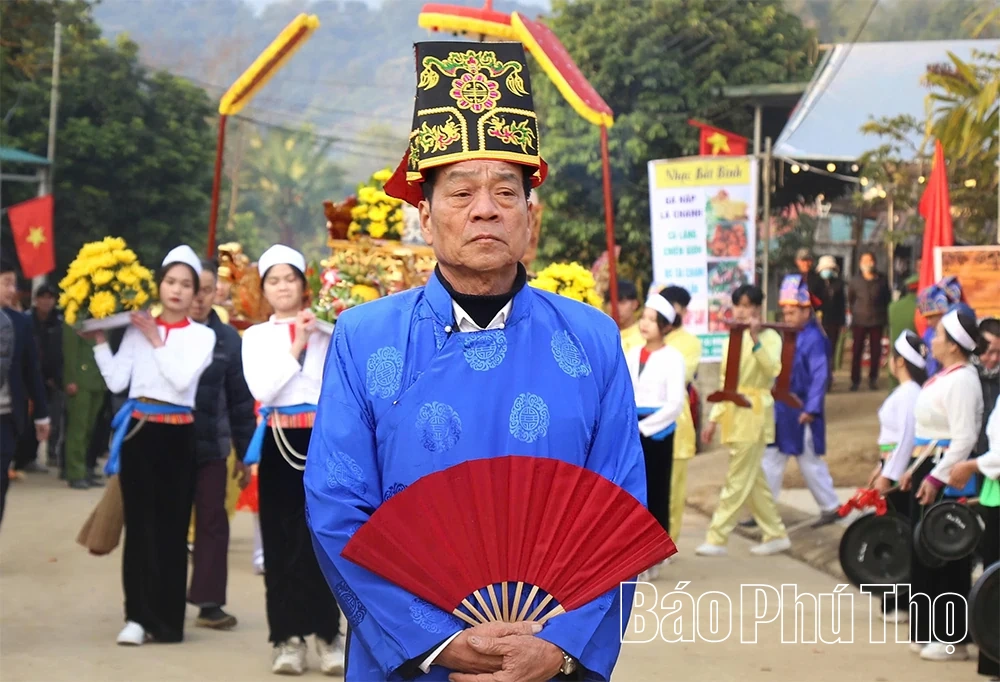
For many years, the distinguished artisan and shaman Bui Van Lung has been regarded as "the guardian of the sacred spirit of the Muong land".
At 69, Mr. Lựng's mind remains as sharp as it was in his youth, when his arm could still draw a sturdy crossbow made from male bamboo stalks deep in the forest. He doesn't have the imposing, muscular, and robust appearance of the village elders of the Central Highlands.
But his "authority" in this valley stems from his knowledge, his thorough understanding of the customs, history, and beliefs of the Muong people, and from his unwavering dedication to reviving and preserving the flow of Muong culture in the modern era.
He said: "From the very beginning of their lineage, the Muong people did not have a written language. Through countless historical changes, wars, and upheavals, they have still preserved a rich and unique culture, passed down from generation to generation through memory, storytelling, and performance. Therefore, in each village and region, there are those who 'keep the flame alive'..."
And in the Muong Bi region, he, the distinguished artisan and shaman Bui Van Lung, is mentioned as a typical symbol. Just sitting by the fire in his stilt house on a winter night, listening to him recount the old way of life of the Muong people with his summaries like "steamed rice, stilt houses, carried water, roasted pork, days passing and months advancing"; listening to the sacred "roong mo" chants; listening to him sing the poignant or passionate songs of ancient narrative poems such as Ut Lot - Ho Lieu, Nang Nga - Hai Moi, and especially the epic poem "Giving Birth to the Land, Giving Birth to the Water"... that alone is enough to understand why he is considered a living "history book".
What is most valuable is that these verses, songs, and stories do not remain dormant in his personal memory. Day after day, he passes them on to his children and grandchildren, to the younger generation, by the window of his stilt house, by the warm hearth. For him, preserving culture is not about confining it to a small community or narrow space.
Instead, it must be left "like an underground stream, flowing endlessly, smoothing out each pebble." That is the method his ancestors passed down to him, and which he continues to pass on to future generations.
As a shaman, he believes that Muong shamanism is a great creation of the Muong people. It encapsulates almost all the values that make up Muong culture, including history, literature, society, beliefs, art, and folk knowledge. Shamanism contains a worldview , a philosophy of life, experiences in interacting with nature and the community; it even includes calendars, geography, astrology, ancestor worship, profession worship, rituals such as spirit summoning, ritual pulling, and sacrifice...
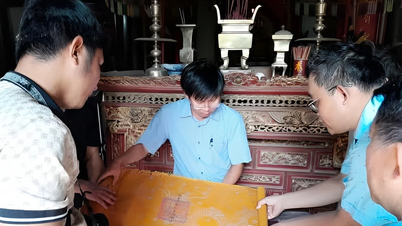
In particular, he was also deeply knowledgeable about the Doi calendar. This calendar consists of 12 bamboo sticks, engraved with symbols of varying lengths, dots, and arrows to predict weather, seasons, and auspicious or inauspicious days according to the movement of the Doi constellation. This is an invention stemming from the wealth of knowledge accumulated over many generations of the Muong people.
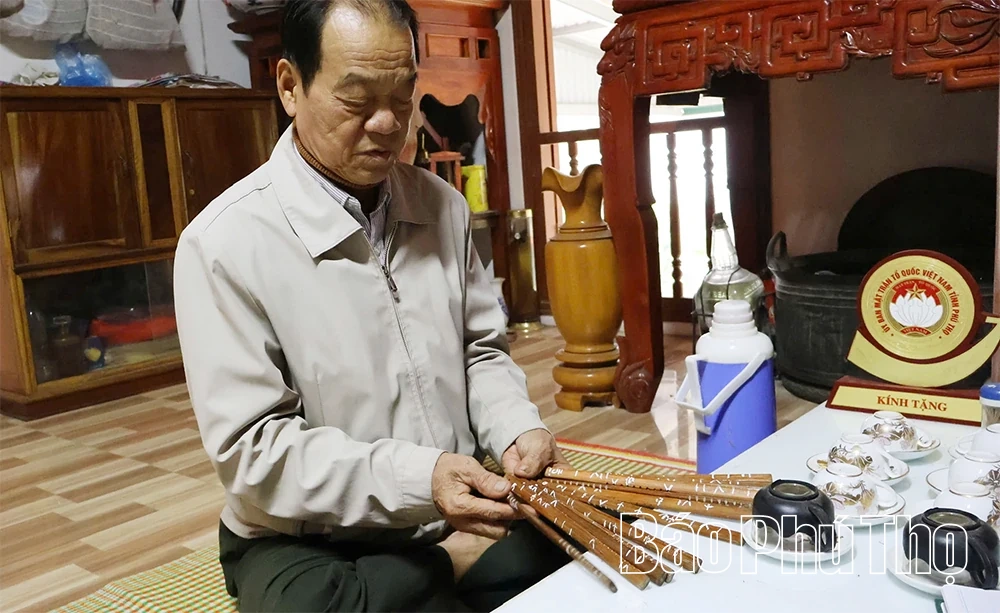
With his profound knowledge and understanding of culture and spirituality, the distinguished artisan and shaman Bui Van Lung is considered a living history book of the Muong Bi region.
Born into a family with nine generations of shamans, Bui Van Lung came to the profession by chance. He had served in the army, and his family members were involved in various social activities. But the ancestors of his family chose him to inherit the family's traditional shamanic profession. At the age of 25, he officially began learning the trade, and at 27, he started practicing. Afterward, he volunteered for the army and fought on the Cambodian battlefield.
It wasn't until he was 32 years old that he left the army and returned to his hometown to continue his shamanic work. Nearly 40 years into his career, he can't even remember how many ceremonies he's performed for. He only knows that for each ceremony, he always carries his "sacred bag" with a green hat, a black silk robe, and a fan – inseparable items of a shaman, cherishing them as if they were the very essence of his people's culture.
In conversation with us, he said: "In the life of the Muong people, the role of the shaman is closely linked to the human life cycle, from birth, praying for children to eat well and grow quickly, to old age, performing rituals to pray for health, and when death comes, the shaman guides the soul of the deceased to the Heavenly Realm."
"Whatever is inherent in the Muong people is also present in Mo Muong," he said. Mo serves both as a means of communication with ancestors and deities, and also conveys the deepest humanistic values, namely the way to teach descendants to be good people, to live with respect for love and righteousness.
Not only is he a keeper of the soul of the Muong folk art, but Meritorious Artist Bui Van Lung has also created a special milestone: he is the first person to bring Muong shamanism abroad, performing at Sommelo, Finland.
The ancient Mường folk songs, once echoing by the hearths of the Mường people, have now resonated within the European cultural landscape, deeply moving international friends. This is not only a source of personal pride but also a turning point that has propelled Mường folk songs beyond geographical boundaries, affirming the value of this folk cultural heritage.
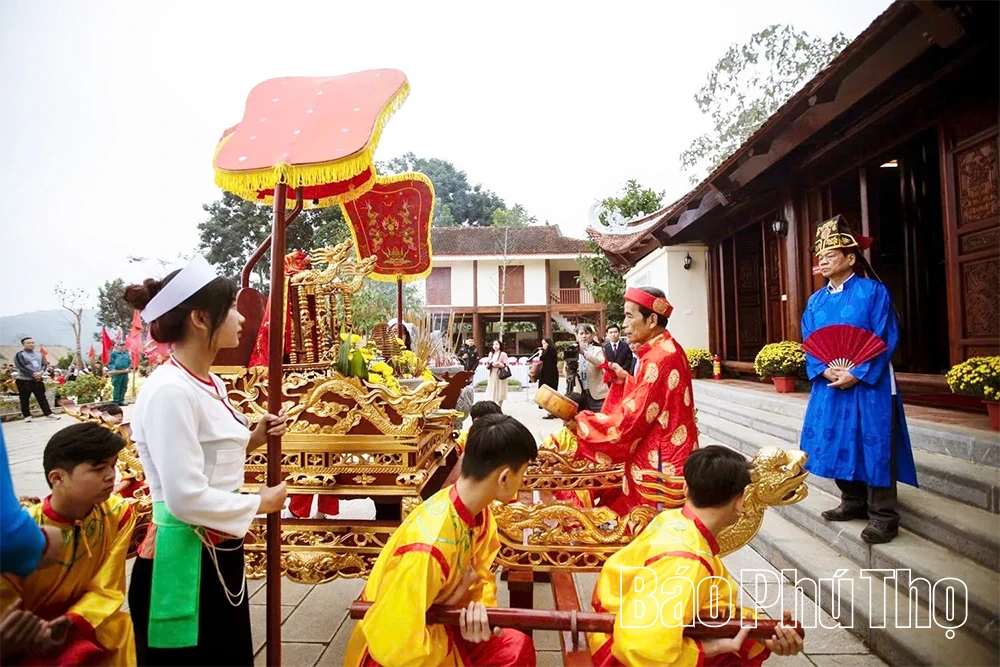
Distinguished artisan and shaman Bui Van Lung is the first and only person to date to bring Muong shamanism abroad, performing it in Finland.
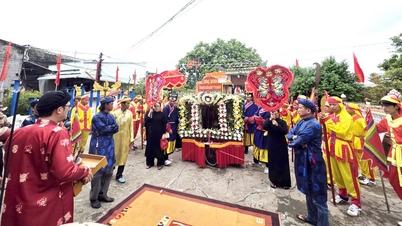
In Muong Bi, for many years he has also served as the chief officiant of the Muong Bi Opening Ceremony, the biggest festival of the year for the community, also known as the Field Opening Ceremony or Forest Opening Ceremony, associated with the legend of Queen Mother Hoang Ba, who founded the land of Muong Bi, taught the people to grow mulberry trees, raise silkworms, and weave cloth...
In the sacred space of the festival, the shaman's chanting connects the past with the present, and with the ancestors. Muong shamanism has been recognized as a National Intangible Cultural Heritage. In 2020, Muong shamanism was selected to be submitted to UNESCO for recognition as a World Cultural Heritage, a timely acknowledgment of its unique value.
Previously, in November 2015, Mr. Bui Van Lung was one of the first eight people in Hoa Binh province to be awarded the title of Outstanding Artisan in the category of social customs and beliefs.
Amidst the ever-changing rhythm of life, the distinguished artisan and shaman Bui Van Lung quietly keeps the flame alive. As the Muong people call him, the guardian of the sacred soul of the Muong land, a "living history book" so that the past does not fade away, the present has a foundation, and the future can still recognize who it is in the enduring cultural flow of the Muong people.
Manh Hung
Source: https://baophutho.vn/pho-su-song-o-muong-bi-246394.htm














![[Photo] Reception to welcome General Secretary and President To Lam and his wife on their State visit to the Philippines](https://vphoto.vietnam.vn/thumb/1200x675/vietnam/resource/IMAGE/2026/06/01/1780295488620_vna-potal-chieu-dai-chao-mung-tong-bi-thu-chu-tich-nuoc-to-lam-va-phu-nhan-tham-cap-nha-nuoc-toi-philippines-8798060-7855-jpg.webp)
















































Comment (0)