


Farmers in Tam Nong commune are weeding their early spring rice crop.
Because the rice fields are mostly located on hillsides and forests, controlling rats that damage rice crops is always a priority for farmers in Tay Coc commune. Comrade Le Van Thuy, Vice Chairman of the Fatherland Front Committee and Chairman of the Farmers' Association of the commune, said: "The commune has regularly organized concentrated rat extermination in recent years. Besides using biological pesticides mixed with boiled rice as bait, we encourage farmers to clear bushes along the edges of the fields to destroy rat hiding places and breeding grounds, and to enclose the fields with plastic sheeting to prevent rats from entering... Thanks to these efforts, the rate of rat damage has decreased, and crops are protected."
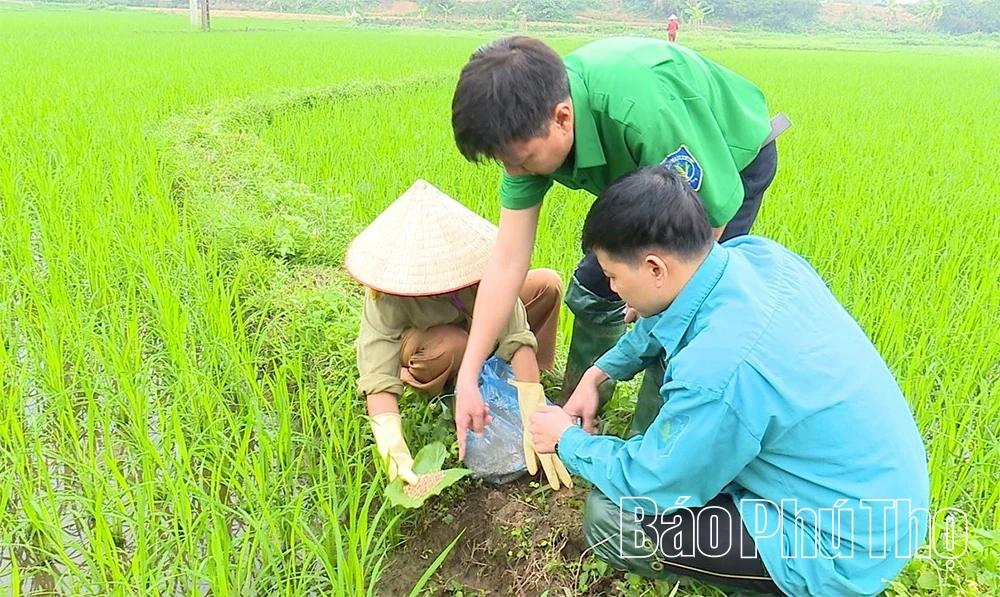
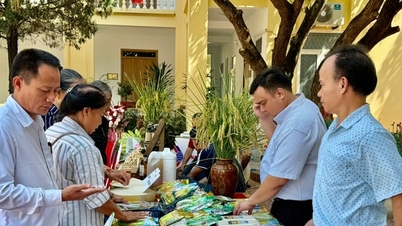
Plant protection officers in the Lam Thao area are instructing farmers on how to set traps to catch rats that are damaging the spring rice crop.
According to the plan, this spring, Phu Tho province will plant approximately 80,250 hectares of rice, with an expected yield of over 62.2 quintals/hectare; the total expected production is about 500,000 tons. Besides rice, the province also plans to plant about 22,600 hectares of corn and 12,600 hectares of various green vegetables; 5,300 hectares of peanuts; 1,680 hectares of sweet potatoes and some other crops.

Farmers are controlling pests and diseases affecting the spring rice crop in Dao Xa commune.
Currently, spring vegetables are thriving, providing a stable income for growers. However, the transitional period between seasons is also when many types of pests and butterflies begin laying eggs and hatching into larvae that cause significant damage. To protect vegetables, people in concentrated vegetable-growing areas and safe vegetable production cooperatives are applying various pest control measures using organic and bio-safe methods, such as hand-picking insects; using biological products; and covering with plastic film and netting to both prevent pests and protect against weather-related diseases.
Mr. Nguyen Van Nguyen, Director of Do Xuyen Safe Vegetable Cooperative in Lien Minh commune, said: "In implementing vegetable production according to VietGAP standards, the cooperative directs its members not to use chemical products, but only to use biological pesticides from the permitted list for pest and disease control. In addition, we encourage people to manually remove pests, proactively clean up their gardens, and destroy diseased or damaged plants to prevent the spread to the remaining area; combine this with balanced fertilization to help plants grow healthily and increase their resistance to pests and diseases; and regularly inspect the fields, especially during humid weather conditions that easily lead to fungal diseases."
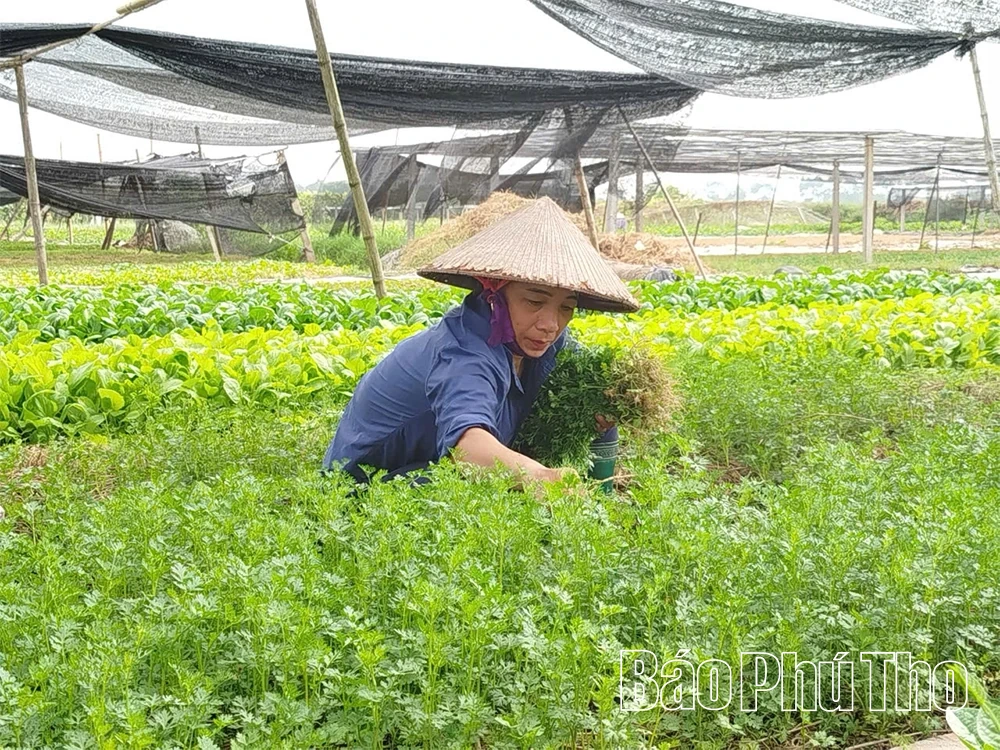
Members of the Do Xuyen Safe Vegetable Cooperative in Lien Minh commune are harvesting their spring vegetables.
Comrade Nguyen Truong Giang - Deputy Head of the Provincial Department of Crop Production and Plant Protection, said: The spring crop is the most important crop of the year, directly affecting the production results for the whole year. Therefore, pest control plays a crucial role. In the coming time, some pests and diseases such as leaf-rolling caterpillars, stem borers, and downy mildew are likely to still occur and cause damage. Therefore, farmers need to follow the recommendations and guidance of specialized agencies to minimize losses in yield and crop quality.
The Sub-Department has issued a document requesting regional Plant Protection Stations to send staff to directly inspect fields and coordinate with local authorities to guide farmers on how to control pests and diseases according to guidelines to achieve high efficiency, reduce costs, and contribute to protecting the rural environment.
Quan Lam
Source: https://baophutho.vn/phong-tru-sau-benh-hai-cay-trong-vu-xuan-249112.htm

![[Photo] Secretary of the National Assembly Party Committee, Chairman of the National Assembly presides over the meeting of the Standing Committee and Executive Committee of the National Assembly Party Committee.](https://vphoto.vietnam.vn/thumb/1200x675/vietnam/resource/IMAGE/2026/06/03/1780480353201_ndo_br_bnd-2585-jpg.webp)
![[Photo] General Secretary and President To Lam presides over a meeting with the Central Organizing Committee.](https://vphoto.vietnam.vn/thumb/1200x675/vietnam/resource/IMAGE/2026/06/03/1780482764658_a1-bnd-4741-3342-jpg.webp)
![[Photo] First session of the 14th Congress of the Vietnam Trade Union](https://vphoto.vietnam.vn/thumb/1200x675/vietnam/resource/IMAGE/2026/06/03/1780465947883_ndo_br_img-3852-jpg.webp)






























![[Video] Sunset at Lap An Lagoon – Where the sun sets over the fishing nets](https://vphoto.vietnam.vn/thumb/1200x675/vietnam/resource/IMAGE/2026/05/31/1780192137701_beach-landscape-sea-water-nature-grass-745871-pxhere-com.jpeg)


























Comment (0)