

Further east, the river has more tributaries, each bearing a different name depending on the section or branch; there are also many canals and dams serving to irrigate the fertile fields.
On the Phuoc Giang River, the Ba Dien Dam, over 100 meters long, was once a famous dam. During the dry season, the dam was closed to provide water for irrigating the fields, and during the rainy season, it was opened to release floodwaters. The dam's name originates from the names of two villages, Ba La and Dien An. These two villages were instrumental in digging the canal and building the dam to bring water from the midland region to the plains to irrigate the water-scarce fields during the dry season. To this day, the shrine dedicated to the ancestors who initiated and mobilized their descendants to build the Ba Dien Dam still stands, cared for and honored with incense offerings by later generations.
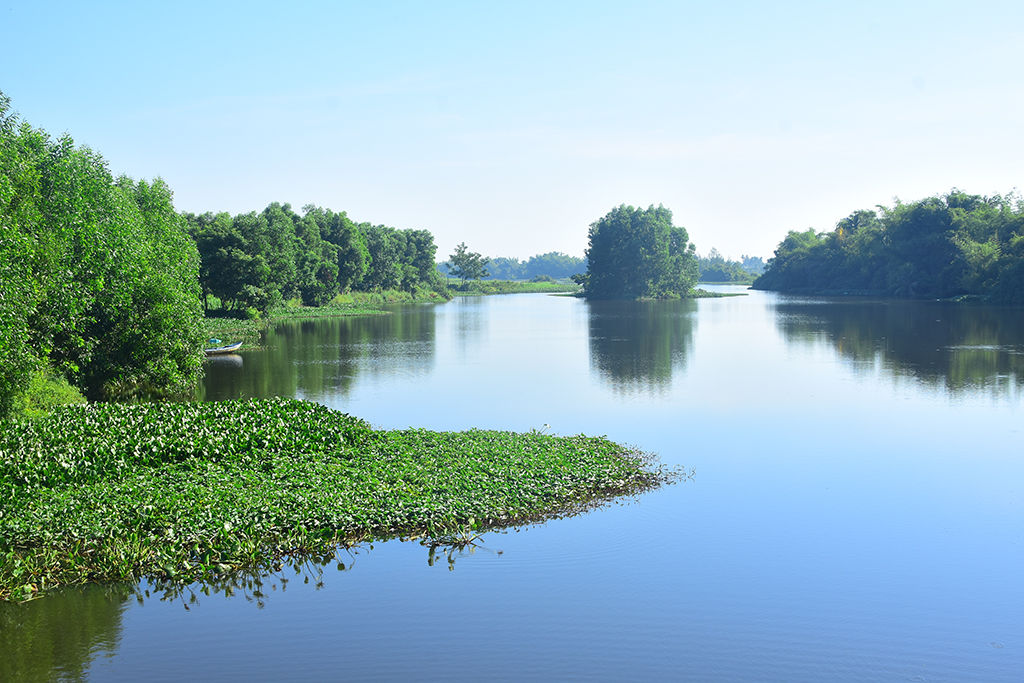
Phuoc Giang River as seen from La Ha village
Upon reaching Quang Ngai City, the Phuoc Giang River is renamed Bau Giang, continuing eastward through various names such as Hien Luong, Ham Long, Phu Tho , and Co Luy before merging with the Ve River and emptying into the sea. Near the end of the river, the Phuoc Giang River encircles Co Luy village, surrounded by vast expanses of water on one side and the sea on the other, where waves constantly lap against the shore, creating the scenic Co Luy village (Co Luy is a secluded village) that many poets and writers have praised in their poems.
Today, the Phuoc Giang River still plays a crucial role in supplying water from the Thach Nham canal to irrigate hundreds of hectares of agricultural land in Nghia Trung, Nghia Thuong communes, etc. (Tu Nghia District), while also contributing to beautifying the environment and maintaining clean air in this area that is gradually urbanizing.
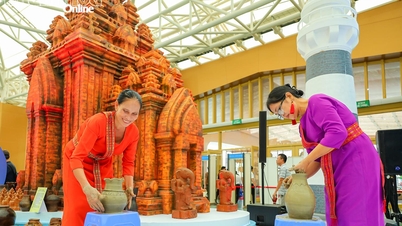
Pond and Cham ruins
The Phước Giang River, when flowing south of Bút Mountain, is called Bàu Giang because there used to be a fairly large natural pond adjacent to the fields bordering Đá Voi Mountain. Đá Voi Mountain is named that way because there are rock formations resembling elephants scattered across the mountain slopes, and even here and there in the fields and villages.
There is a folk song that cleverly borrows place names around the Bau Giang River to express the feelings of a girl with a sweetheart in Van Tuong village, bordering the Tra Khuc River:
I stood on Elephant Rock Mountain and looked across at Vientiane.
He is the eldest son, and I am the eldest sister.
He wants me to go and marry into his family.
Why abandon your younger siblings who are suffering so much!
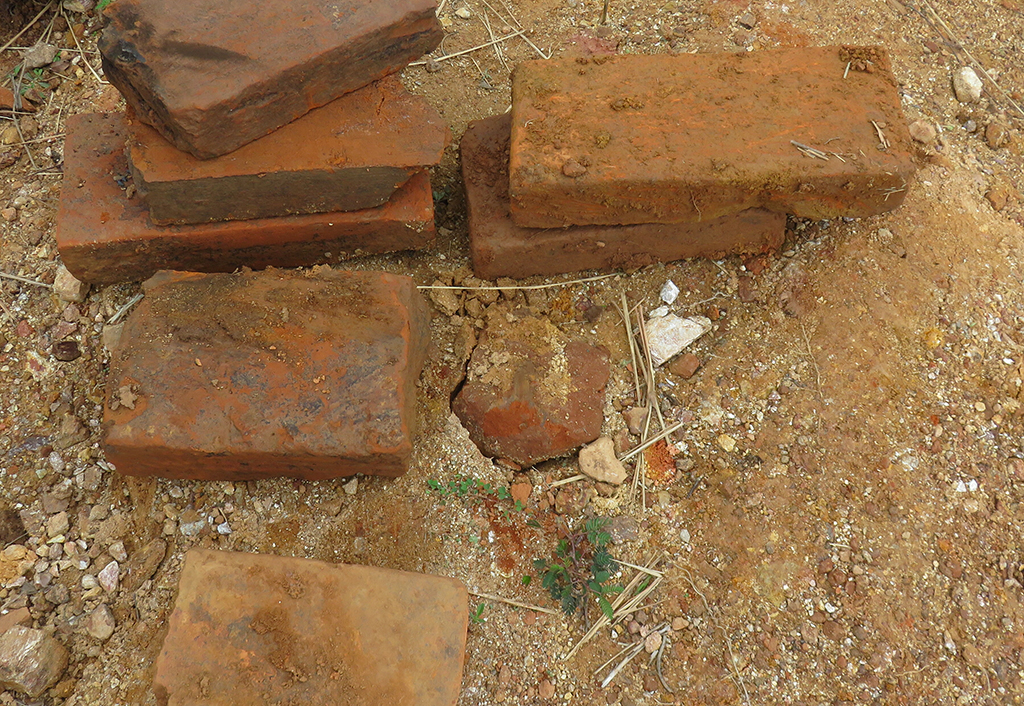
Cham bricks are scattered at the foot of Elephant Rock Mountain, on the right bank of Phuoc Giang River.
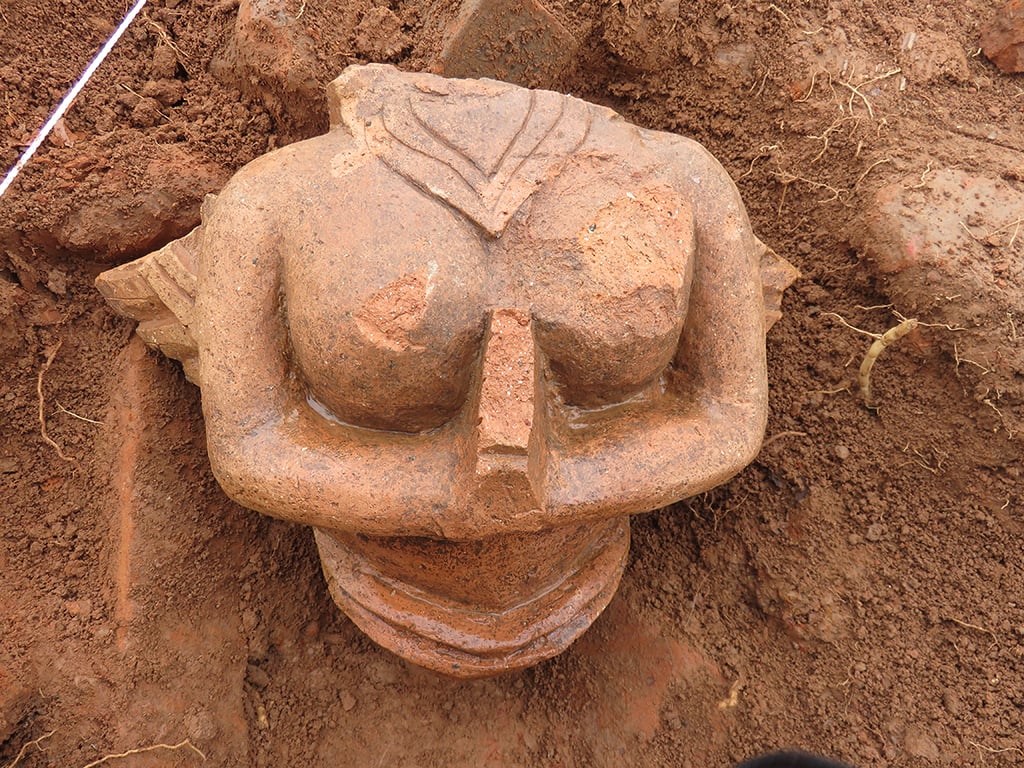
Terracotta statues were unearthed at But Mountain, on the left bank of Phuoc Giang River.
The Phước Giang - Bàu Giang area, now part of La Hà town, Tư Nghĩa district, boasts picturesque scenery with lush green fields, and is mentioned in many anecdotes associated with the scenic spots of La Hà Stone Battlefield and Thiên Bút Phê Vân (Heavenly Pen Drawing Clouds). Nature has changed, and the beautiful landscapes of the past have gradually altered over time, but the river and the surrounding land still hold many mysteries of the past.
In his monumental work , *Inventaire Descriptif des Monuments Cams de L'Annam* (Statistical Survey of Cham Monuments in Central Vietnam) , when surveying the Chánh Lộ site, the French scholar H. Parmentier mentioned seeing Cham bricks on the summit of Núi Bút (But Mountain). The Cham tower on the summit of Núi Bút was excavated in 2017, uncovering many valuable artifacts and attracting considerable attention from researchers and the public. However, in reality, not only on the summit of Núi Bút, but also scattered throughout the southern area of the Phước Giang River basin (Bàu Giang) are quite a number of Cham bricks and traces of ruins built by the Cham people.
In mid-2017, I followed a research team including Associate Professor Ngo Van Doanh (a Cham art expert), Dr. Vu Quoc Hien (the lead excavator of Nui But Tower, now deceased), and Dr. Nguyen Dang Vu (former Director of the Department of Culture, Sports and Tourism of Quang Ngai province) to the Da Voi mountain area. I witnessed firsthand many Cham bricks scattered here and there, some of which were reused by local residents to build house foundations, cattle sheds, and retaining walls around their gardens to prevent landslides. Elderly people recounted that in the past, when digging house foundations or wells, locals discovered many stone statues, altars, and even Linga-Yoni sets, but these have since been lost for various reasons.
The low terrain at the foot of Thien But Mountain allows us to speculate that centuries ago there was a pond (now part of the Bau Giang River) enclosing the eastern foothills of the mountain, encompassing the area that later became the Ngoc An field. Amidst the vast expanse of sky and water, Thien But Mountain stands out, shimmering like the legendary Mount Meru in Cham culture.
Could there be a connection between the Chánh Lộ Tower (excavated by French archaeologists in 1904), the Núi Bút Tower (excavated by the Quảng Ngãi General Museum in 2017), and the Cham architectural remains on the southern bank of the Phước Giang - Bàu Giang River, as mentioned above, within a common Cham temple complex in the southern part of Amaravati province?
The world is vast and boundless. So many questions echo from the past, yet I don't know when I'll find the answers. So let's just pause by Thien But Mountain, gaze up at the misty peak, and share the feelings of the girl from Quang Ngai in these folk songs, so full of meaning and emotion:
Looking up at Thien But, the Dang Inn
The mountains are as rocky as my heart aches for him. (to be continued)
Source: https://thanhnien.vn/ke-chuyen-dong-song-xu-quang-phuoc-giang-and-nhung-phe-tich-cham-185241117205611039.htm


![[Photo] Ba Lang An Lighthouse - the "eye of the sea" amidst the "rock museum" of Quang Ngai province.](https://vphoto.vietnam.vn/thumb/1200x675/vietnam/resource/IMAGE/2026/05/29/1780038698840_anh-man-hinh-2026-05-29-luc-14-10-42.png)

















![[Image] Pleasant weather helps students enter the 10th grade entrance exam with confidence.](https://vphoto.vietnam.vn/thumb/1200x675/vietnam/resource/IMAGE/2026/05/29/1780034401612_ngay-1-thi-lop-10-minh-duy-8-5009-jpg.webp)


























































Comment (0)