

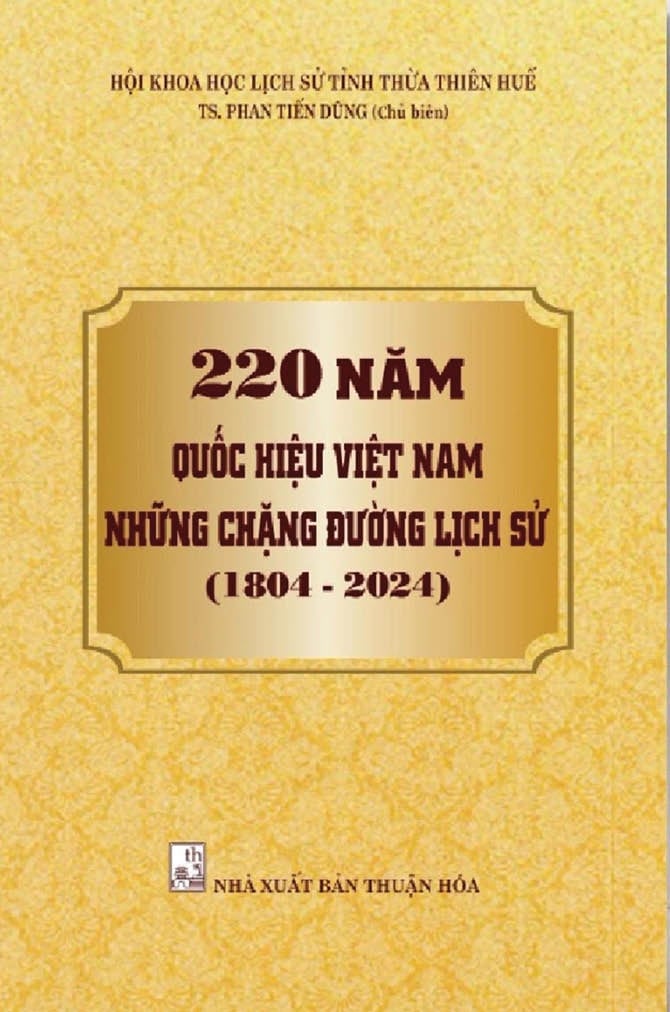
 |
| Cover of the book "220 Years of Vietnam's National Name - Historical Journeys (1804-2024)" |
As we know, the national name plays a crucial role and holds an important position in all aspects of national life; it is the official name used in all administrative documents of the country. From a diplomatic perspective, the national name has legal value, representing the legitimacy of the nation, recognized by other countries and peoples, and possessing international significance.
In Vietnamese history, the name Vietnam has existed for a long time, but it was not the official national name until the year of Giap Ty, the day of Dinh Suu, February 17th (March 28th, 1804), when King Gia Long held a ceremony at the Thai Mieu (within the Imperial Citadel) to officially name the country Vietnam. The national name Vietnam was maintained for nearly four decades, through two reigns of King Gia Long and King Minh Mang. In the 19th year of Minh Mang's reign (1838), the king changed the national name from Vietnam to Dai Nam.
In 1945, the August Revolution succeeded, ending the Nguyen Dynasty. On September 2, 1945, President Ho Chi Minh, in the Declaration of Independence, proclaimed the establishment of the Democratic Republic of Vietnam – now the Socialist Republic of Vietnam. Throughout history, the national name Vietnam has affirmed the position of an independent and unified country.
According to Associate Professor Dr. Tran Duc Cuong, President of the Vietnam Historical Science Association, the event of 1804, when the country officially adopted the name Vietnam, was an extremely significant event in the nation's development over the past two centuries.
The entire Vietnamese nation has made immense contributions to maintaining and developing Vietnam, so that today, Vietnam plays an increasingly important role and holds a significant position on the international stage in the fields of politics, economics, culture, and society. Vietnam is integrating into the global community as a responsible and reputable nation.
Major General, Dr. Nguyen Hoang Nhien, Director of the Institute of Military History, stated that when studying the national name of Vietnam during the wars of resistance against foreign invaders, it has been affirmed that: Resistance against foreign invaders is a major content of Vietnamese military history in particular, and Vietnamese history in general. The 21 wars of resistance against foreign invaders, spanning 22 centuries, have left important imprints on the history of nation-building and national defense of the Vietnamese people. These wars of resistance against foreign invaders have always been closely associated with the national name of Vietnam during various historical periods.
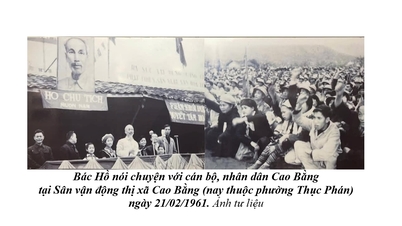
Associate Professor Dr. Hoang Chi Hieu and Dr. Le Thi Qui Duc, in their research on the national name of Vietnam in Ho Chi Minh's thought before 1945, stated: "...Since the founding of the Communist Party of Vietnam (1930), Nguyen Ai Quoc - Ho Chi Minh affirmed the name Vietnam for all his thoughts and actions. Loyal to that decision, we can see that all the revolutionary organizations he founded afterwards were associated with the name Vietnam. This is the inheritance of tradition and the highest crystallization of Nguyen Ai Quoc - Ho Chi Minh's thought on a name with a long history, and also the realization of the aspirations of countless generations of patriotic Vietnamese people in the first half of the 20th century."
Source: https://huengaynay.vn/chinh-polit-xa-hoi/quoc-hieu-viet-nam-qua-cac-thoi-ky-150855.html



![[Image] National Assembly discusses the implementation of the socio-economic development plan.](https://vphoto.vietnam.vn/thumb/1200x675/vietnam/resource/IMAGE/2026/04/20/1776696707422_ndo_br_img-20260420-185419-jpg.webp)
![[Photo] General Secretary and President To Lam meets with National Assembly delegates from ethnic minorities.](https://vphoto.vietnam.vn/thumb/1200x675/vietnam/resource/IMAGE/2026/04/20/1776696701056_a1-bnd-8331-3342-jpg.webp)























































































Comment (0)