

On the afternoon of April 23rd, with a majority of delegates in favor, the National Assembly officially voted to pass the amended Law on the Capital City, with 488 out of 492 participating delegates voting in favor (equivalent to 97.60% of the total number of National Assembly delegates). This is a historic law that comprehensively decentralizes 199 powers to the Hanoi City government, creating a strong legal framework for the capital city to make breakthroughs in the new era.
Comprehensive decentralization and piloting breakthrough mechanisms.
Presenting the report explaining, receiving feedback, and revising the draft law before the National Assembly votes to pass it, Minister of Justice Hoang Thanh Tung affirmed that the draft law had been comprehensively reviewed to fully institutionalize the resolutions of the Politburo , while also innovating the thinking on lawmaking towards a more substantive decentralization and delegation of power to the Hanoi city government.
Notably, Hanoi city has been granted 199 special and superior powers. These include 127 powers of the People's Council, 56 of the People's Committee, and 16 of the Chairman of the People's Committee.
The law clearly distinguishes between the authority to issue ordinary legal documents (Article 8) and the right to pilot groundbreaking mechanisms and policies (Article 9). This provision allows Hanoi to proactively experiment with new management models and development solutions for practical issues that arise and for which there is no legal precedent, helping to quickly resolve institutional "bottlenecks".
For the first time, the concepts of "underground space," "low-level space," and "high-level space" have been specifically codified in law. Planning for these spaces requires close coordination between the Ministry of National Defence, the Ministry of Public Security , and the Ministry of Construction to ensure national security and defense.
In particular, the Law stipulates the development of urban railway systems according to the TOD (Transit-Oriented Development) model. Hanoi is allowed to retain all revenue from increased floor area, infrastructure improvement fees, and land value appreciation within TOD areas for reinvestment in transportation. This is a huge financial resource for the city to complete its modern urban railway network.
Financially, Hanoi receives all of the increased central government revenue collected within its jurisdiction. The city also retains 100% of revenue from four sources: land use fees, land lease fees, revenue from carbon credit transactions, and new fees and charges. The City People's Council has the right to use local budget funds to support other localities or invest in projects outside the city.
To strengthen regional linkages, the Law stipulates the establishment of the Capital Region Development Fund. This fund concentrates capital from the central government budget and the provinces and cities in the region to address regional transportation projects, environmental pollution control, and disease control. To encourage innovation, businesses conducting R&D activities in Hanoi are allowed to deduct up to 200% of actual costs from taxes.
Strict measures to deal with violations.
One notable regulation is the provision allowing the disconnection of electricity and water supply to buildings with serious violations. This measure applies to buildings constructed in violation of planning regulations, without permits, failing to meet fire safety standards (especially karaoke bars and nightclubs), or those with unaddressed environmental violations.
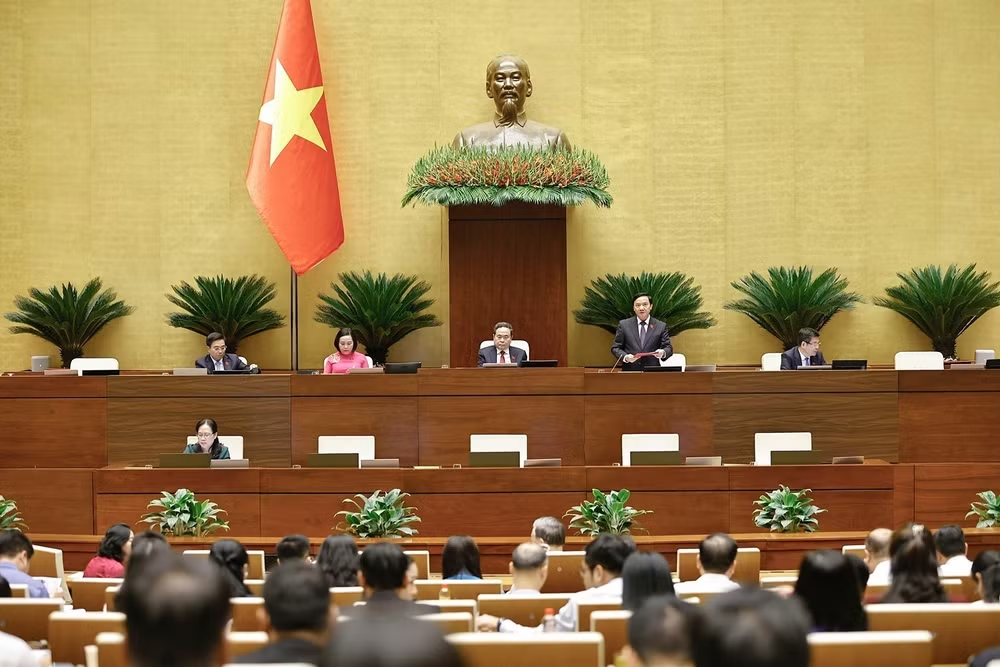
The law also allows for the establishment of “low-emission zones” to restrict polluting vehicles and improve air quality. In the fields of education and healthcare, the Chairman of the People's Committee of the City is granted a high degree of autonomy in establishing universities and colleges and recognizing professional licenses for foreigners.
Finally, the 2026 Capital City Law establishes a mechanism for protecting genuine officials. Accordingly, heads of departments and civil servants involved in drafting and implementing the Law will be exempt from or exempt from legal liability if they follow the correct procedures and are "not acting for personal gain," even if unintentional damage occurs. This helps to dispel apprehension and encourages innovation for the development of the Capital City.
The adoption of the amended Capital City Law is expected to create an important legal framework, promoting Hanoi's development to become a political, economic, and cultural center of the country.
The Law on the Capital City of 2026 will officially come into effect on July 1, 2026, replacing the Law on the Capital City of 2024.
Source: https://www.vietnamplus.vn/quoc-hoi-thong-qua-luat-thu-do-dot-pha-voi-199-tham-quyen-dac-thu-post1106606.vnp



![[Image] Pleasant weather helps students enter the 10th grade entrance exam with confidence.](https://vphoto.vietnam.vn/thumb/1200x675/vietnam/resource/IMAGE/2026/05/29/1780034401612_ngay-1-thi-lop-10-minh-duy-8-5009-jpg.webp)

![[Photo] Ba Lang An Lighthouse - the "eye of the sea" amidst the "rock museum" of Quang Ngai province.](https://vphoto.vietnam.vn/thumb/1200x675/vietnam/resource/IMAGE/2026/05/29/1780038698840_anh-man-hinh-2026-05-29-luc-14-10-42.png)



























































































Comment (0)